In Spite of Your Fear or Because of Your Fear

photo

I’m a sucker for cards like these. There is something appealing to me about the ability to go for it, even if it means being uncomfortable and risking. It is impressive to me when people move ahead in spite of their fear.

p1000220

Fear can be a tricky thing, though. When I was in college at PUC I went out to Lake Berryessa with some friends one afternoon and we ended up doing some cliff jumping. It was high (a couple of us went out to the cliff the next day with a 100’ tape and measured the jump at close to 80’) and I didn’t much like heights. I jumped, however, and lived to tell about it. Thinking about it later I thought about how it might have looked like a brave thing for us to do, but at least in my case I knew different. I jumped, not so much because I overcame the fear, but because I was so afraid of what people would think of me if I didn’t jump. It was kind of sad as I thought about it.

“We don’t want to be imprisoned by our fear, but we don’t want to be goaded into jumping off of cliffs either.”

We don’t want to be imprisoned by our fear, but we don’t want to be goaded into jumping off of cliffs either. Choice theory describes our physiological need for safety and survival, and like the rest of our basic needs it varies in strength with each of us. Some people have a very low safety need, while others have a very high need for safety. The safety and survival need exerts a pressure on us to be met, but we each have to decide how to interpret that pressure and how to live our lives in response to those urgings.

This is one area where it is common for our quality world pictures to be in conflict. As I stood on top of the cliff, pondering whether or not I would jump, I was in huge conflict. A part of my quality world didn’t even want to go to the edge of the cliff and look over the side, never mind actually jump off of it. Yet another part of my quality world was pointing out to me how it would look if I didn’t jump. The word ‘Wuss’ came to mind.

More often, though, we are not standing on the edge of real cliffs, but instead are atop cliffs of our own imagining. We allow our safety need to hold more control than it deserves and keep us from doing things that deep down inside we really want to do, behaviors and activities that would be good for us and happiness-producing. We worry about what someone will think of us when it really doesn’t matter.

It boils down to who we really are and what we really want to do. If I want to experience the rush of jumping off of a cliff for the freedom and fun of it, then I should do it. However, if I am prompted to jump off of a cliff because I am worried and fearful of what others think if I don’t, then I should take a second look at who I am and what I want. If a person wants to apply for a better job because he/she believes they are ready for the challenge and wants to go for it, then fine. But if the person is applying for a higher position because of a fear thing and a status thing, then some personal reflection is in order. Choice theory can really help with that kind of reflection.

photo

I suspect that people with a moderate to high survival/safety need are the ones that mostly buy the cards with sayings like “Life begins at the end of your comfort zone.” We hate it when our fear holds us back. Just keep in mind – am I wanting to do this thing in spite of my fear or because of my fear?

=================

A copy of the Glasser biography, Champion of Choice, can make an excellent Christmas gift. It’s easy to get a copy of the book through Amazon at –

For a signed copy of the biography, contact me at jimroyglasserbio@gmail.com

Now priced at $18.13 on Amazon.

Now priced at $18.13 on Amazon.

From the Mouths of Kids – Thanksgiving and Choice Theory

If you remember this popular daytime TV show you'd be .  .  . as old as me.

If you remember this popular daytime TV show you’d be . . . as old as me.

When elementary students (who had been taught about choice theory) were asked “What is choice theory about Thanksgiving?” this is what they had to say.

“If the need for survival is about food, well, Thanksgiving is about food.”   Nash, 6th grade

“I get to stay up as long as I want during vacation and staying up late is in my quality world. Well, not as late as I want  .  .  .  but late.”   Molly, 5th grade

“I love my aunts and uncles and I feel like I belong when I am with my cousins.”   Megan, 4th grade

“My freedom need is thrown out the window during Thanksgiving break, since I am trapped in a car forever driving to my grandparents house.”   Dak, 8th grade

“I let Aunt Helen kiss me. I think that’s love.”   Ryan, 3rd grade

“It’s deadly habits day at my house. My mother always invites a lot of people over and she’s all freaked about the food situation, and then my dad is spaced out watching football all day. Not a good situation.”   Becky, 7th grade

“I feel powerful when I help my mother make a lot of pies.”   Kalin, 4th grade

“My dad gets a couple of days off of work so my fun need is met being with him.”   Brett, 5th grade

“Mashed potatoes and turkey are need-satisfying on so many levels.”   Grady, 8th grade

“I think about how much I have when so many other people have so little. It’s not right when people’s survival need isn’t being met.”   Heather, 5th grade

“People bring us bags of food, which is nice. But it’s a little embarrassing, too. It doesn’t feel very powerful when you need people to bring you food.”   Amy, 7th grade

“Black Friday is about chaos. Wait a minute, chaos isn’t a basic need.”   Darcy, 8th grade

“I get a good feeling when I think about Thanksgiving leftovers. What choice theory thing would that be about? Quality world pictures? Yeh, that’s it.”   Brad, 7th grade

“My parents seem to get along better during Thanksgiving. I guess that’s love and belonging, right? Or maybe the caring habits. Whatever it is, I like it.”   Madelyn, 6th grade

“Everything would be good about Thanksgiving if it wasn’t for the yams. I do not feel powerful and I do not feel free because of the yams.”   Ethan, 3rd grade

“Thanksgiving is about love! That’s just it.”   David, 1st grade

============

The Glasser biography, Champion of Choice, would make an excellent Christmas gift. Get in touch with me for a signed copy at jimroyglasserbio@gmail.com.

Now priced at $17.49 on Amazon.

Now priced at $17.49 on Amazon.

You can also get copies through Amazon at –

Remember that electronic versions of the biography are available at –

http://www.zeigtucker.com/product/william-glasser-champion-of-choice-ebook/

===========

Detachment is not that you should own nothing. But that nothing should own you.
Ali ibn abi Talib

8 Do’s and Don’ts Choice Theory Taught Me About Working with Parents

Remarkably, not only are BOTH parents present at this conference, but they are holding hands and smiling. Oh, wait, this is a picture of realtor telling clients their house has just sold for more than the asking price.

Remarkably, not only are BOTH parents present at this conference, but they are holding hands and smiling. Oh, wait, this is a picture of a realtor telling clients their house has just sold for more than the asking price.

It can be stressful working with parents, especially parents that are difficult in some way, but keeping the following points in mind will go a long way toward minimizing the stress.

Do affirm the parent’s love for their child and your mutual desire for the child to thrive.
This is an area in which teacher and parent can always agree; sometimes it can feel like it’s the only area of agreement.

Do describe matter-of-factly the child’s behavior or performance.
You don’t need to pile on, but you shouldn’t hold back from sharing essential details either. The key lies in using a matter-of-fact tone, infused with ample amounts of optimism.

Do express confidence in the child’s ability to create and keep an improvement plan.
Pretty much everything hinges on the child’s desire and ability to meet reachable goals, whether behaviorally or academically. Parents sometimes need to be reminded that their child is capable of taking steps toward being responsible.

photo


Do involve the student in conferences when appropriate.
This is an interesting, in that, the more choice theory becomes a part of a classroom, the more students handle their own problem-solving conferences. The statement could just as easily be turned around to say, “Do involve parents in conferences when appropriate.”

Do teach parents how to support their child while not rescuing him from appropriate consequences.
It is very common, especially (ironically) by by those who punish, for parents to “rescue” their child from dealing with natural consequences or resolving a problem he/she created. Punishment is about applying punitive pain to an already bad situation, and something in parents, even within this who think they need to apply it, that wants to protect their children from such pain, especially when they see an “outsider” doing it. It often comes as a relief to parents that we are not talking about adding arbitrary pain, but instead want to simply help students learn to address problems they have caused.

Don’t enter a conference with a parent with the intention of having to prove the “guilt” of their child.
Seeking to build a case against a student is a defensive strategy and comes out of our fear. It almost guarantees a conference with a parent will not go well. As you present your “case” the parent becomes defensive and stakes out a zone of protection for their child. Better to stay away from building cases.

Don’t look to parents to solve their child’s behavior problems at school.
It comes as such a relief to parents when a teacher informs them that problems or challenges at school can be handled at school. In traditional school settings, parents are used as part of the discipline plan. (i.e. – if you get three checks on the board I will have to call your parents), as a part of the threat that you better shape up. Not so in a choice theory school. Parents are kept informed, but are encouraged to let their child work through the improvement process.

Don’t allow the student to create a school vs parent conflict.
If the student is not planning and implementing his own behavior plan, then he is learning to play his teacher against his parents, or vice versa. When a teacher “bypasses’ the student to involve his parents in making their child behave, a cat and mouse strategy game is created where the student sits back and watches his teacher and his parents go at it. Better to work with the student directly.

Most parents are a pleasure to work with and appreciate choice theory tips that will help them work with their own children more effectively. Some parents are at their wits end when it comes to managing their child’s behavior at home and are desperate for insights into how to do it better. Kids don’t come with instruction manuals and parenting can be what feels like a lonely, intense struggle at times. Viewing choice theory as an instruction manual for teachers and parents is probably a pretty good way to look at it.

===============

If you have read Soul Shapers it would be great if you could share a short review of the book on Amazon.

If you have read Soul Shapers it would be great if you could share a short review of the book on Amazon.

The book, Soul Shapers: A Better Plan for Parents and Teachers, provides many insights into how teachers and parents can manage students in a way that improves relationships and behavior. You can easily access the book through Amazon at –

Or you can get a signed copy of Soul Shapers by contacting me at thebetterplan@gmail.com.

Stamina

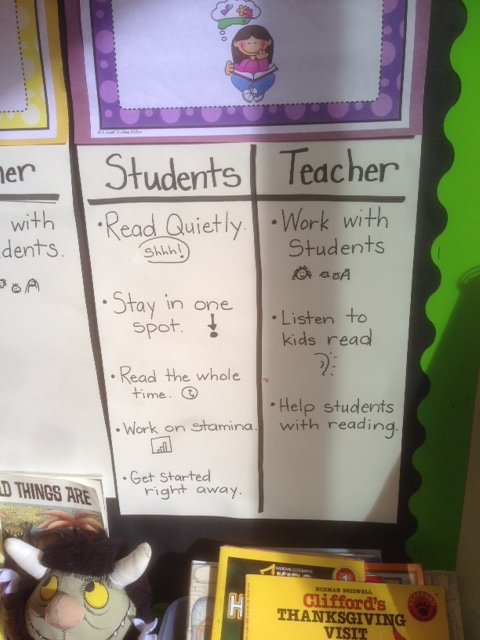
As a board member of NapaLearns, an amazing non-profit committee that supports Napa County schools, I have the privilege of visiting a different school each month. Yesterday our meeting took place at Donaldson Way Elementary School in American Canyon, California. Part of our meeting involved visiting classrooms and seeing first hand what students were working on. I saw the small poster in the picture below in a first grade classroom there. Something on the poster caught my eye. Do you see it?

Procedural steps for reading time for both the students and the teacher.

Procedural steps for reading time for both the students and the teacher.This is a poster that shares the steps for the Procedure to follow when it is reading time.

This is a poster that shares the steps for the Procedure to follow when it is reading time. Students are reminded to –

Read quietly

Stay in one spot

Read the whole time

Work on stamina

Get started right away

The step that caught my eye was the one that asks students to “work on stamina.” I thought I had a grasp of what the procedural step was wanting, but just in case I asked a first grade student to explain to me what “work on stamina” meant. The student didn’t hesitate and described how it takes practice to read for longer than a few minutes, but that the class was doing better at it. The goal was to sit still and quietly read for like, a while.

I was excited about this approach for several reasons, all of the reasons in some way having to do with choice theory.

Reason #1
Procedures help things run smoothly. When lots of students in a classroom need to do lots of different things at lots of different times, Procedures just help everything work better. Procedures aren’t like rules where students get in trouble for not doing them. The Procedures are reviewed and practiced, and when students forget them they are asked to do the Procedure correctly. In the spirit of choice theory, this is such a humane way to create important routines in the classroom. As teachers we have expectations and we state these expectations to our students, yet there is a way to teach expectations without turning them into a power struggle.

Reason #2
The step that asked students to “work on stamina” acknowledged that 1st grade students don’t automatically know what stamina is, nor do they have great amounts of it when it comes to reading. The teacher anticipated that her students wouldn’t have a lot of reading stamina, but that it’s ok and they would work on it. No need to get frustrated at students or worse, to get disgusted at them for their poor habits. No need to try and control them or force them into quiet reading time. Stamina is something that can be learned. It is so choice theory to recognize the age-appropriate abilities of students, and to support them as they work to grow and improve those abilities.

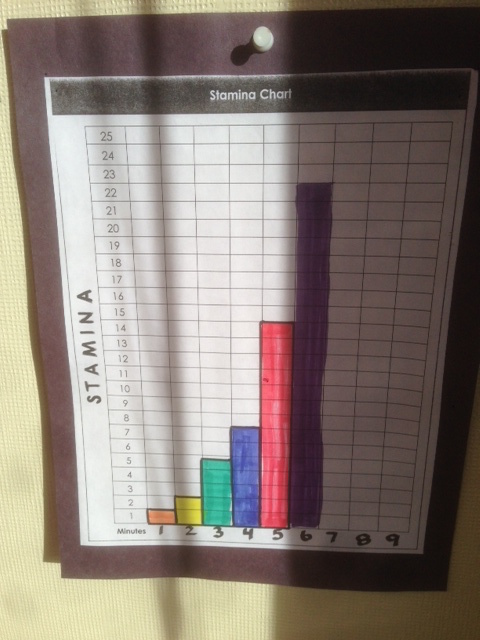
The remarkable reading data chart.

The remarkable reading data chart.

Reason #3
When I had a chance to talk with the teacher about the “work on stamina” step, she pointed to a poster next to the window that tracked the students’ progress. It’s the picture above. I hadn’t noticed it before, but now I honed in on this simple, yet remarkable data. She explained that they were tracking how long everyone in the class, when it was time for reading, could quietly read in one place. The chart shows that the first day some students could only make it for one minute. The second day, though, all the students made it for at least two minutes. The third day they all read quietly for almost five minutes. By day six, all of them read quietly, in one place, for 22 minutes. Think about it. A full classroom of active, diverse 1st grade suburban kids and all of them reading for 22 minutes. Obviously, the teacher presented the Procedure in such a way that the students themselves bought into it. They wanted to improve; they wanted to read more; they wanted the bar on that chart to go higher. It wasn’t a behavioral issue. It was simply about working on and building stamina.

Student books waiting to be read.

Student books waiting to be read.

It would have been easy, common actually, to try and discipline these young readers into reading quietly. But the results would have been far different than the results in this classroom. Criticizing, blaming, nagging, threatening, and punishing would harm the relationship between the teacher and the students, and the students would most likely grow up to not enjoy reading. I like the Procedure and data chart a lot better.

==========

Send me an example of how choice theory is showing up in your classroom. I would love to see it or hear about what you are doing!

==========

Now priced at $17.82 on Amazon; 22 reviews have been submitted.

Now priced at $17.82 on Amazon; 22 reviews have been submitted.

The Glasser biography, Champion of Choice, can make a great Christmas gift. It’s easy to purchase the book through Amazon at –

For a signed copy of Champion of Choice, contact me at –

thebetterplan@gmail.com.

The book, plus shipping it anywhere in the U.S., comes to $26.

For international orders, going through Amazon is the cheapest way to go. I am happy, though, to sign a bookplate and send it to you so that it can be placed on the inside cover. Let me know.

200 Top Psychologists – Where Is Glasser On the List?

William Glasser (1981)

William Glasser (1981)

A recently published APA article listed in rank order the top 200 psychologists of the modern era, which means since WWII. The authors of the article emphasized that they wanted to systematically identify eminent psychologists. Eminent has to do with the degree of recognition, impact, and respect an individual has on the field. To do this they focused on three main criteria – citation metrics, textbook page coverage, and major awards.

Albert Bandura

Albert Bandura

Although not from the field of psychology myself, there were a number of names I recognized. Here is a sampling from the list of 200 –

#1 Bandura, Albert
#2 Piaget, Jean
#5 Seligman, Martin
#6 Skinner, B.F.
#7 Chomsky, Noam
#12 Rogers, Carl
#17 Allport, Gordon
#33 Bruner, Jerome
#52 Beck, Aaron
#74 Gardner, Howard
#134 Csikszentmihalyi, Mihalyi
#139 Dweck, Carol

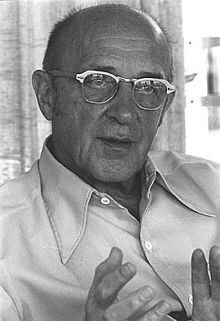
Carl Rogers

Carl Rogers

So, you’re probably wondering, where is William Glasser on this list? Incredibly, to me, Glasser is nowhere to be found among the top 200 psychologists. Zilch. Nada. It doesn’t seem possible that he isn’t on the list. But maybe the criteria were not suited to him. The list seemed to honor psychologists who pursued that role as scientists. Someone more knowledgeable than me can probably provide a better explanation.

The reference for the article is –

Diener, E., Oishi, S., and Park, J. (2014, August 25). An incomplete list of eminent psychologists of the modern era. Archives of Scientific Psycholgy, Vol 2(1), pp. 20-31.

===============

In anticipation of my teaching a classroom management course this quarter, on September 6 I posted a blog inviting you to share the elements that you felt were essential in a class on classroom management. Many of you responded. More recently, on November 7, I posted a blog asking for advice on how teachers can effectively work with parents. Again, you responded. The reason I am mentioning this is that students in my class have been reading your posts and have responded to many of them. I encourage you to take a look at the responses that follow these two posts – September 6 and November 7 – and even consider responding to the students who wrote to you. Thanks again for your help on this!


A Spine Surgeon’s Road Map Out of Chronic Pain

For those who are dealing with chronic pain, especially back pain, the following short clip from a recent Dr. Oz program could be the springboard to a new, pain-free life.


One of the reasons that the clip is so significant to me is that David Hanscom and I have been friends since we attended Pacific Union College together in the mid-70s. Over the years we have stayed in touch, although not consistently. A few years back, a mutual friend created a reunion golf event and David and I were able to briefly catch up.

I described how I was in the process of writing the biography of a guy named William Glasser, and he described how he was writing a book on how people could effectively deal with chronic pain, more often without invasive surgery. I knew about the years of training Dave had devoted to becoming a successful and respected spine surgeon, a man skilled at healing through cutting into tissue, so it very much caught my attention as he talked about the answer, for most people, having nothing to do with a scalpel.

I remember a feeling of excitement coming over me as I realized we were probably working on extremely complimentary topics, and I sensed he was coming to that realization, too, as he processed the implications of choice theory. Our conversation took place in the parking lot after the golfing was done, amidst quick conversations with other friends, some of them needing to get to other appointments or catch planes back to home. Yet Dave and I both knew we needed to talk more, to compare notes more, regarding the separate work we were each doing. We made the promise to each other to do just that, although truth be told, it is a promise we still haven’t kept.

We will make good on our promise. It is important that we do. We are both into people experiencing optimal mental and physical health. The healing power of the mind is incredibly amazing! Dr. Glasser understood it and Dr. Hanscom understands it. For now, I will share the following –

back-in-control-front


Back in Control is an Editors’ Favorite, one of the Best Books of 2014, and a Book of the Year on Amazon. You can access it here –http://www.amazon.com/Back-Control-surgeons-roadmap-chronic/dp/0988272903/ref=sr_1_1?s=books&ie=UTF8&qid=1415493599&sr=1-1&keywords=Back+in+Control

Or here –  www.backincontrolbook.com

You can also follow David Hanscom on Facebook at – Back in Control by Dr. David Hanscom

If you or someone you know is dealing with chronic pain, I hope today’s post has provided helpful information. From what I can tell it is consistent with and complimentary to a choice theory way of life. As always, I am open to your responses.

=================

Several of you responded to my request for teacher tips on how to effectively work with parents. Thank you, a lot for taking a moment to share an insight. We could still use a few more tips, so take a moment and type out a strategy or two. When you respond, remember to click the box that sets it up so that you will be alerted when someone responds to your comment. Click on the following link to get to the teacher tip post – https://thebetterplan.org/2014/11/07/taking-the-ugh-out-of-working-with-parents/


Taking the UGH Out of Working with Parents

Erasmus. He looks a bit smug to me.

Erasmus. He looks a bit smug to me.

The Dutch philosopher Erasmus (1466-1536) is credited with originating the famed statement, “Women, can’t live with them, can’t live without them.” It isn’t unusual for teachers to apply this same philosophical insight to their own field of endeavor when they sometimes mutter, “Parents, can’t live with them, can’t live without them.”

Books have been written on the topic, even though NOT all parents are difficult.

Books have been written on the topic, even though NOT all parents are difficult.

There are so many different kinds of parents with whom teachers work. Some parents are incredibly supportive of teachers; others are less engaged in their child’s education, a distant entity when it comes to academic or social events; while others are just plain difficult to work with. It could be that the difficult ones are difficult enough that they tempt teachers and principals to view all parents through a defensive lens, but if this is so it is unfortunate. There are all kinds of parents and for the sake of the students it is important that teachers connect with parents as effectively as possible.

YOU CAN HELP!

Finger_pointing

With this in mind, I have a request of you. One of the topics we will cover in my Classroom Management class this quarter is the topic of “Working with Parents.” Will you take a moment and share a strategy or insight that pre-service teachers can keep in mind when they work with their students’ parents? It can be one strategy or it can be several. Your insights can be from the perspective of a teacher or they can be from the perspective of a parent? It could be a strategy that you have found to work well, or it can be something to be avoided. My students truly will benefit from what you share.

There is a dialogue box below in which you can quickly type your thoughts. Thank you for taking the time to help us!

Help from the Iceberg

iceberg2

There is something fascinating about icebergs – the way they fall into the sea from their glacial upbringing, their massive size and heft, and the mysteries and stories that surround them. The fateful sinking of the unsinkable Titantic in 1912 is a famous example of iceberg lore.

Partly because the fresh water from which icebergs are formed is less dense that the salt water in which they float, only about 10% of the iceberg is visible above the water line. This is where the phrase “tip of the iceberg” comes from. The part of the iceberg you can see may look huge, but it is only a small fraction of its total size. It’s the 90% underneath the water that really forms the mass of the iceberg.

iceberg

The science of an iceberg has actually helped me to understand some elements of choice theory a little better. Two of choice theory’s key elements include 1) the basic needs, and 2) the quality world. For me, the basic needs include –

Purpose and Meaning
Love and Belonging
Power and Achievement
Freedom and Autonomy
Fun and Joy
Survival and Safety

As a review –

Every human being has a unique set of basic needs that were passed on from his/her biological parents.
While every person arrives with a set of basic needs, no one arrives with instructions on how to meet them. From birth to death we are involved with learning to effectively meet our needs.
Our basic needs vary. A person can have a low need for fun and a high need for power. Many different combinations of need strengths can exist.
The needs want to be met. The stronger the need, the greater the urgency to fulfill it.
The need strengths do not change over time.

Glasser described the quality world as a special picture book in our head in which we collect pictures of the people, things, places, ideas, and activities that help us meet one or more of our basic needs. We begin to create this picture album from the moment we are born. We place people and things in our personal picture album; no one can force their way in uninvited. We can also take people and things out of our quality world, although that can be a very painful process. Our quality world represents the people, things, and ideas that are the most need-satisfying to us. As a result we put a lot of energy and effort into creating circumstances that match the pictures we have created. Problems can arise when we try to force others to match the pictures in our quality world. Choice theory reminds us, though, that the only person we can control is ourselves.

Screenshot 2014-11-05 21.11.15

The iceberg represents a helpful picture at this point. The part of the iceberg that is under the water, the huge 90% part of the iceberg, is similar to the basic needs. The basic needs are of huge importance in our lives. They exert an influence that is hard to overstate. Yet, like the invisible underwater portion of the iceberg, our basic needs are not easily seen or identified. There is no blood test, no x-ray, no brain scan that reveals what our need strengths are.

brain-scan

We get good clues about our basic needs, though, from the part of the iceberg we can see, that 10% above the water line that is comparable to our quality world picture books. How we behave in different life settings – with our families, at work, at play, when we have spare time, when things are going well, and when things are going not so well – provides us with good clues as to our basic need strengths. Understanding our personal basic needs and being aware of our own quality world pictures that help us meet those needs will go a long way toward us achieving happiness and mental health.

51Yq0hL1NEL._BO2,204,203,200_PIsitb-sticker-v3-big,TopRight,0,-55_SX278_SY278_PIkin4,BottomRight,1,22_AA300_SH20_OU01_

I mentioned Dr. Brene Brown, the author of Daring Greatly, in the last blog and I want to close with a couple of things she said that reminded me of the iceberg principle. She writes –

When we feel shame, we are most likely to protect ourselves by blaming something or someone, rationalizing our lapse, offering a disingenuous apology, or hiding out.

Shame seems to come from that invisible, immense underwater region of the iceberg that we can’t see and probably don’t want to see. She goes on to write –

When we apologize for something we’ve done, make amends, or change a behavior that doesn’t align with our values, guilt—not shame—is most often the driving force.

Guilt isn’t something that I want or feel comfortable with, but it is a part of the iceberg I can see, and therefore I can deal with it and make things right.

==========

Now priced at $18.51 on Amazon; 21 reviews have been submitted.

Now priced at $18.51 on Amazon; 21 reviews have been submitted.

The eBook version can be accessed at –

https://www.zeigtucker.com/product/william-glasser-champion-of-choice-ebook/

The paperback version can be accessed at –

http://wglasserbooks.com

or from Amazon at –

http://www.amazon.com/William-Glasser-Champion-Jim-Roy/dp/193444247X/ref=sr_1_1?s=books&ie=UTF8&qid=1410617000&sr=1-1&keywords=champion+of+choice

Signed copies of Champion of Choice can be accessed through me at –

jimroyglasserbio@gmail.com

Good News About Guilt

dreamstime_132351051-300x200

During one of our interviews for the biography, Glasser said something that caught my ear. Maybe it was my religious upbringing that acted like Velcro to his comments on guilt, but whatever it was the comments have stuck with me ever since.

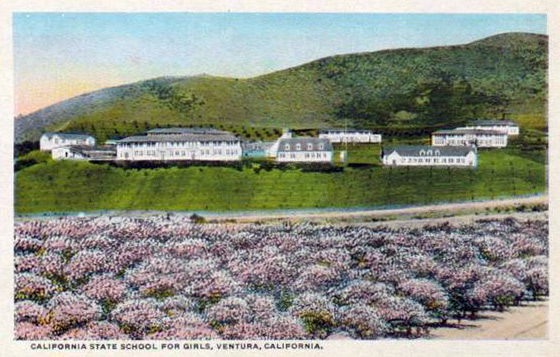
One of the girls Glasser worked with at the Ventura School seemed to have a breakthrough, and upon realizing she needed to start being truthful with those trying to help her, began revealing the details of her destructive past. She felt a lot of guilt and hoped to be forgiven.

The Ventura School for Girls, before it was moved to Ojai.

The Ventura School for Girls, before it was moved to Ojai.

Recalling this later, Glasser wrote in Reality Therapy (1965) that, “Instead of forgiving her, which used to be my natural impulse before I discovered how wrong it is therapeutically, I told her she was right to feel miserable and probably would continue to feel bad for the next few weeks. In reality therapy,” he continued, “it is important not to minimize guilt when it is deserved.”

From my own upbringing the idea of guilt had been a kind of bad word, something you needed to stay away from, and even to be cleansed from, so considering it from this matter of fact perspective was ear-catching. The following excerpt from Champion of Choice (2014) further explains his perspective.

When I questioned Glasser on that stance, he replied, “Yeh, yeh, I think guilt is a perfectly good emotion. I have nothing against guilt.” He added: “Well, the girls used to ask me this question, ‘Dr. Glasser, will you forgive me for the things I’ve done?’ You know they have a little religious background, some of them, and I said, ‘That’s not up to me to forgive you. I won’t hold what you’ve done against you, but in terms of forgiving that’s something you have to work out with your own self. I can’t forgive you. You did something wrong. You did it. The best way, if you’ve done something wrong, is to stop doing it, and maybe even treat the people you wronged, if you treated people wrong, better. That’s my advice, but that again up to you.’”

But if someone, like a person may come into my private office and say, ‘I feel so guilty, and I don’t know why.’ I said, ‘What have you done wrong?’ And that came as a new concept. Guilt without sin is a very common concept among people. It’s like you carry around the sin of the world or something like that. I said, ‘Well, if you can tell me something you’ve done really wrong, then I could certainly appreciate that you feel guilty about it, and I think that’s good. The guilt will prevent you from doing it again. But if you’re all upset and worked up and you’ve done nothing wrong, then I have no interest in it. It’s up to you.’”   pg. 111

Guilt is a huge factor when it comes to mental health. Not dealing with guilt effectively leads to a poor self-concept, broken relationships, and often a series of trips to a counselor or therapist. Religion is supposed to help us deal with guilt, but unfortunately, religion often does the opposite.

Shame3-720x380

Thanks to a tip from a friend I was alerted to the work of Dr. Brene Brown, who does research on shame and guilt. In her book, Daring Greatly (2012), Brown states that “Shame derives its power from being unspeakable. That’s why it loves perfectionists—it’s so easy to keep us quiet. If we cultivate enough awareness about shame to name it and speak to it, we’ve basically cut it off at the knees. Shame hates having words wrapped around it. If we speak shame, it begins to wither.”

Shame is a foreboding sense of unworthiness that is powered by the belief that, at the core of who I am as a person, “I am bad.” Guilt, on the other hand, has to do with a specific behavior or mistake. Instead of thinking I am bad, our self-talk would say that “I did something bad.” Interestingly, while shame leads toward self-protection, blaming others, and rationalizing our imperfections, guilt can prod us toward apologizing and changing a behavior.

Glasser alerted me to the idea that guilt can be useful and serves a purpose when it 1) causes us to stay aligned with our deeply held values, and 2) helps us stay connected to others. Brown seems to view guilt in the same way, that it can be a healthy part of our lives, but emphasizes how shame is different altogether from guilt. Shame causes us to isolate rather than reach out, to become silent rather than communicate openly, and to wrap ourselves in aloneness rather than foster intimacy with those who are important to us.

It might be hard to believe there is good news in guilt, but apparently there is.

===============

Now priced at $18.51 on Amazon; 21 reviews have been submitted.

Now priced at $18.51 on Amazon; 21 reviews have been submitted.

The eBook version can be accessed at –

https://www.zeigtucker.com/product/william-glasser-champion-of-choice-ebook/

The paperback version can be accessed at –

http://wglasserbooks.com

or from Amazon at –

http://www.amazon.com/William-Glasser-Champion-Jim-Roy/dp/193444247X/ref=sr_1_1?s=books&ie=UTF8&qid=1410617000&sr=1-1&keywords=champion+of+choice

Signed copies of Champion of Choice can be accessed through me at –

jimroyglasserbio@gmail.com

Compassion and Slim Choices

photo

The power of choice may be the most powerful power that human beings can access! We have the ability, do we not, to choose what we will do this moment, to choose our course of action, to literally choose our destiny. Some embrace this as the reason for their own success, while at the same time citing it as the reason for other’s failure. People who are struggling could make different choices. It is as simple as that. But is it that simple?

A friend who works with people who are coping with grinding, generational poverty, recently talked with me about this. He described how the spectrum of choices available to different individuals can vary so greatly that they are barely comparable. Consider the following graphic –

photo 1

Person 1 – Joe, does have a spectrum of choices, however financially, socially, and emotionally slim those choices might be.

photo 2
Person 2 – Gavin, has a much wider spectrum of choices. He comes from a financially solid background and has a large number of social connections from which to attain his own goals.

It is interesting that the choice options which may appear as the absolute best for Joe appear as the lowest possible options for Gavin. Their worlds are that different. And given this reality, what are the implications for those who work with the Joe’s and Gavin’s among us?

1950s, pre-fame Bill Glasser

1950s, pre-fame Bill Glasser

In his first big seller, Reality Therapy (1965), Glasser emphasized the role of personal responsibility. He described then how being responsible is analogous to being mentally healthy, while being irresponsible is equated with mental illness. Responsibility was basic to reality therapy and living responsibly ultimately led to happiness. These statements may have been accurate, yet Glasser became uncomfortable with how the concept of responsibility was being applied. Practitioners, many of them teachers, social workers, counselors, or in law enforcement, were using responsibility more like a “sledge hammer” than a goal or guide. When it became apparent that a student or parolee or client was behaving irresponsibly, then guilt or threats or disappointment would be applied in various forms. Seeing this trend develop, Glasser pulled back from the responsibility emphasis. The strands of responsibility could only be presented or emphasized from a foundation of involvement or a positive relationship.

The spectrum of choice issue may be similar to the responsibility issue, in that it may be too easy to assume that choice is choice and that everybody has access to a wide spectrum of options. If we think that way it will be just as easy to become judgmental toward anyone that doesn’t access good choices (which are obvious to us) or who may even make bad choices (when to us it is so plain that it could only be a bad choice).

The implication for us is to remember how different the choice options are for people, especially those affected by poverty, and how important it is for us to be compassionate in our thinking and our behavior.

Expecting Joe to view his life options in the same way that Gavin views his options is not realistic, and in some ways even cruel. One of the awesome aspects of choice theory is that it enables us to work with others as individuals, truly taking their reality into account as plans are formed toward a better future.