Posts tagged “William Glasser

Glasser’s Big 3 Quality School Pieces

IMG_0465

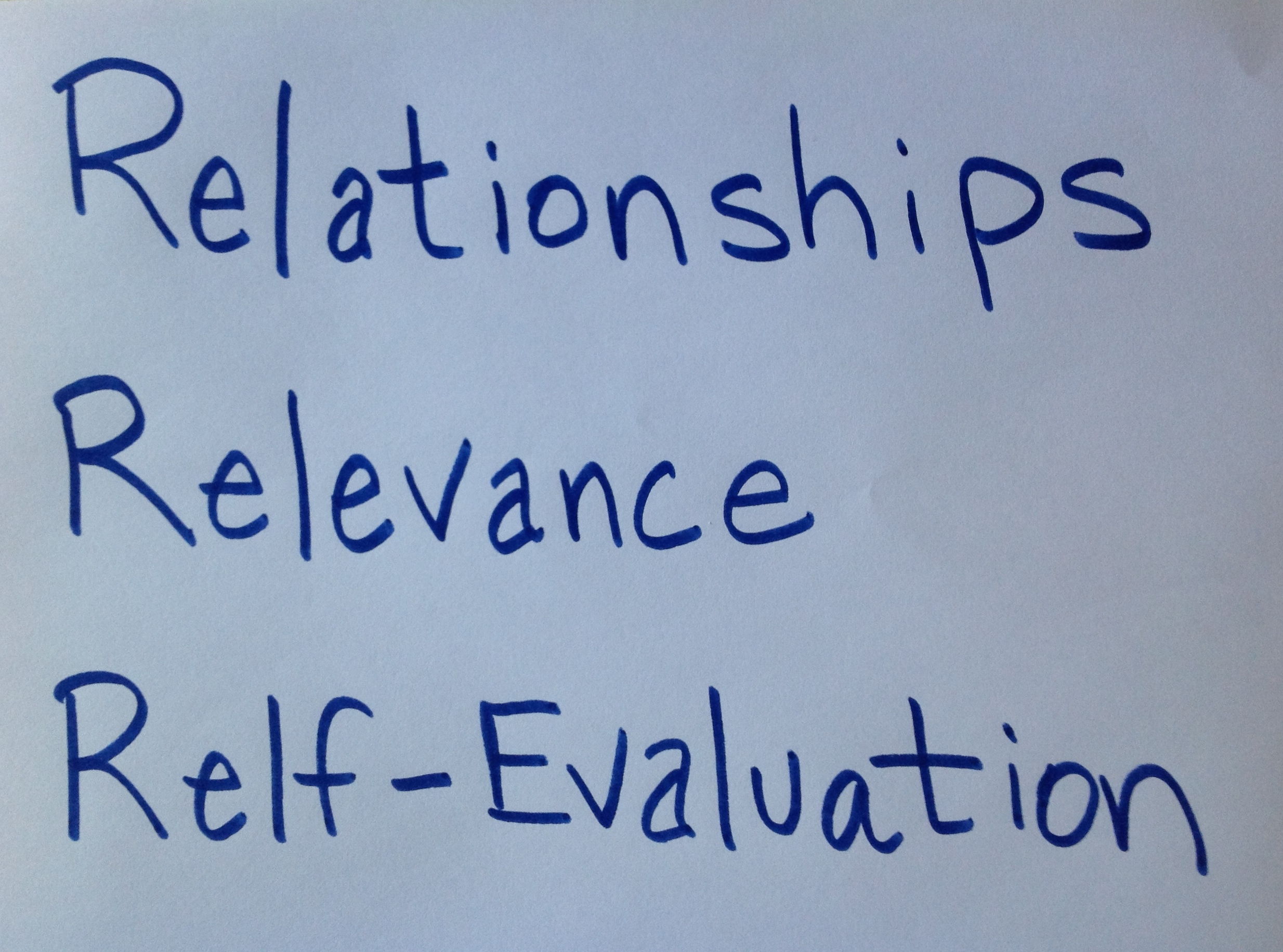
Glasser believed that three essential elements in a Quality School are –

+ Relationships

+ Relevance, and

+ Relf-Evaluation

(It helps if all the elements on a list like this begin with the same letter.)

There are nuances to these three elements, and there are other elements entirely, but any school that authentically and effectively addresses these three will be well on its way to being a Glasser Quality School.

IMG_0469

Relationships

Glasser wanted schools to be places of joy, where staff and students treated each other warmly and with respect. I refer to this piece as Intentional Friendship. It isn’t something we just hope for, it is something we strategically plan for and implement. Students respond well to our Intentional Friendship efforts, however not all will do so right away. Some have attended schools that rely on coercion and punishment and have never experienced a place – at home or school – that is based on positive relationships and natural consequences. They have used their cold, adversarial attitudes as leveraged responses to the school’s effort to control them. When a school ceases to behave in this way, and to literally take the fight out of their rules and procedures, students don’t exactly know how to respond at first. So they test their teachers to see if this approach is really real or just some form of control in disguise. I think a term we need to embrace is the idea of Unconditional Liking. And by that I mean that we behave like we like our students, not just love them in some ethereal, spiritual way, but really like them. Many of our students have never experienced unconditional anything. It’s a powerful element in a Quality School.
IMG_0468

Relevance

We all crave it. We want things in which we are involved to matter. Students are no different in what they experience at school. Busy work is the opposite of relevance. Teachers know this, yet it isn’t always easy to develop lessons that are relevant. Part of students’ complaints about school is that so much of what they do isn’t relevant to them. Consider some simple ways that topics and assignments can be made to matter more.

+ Fifth and sixth graders learn and review Math processes by calculating the performance data of their favorite baseball team – earned run averages of pitchers and batting averages of batters. Older students can study the concepts of Billy Beane, the GM of the Oakland A’s, and the metrics from which little known players are evaluated and ultimately hired at a much lower rate than the well-known, but expensive stars. (The A’s are in first place as we speak.)

+ Second and third graders track 10 day weather predictions on The Weather Channel and determine their rate of accuracy.

+ Eighth graders consider the effects that a meat diet has on the planet. How would things be different if everyone was a vegetarian?

+ It is now being said that major portions of the Antarctic ice shelves are melting and that the rate of melt is now irreversible. High school students present reports on the extent to which this claim is true.

+ High school students research the effects on the economy of raising the minimum wage to $12.00 and hour and give presentations that include the math they used to support their conclusions.

These are just examples. You can come up with even more I am sure. The point is that as teachers we must be vigilant in our search for relevance.

IMG_0467

Self-Evaluation

The Self-Evaluation piece is an essential piece of a Quality School, yet it is easy for educators to leave this piece out. Our view that academic evaluation is the teacher’s domain runs deep apparently. Maybe we view evaluation as our responsibility; maybe we see evaluation as an element of control that we don’t want to share; or maybe we think students won’t take it seriously. Whatever our reason for doing all of the evaluating, as teachers we need to reconsider this way of doing things and think of ways we can share this process with students.

One way to do this is to include a student self-evaluation column, as well as a teacher verification column, in the rubrics that you produce. Not every assignment will have such a rubric, but certainly the major assignments and projects will benefit from giving students a chance to rate their own performance. When they submit their assignment or project they will also submit a completed self-evaluation. My experience is that they in fact do take self-evaluation seriously. Their scoring and my scoring as teacher do not always match, but our scoring differently always leads to important conversations about their performance.

I may say that “I notice that you have given your self a 5 out of 5 on the personal examples section of the paper. Could you show me where those are?” The student may then attempt to show me how they interpreted that requirement or they may admit that maybe they didn’t do as much as they thought on that area. We eventually agree on a score, politely, focusing on the content rather than the person. I have noticed that it isn’t unusual for them to give themselves lower scores than I gave them. It is fun when that happens to point out to them the ways they got it right.

Glasser and Deming agreed that self-evaluation was really the only evaluation that mattered. We have to hold to this principle, pursue it, nurture it, if we are to create learning environments that are need-satisfying.

Relationships, relevance, and self-evaluation are just as important in the home, or in our churches, too. They are basically three of the essential principles of life.

=====================

Remember that our Choice Theory Study Group has been cancelled this coming Sabbath, May 24. I know you may be keenly disappointed, maybe even overcome with despondency, but try to have a good weekend anyway.
You’re Adding PURPOSE on Purpose?

The two most important days in your life are the day you are born and the day you realize your purpose.   Mark Twain

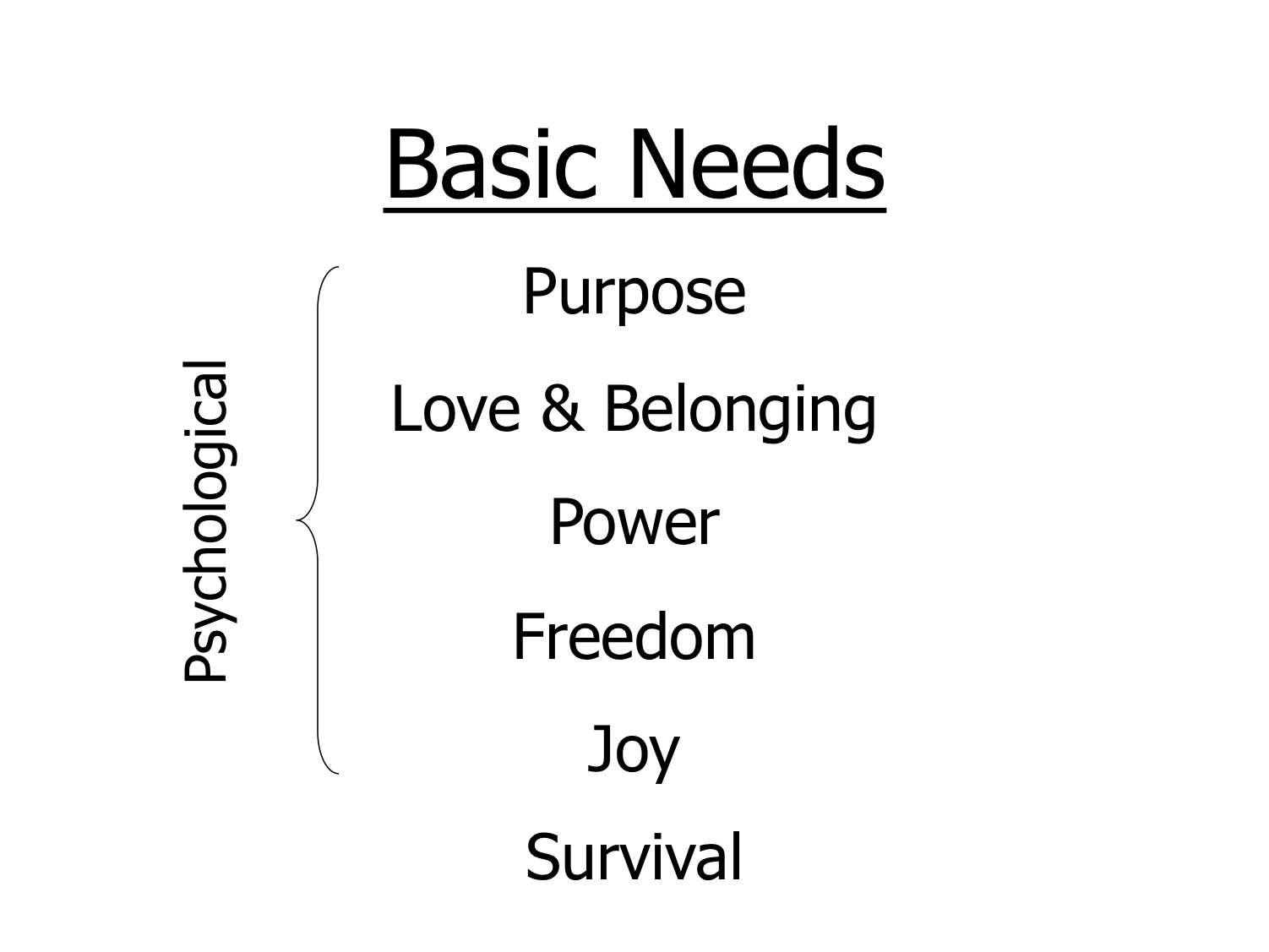
Some of you noticed that I have added Purpose as an additional need to the five Glasser identified. It is true, and I not only added it, I put it at the top of the list. I did not do this flippantly. Instead, my suggesting this new addition represents a very personal process involving a great deal of reflection.

Correct Basic Needs

The thing that started this personal process was my wondering where my spirituality fit into the Basic Needs. And by spirituality I mean something much deeper than religion or church orientation. My spirituality has to do with Who I really am and What are my deepest beliefs and What is the meaning of life (it’s beginning and it’s end) and ultimately, What is my purpose in the grand scheme of things?

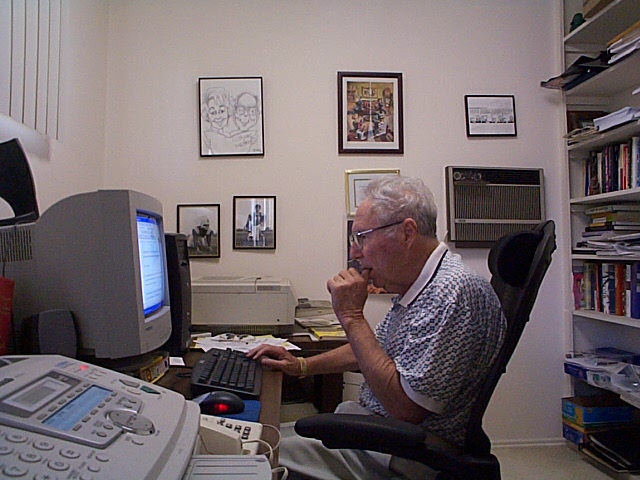
William Glasser at work in his home office. (2004) Jim Roy photo.

William Glasser at work in his home office. (2004) Jim Roy photo.

I tried to talk Glasser into endorsing this additional need, but he wouldn’t buy it. (When I first talked with him about it I referred to it as an Existential need, thinking he would be more comfortable with a “secular” wording.) I think he didn’t endorse the Purpose need for two reasons. The first reason had to do with not wanting to mess with the five needs he had emphasized for so long. Even though he had suggested the probability of their being more than five needs in his earlier writing (Control Theory, p. 16), he had settled into a firmness with his five. The second reason, I think, had to do with his seeing religion and spirituality as the same thing. He saw religious participation as a Quality World value or activity, and as such it didn’t qualify as a Basic Need. On top of this, in general, he didn’t view religion as a positive force throughout earth’s history. Without his endorsement I put my thoughts on this on a back burner and worked on other things. Even on a back burner, though, for me, the Purpose need wouldn’t go away.

I am convinced we are driven to understand our personal purpose and to make meaning of our lives, and that meeting this need is essential for the other needs to be fully met.

For a need to qualify as a Basic Need it would have to be needed, at least to a small degree, by all human beings. I believe the Purpose need meets this criteria as every human being has a deep need for personal meaning and the idea of coming into a sense of self. The self-help quest (books, seminars, videos, etc.) is an industry bringing in 2.5 billion dollars a year, so there are a lot of us seeking this thing called meaning.

I see college students that struggle because their life purpose is not clear to themselves. Their other needs are being met – they have friends and social connections, they are free to come and go, and they have some fun in their lives – but not having their identity and purpose clarified hampers their success. In fact, a lack of purpose can derail a college student’s academic success.

0613_superman_630x420

I am suggesting that the need for Purpose and Meaning is a universal need that people seek to meet in all kinds of ways. For many their involvement in a religion contributes to filling this need; others who are spiritual, although not into a religion, find meaning in their journeys as well. And even non-spiritual, non-religious people have their own ways of finding purpose and meaning. For instance, it is interesting how movies that depict superheroes, science fiction stories based on “a long, long time ago, in a faraway galaxy” themes, and end-of-the-world scenarios are so popular. It is like we have an innate curiosity about where we fit into the past, present, and future. It is like we have a consciousness void inside of us that can only be filled as our need for Purpose and Meaning are satisfied.

We are always monitoring the extent to which our Basic Needs are being met, something I do quite a bit when it comes to my own need for Purpose and Meaning. Maybe some of you can relate to that.

Every person has a purpose. Never give up.   Manual DeVie

==============

For those of you just getting started with following The Better Plan blog, a great way to catch up is to go the link toward the upper left hand corner labeled 2013 – Year At A Glance. Each of last year’s posts are in chronological order and just a click away from accessing.


The Simon Cowell In Each of Us

$T2eC16h,!)EE9s2uiwPRBR)O6o2dG!~~60_35

At their core the 7 Deadly Habits are built on the foundation of judging others. Think about it.

The 7 Deadly Habits are –

1. Criticizing
2. Blaming
3. Complaining
4. Nagging
5. Threatening
6. Punishing
7. Rewarding to manipulate

Each of these habits involves the spirit of judgment. Criticizing, blaming, complaining, and nagging serve as tools for one person to apply behavioral pressure on a family member or colleague. Threatening and punishing take the spirit of judgment to a more intense level. And even rewarding to manipulate, which feels better than punishment, is still a form of manipulation.

This year's American Idol judges - Harry Connick, Jr., Jennifer Lopez, and Keith Urban.

This year’s American Idol judges – Harry Connick, Jr., Jennifer Lopez, and Keith Urban.

We marinate in a judging society, with TV shows like American Idol, Dancing with the Stars, Survivor, The Bachelor, America’s Next Top Model, The Voice, and Top Chef thriving and calling for our attention. Immersed in a society of judgment it shouldn’t be a surprise that we view others, even our family and friends, in this same way. And in this same way we begin to develop a little “Simon Cowell” in our brains, an overconfident, opinionated, supposedly “all knowing” presence that knows what’s best.

The choice theory axiom that Glasser put at the top of the list is –

The only person you can control is yourself.

This axiom, or principle as I would call it, really does speak to this issue. It’s not about judging and controlling others. It’s about knowing and directing ourselves. When we honor this axiom we become happier and our relationships become stronger and more intimate.

School Application

I think it can be said that –

Without intervention students will judge others.

Schools can make a significant positive social impact by minimizing, or even eliminating, activities that rely on students being ranked and compared to one another. Resist the temptation to turn activities into contests in which students are pitted against each other. We don’t need to determine the “best” essay or who is the “best” speller. Instead, our goal should be to design activities in which all of the students are drawn to participate in and engaged in the learning.

Even our recess games and rainy day indoor games can contribute to this spirit of inclusion. For instance, consider the following version of musical chairs.

In the normal version of musical chairs there are always fewer chairs than participants and the goal is to be quicker, stronger, and more aggressive than your playmates and get one of those remaining chairs. There is often a sneaky piano player or musical device to add to the drama, but the basic premise is you better get one of those chairs, even at the expense of someone else who has the same goal. The result is that very quickly most of the players are standing against the wall watching while the few remaining players push, pull, tackle, and attack their way to victory.

musical-chairs

In a cooperative version of musical chairs you still have the sneaky music (ya gotta have the music) and you still remove chairs as the game goes along. The difference is that you don’t remove players. This means that as the game goes on you have the same number of players having to sit, stand, and be suspended from fewer and fewer chairs. It gets pretty hilarious when 10 players have to somehow get situated on two chairs.

The message we send to children in the normal version is that in life there will always be fewer prizes than participants and that you better be quicker and more aggressive in getting your needs met, even if it keeps someone else from meeting theirs.

In the cooperative version children are introduced to the idea that we are in this thing called life together, and that if we hold on to one another and help each other we can all make it. There may be fewer chairs in life, but that doesn’t mean we can’t share what’s left.

=============

The Glasser biography can be had through the following link –

The Glasser Book Store
http://wglasserbooks.com/books.html

Zeig, Tucker & Thiesen Publishing
http://www.zeigtucker.com/product/william-glasser-champion-of-choice/

Amazon
http://www.amazon.com/William-Glasser-Champion-Jim-Roy/dp/193444247X/ref=sr_1_1?s=books&ie=UTF8&qid=1398205174&sr=1-1&keywords=william+glasser+champion+of+choice


Hot Off the Press! Really.

Bob Wubbolding, who wrote the Foreword for the biography, and Glasser at the Evolution of Psychotherapy Conference in 2005.

Bob Wubbolding, who wrote the Foreword for the biography, and Glasser at the Evolution of Psychotherapy Conference in 2005.

The Glasser biography became available yesterday on the Zeig, Tucker & Theisen Publishers website. The following link takes you to the right page –

http://www.zeigtucker.com/product/william-glasser-champion-of-choice/

I first learned about the biography being available through an email from William Glasser, Inc.   Hot Off the Press it proclaimed; ten years in the making it pointed out; followed by a short testimonial by Carleen Glasser –

Champion of Choice is a wonderful story and a great read because it gives you the feeling that you are present, watching the life and ideas of a true genius evolve.”

The book is listed at $22.95, but is being sold right now for just $22.00 on the publisher’s website. Buyers are given the option of giving a $5 donation, along with their book purchase, to the William Glasser International organization. It is a very simple process and a nice touch, I think.

I received a compliment yesterday when someone said they loved the promo I wrote for the book on the publisher’s website. I had to admit that I didn’t write it, but that I liked it, too. The promo in question went like this –

WILLIAM GLASSER: Champion of Choice
A biography by Jim Roy

William Glasser did not just have a profession, he had a mission—to empower people through choice, free will, and self-determination. He envisioned a better world, and the weighty issues he tackled reflected that—the definition, diagnosis, and treatment of mental illness; the explosion of psychotropic drugs; addiction and self-medication; failing marriages and the high divorce rate; disconnected families; crime and crowded prisons; underachieving students and marginal schools; and worldwide political oppression and violence.

Jim Roy chronicles the life and legacy of William Glasser whose controversial ideas and brilliant insights significantly impacted mental health and education professionals. Champion of Change illustrates Glasser’s lifelong dedication to help others lead productive, meaningful lives.

Although Glasser was already gaining recognition in the early ‘60s with the publication of his first book, Mental Health or Mental Illness, his notoriety changed significantly after his second, Reality Therapy (1965). Working as psychiatrist in the late ‘60s at the Ventura Schools for Girls, a school for troubled teens, Glasser’s professional life really began to take shape as his ideas were implemented, dramatically changing and reforming young women who most had given up on. His long and successful run at the school prompted another book, Schools Without Failure (1969), which is still a bible to many present-day educators.

Over the next four decades Glasser published 23 books and a slew of booklets and articles, and was interviewed and written about in myriad books, magazines, and journals. The principles and concepts he held and generously shared and articulated through his books and public speaking were reality therapy, control theory, choice theory, and mental health as a public issue rather than a medical issue. The latter being the most controversial in that Glasser swam against the tidal wave that swept in the growing belief that drug therapy should supersede talk therapy.

Also captivating is Glasser’s personal life – his own dysfunctional family history, the family losses he endured, and his quest to find love again. And through it all he selflessly continued to work to change the bigger picture. In the introduction of William Glasser – Champion of Change, it’s stated that novelist Thomas Berger once said writers write because “it isn’t there,” and Jim Roy takes that to heart giving us a comprehensive and compelling biography on voice that will surely echo throughout history.

2014 / 420 Pages / 6 x 9 / Paperbound / Illustrated / ISBN 978-1-934442-47-0 / $22.95
Add $5 donation to William Glasser International ($27.95)

You may have noticed that twice in the promo the biography was referred to as Champion of Change. The layout editor of the biography somehow got that phrase in his mind early on in the process and it continues to show up at various times. My wife thinks that Champion of Change might actually be a better title, but Champion of Choice has won out so far.

Kim Daub Olver, current Executive Director of Glasser International, shared on Facebook yesterday that she feels the book will be a huge contribution to the world. To that I say, I hope so. It would be so cool if the biography really made an impact on people’s thinking and acting.

================

Enjoying The Better Plan blog? Why not click on the Follow link and receive updates as they are posted. You also have my permission to tell family and friends about the blog. We all could use an insight now and then on living a non-coercive life.

Linda, Gone Too Soon

Linda Harshman and Jim Roy, both attending the 2005 Glasser International Conference in Dublin, Ireland.

Linda Harshman and Jim Roy, both attending the 2005 Glasser International Conference in Dublin, Ireland.

Linda Harshman, longtime Executive Director of the Glasser Institute, passed away on Friday evening, April 4. She faithfully held that position for over 20 years and did everything she could for William Glasser and his organization to be successful. Bob Wubbolding, who worked with Linda as the longtime Director of Training for the Institute, wrote that –

Many of you have undoubtedly received the sad news that Linda Harshman died at her home about 11:15 pm Pacific Time on April 4, 2014. She was with her sister Judy and her friend Frank. She was under the care of Hospice for a short time before her death.

Sandie and I spoke to Carleen Glasser today and she joins us in expressing our sadness at the loss of a very fine person. Linda was an anchor for the William Glasser Institute for many years and a dear friend to many of us.

Carleen, Sandie and I were very fortunate to visit with her about 2 weeks ago. Throughout her illness Anna Corbett and Jean Suffield frequently visited with her and cared for her. We owe them a great deal of gratitude for their unrelenting care giving and support. Also, her sister Judy from Nova Scotia provided family closeness and support as Linda approached death.

It was Linda’s wish that there be no public service held for her. Nevertheless, our prayers and thoughts have accompanied her and will continue in the future as we hold her memory close to our hearts.

And John Cooper, chairperson of William Glasser International, wrote that –

I have just learned of the passing of Linda Harshman some 24 hours ago. A sad time for everyone who knew Linda and of her support for Dr Glasser and his work.

It was just recently we heard that Linda was fighting a valiant battle with Stage 4 Cancer. The cards and messages that many people sent to Linda, in the intervening weeks were all read to her by Frank, her friend. We are advised the words of love and appreciation were well received and meant a lot to Linda. Then just days ago we learned that chemotherapy had been ceased and that she was under Hospice Care.

For those who had the opportunity to meet and work with Linda or just knew of her work it is hard to accept that one so animated, strong and energetic in administering the work of the William Glasser Institute is no longer with us. I am advised that Linda played a large part in supporting affiliates / countries as they began to establish their own institutes and that many people would like to acknowledge Linda. Such testimonies may form a part of our recognition. WGI will advise everyone what we will be doing to celebrate her life and work and how you can all contribute.

I am sure I voice the thoughts of all in sending a message that we share the sorrow of Linda’s near friends and family at this time.

I appreciate these messages from Bob and John a lot. They bring all of us together in a shared sense of loss, an appropriate grief. In that spirit I would like to add a tribute to Linda. What follows is an excerpt from the Glasser biography. The excerpt is from a very significant talk that Glasser gave in 1996.  He was setting a course for the future of the Institute, even though others disagreed with him. The disagreement had to do with school discipline plans, but that’s not our focus here. Our focus here is on Linda and the esteem in which Glasser held her. With that in mind, from the biography –

At the end of the talk he said something that really put into perspective what he was trying to say. “So that’s the dilemma we have,” he began to conclude. “On Sunday we’ll talk about that dilemma and see if we can come to some resolution that will be satisfying, but the resolution will not be that I can accept any discipline programs, cuz I can’t. If it ends up right back where it was with me and all the rest of the people go, it’ll be me and Linda and we’ll keep hammering away for the rest of our lives. I feel very, very serious about this. Because I finally recognized what my mission in life is.”

Could there be a higher tribute to Linda’s faithfulness and commitment to Glasser’s vision? Organizationally, Glasser had been walking shoulder to shoulder with Linda and knew that he could count on her, through thick and thin, come what may.

Who would have thought, even just a few years ago, that Glasser and Linda would be gone from us, having passed away only seven months apart? Their passing is a stark reminder that if the show is to go on, the baton must be passed on to others – us – who will accept it in the kind of spirit that inspired the two of them.


Listening to Understand


We may not have ears as big as Abby's, but we still concentrate on really listening to the person talking to us.

We may not have ears as big as Abby’s, but we still concentrate on really listening to the person talking to us.

One of the things I like on Facebook are the concise, insightful quotes and statements that friends share. The quotes often pack a lot of wisdom into a small amount of space. An example of such a quote was recently posted by Maureen Craig McIntosh, a Glasser faculty member from New Brunswick. It read –

The biggest communication problem is we do not listen to understand. We listen to reply.

Most of us quickly recognize truth in this statement, but don’t let quick agreement cause you to miss some of the deeper truths it contains. An experienced Glasser trainer thought enough of the statement to pass it on to us. What are the choice theory implications of listening to understand? Let’s identify a few –

1. One of the reasons we are quick to reply, rather than listen, is that we think we know what’s best for others. As soon as we hear the problem, we want to let others know about our solution.

2. More than simply wanting to share a solution, another reason we are quick to reply is that we may want to control the person who is talking to us. This can be especially true if the person is one of our children, or a spouse, or one of our students.

3. One of the most need-satisfying things we can do for another person is to truly listen to what he/she is trying to say. Active listening can assist another person in problem-solving for himself, which honors the choice theory axiom that the only person I can control is me.

Billy Joel sang about a New York state of mind; it would seem the idea of listening to understand or listening to reply involves a state of mind, too. Fortunately, a state of mind is something we can influence, a lot. We can choose to concentrate on listening more and talking less. One of Covey’s famous 7 Habits of Highly Effective People is to “Seek first to understand, then to be understood.”

==============

Classroom Application

Listening to reply –

Student: I don’t want to go out to recess today.

Teacher: What? What are you talking about?

Student: I don’t want to go out to recess. I just want to stay inside the classroom.

Teacher: That’s ridiculous! You’re coming outside. I can’t have kids all over the place.

Listening to understand –

Student: I don’t want to go out to recess today.

Teacher: I think that might be a first for you. You really don’t want to go outside?

Student: No, I just want to stay in the classroom.

Teacher: Can you tell me what it’s about? Are you not feeling well?

Student: I guess I feel ok; I just want to hang out in here.

Teacher: You know, it felt a little bit like something was troubling you when you came in the classroom at the start of school this morning.

Student: (shrugs)

Teacher: Would you be willing to come outside and hang out with me as I supervise the playground? If you’re ok with talking about it, I would like to hear what you’re thinking this morning. If you don’t want to talk about it, that’s ok, too. And if you don’t want to hang out with me at all, you can sit on the bench outside of the classroom. I’m ok with that. Would either of those options work for you?

Student: (smaller shrug) Yeh, I guess I could hang out with you. That’d be ok.

Home Application

Listening to reply –

Wife: I got offered a promotion today at work.

Husband: Wow! Way to go!

Wife: Yeh, I probably should be excited, but I just . . . I don’t know.

Husband: What do you mean, you don’t know? You’ve earned it. Ya gotta go for it! I assume there would be a raise and we definitely could use the money.

Listening to understand –

Wife: I got offered a promotion today at work.

Husband: Wow! Way to go!

Wife: Yeh, I probably should be excited, but I just . . . I don’t know.

Husband: It looks like you have mixed feelings about it.

Wife: Yeh, I do. I really do. A part of me realizes it is a great opportunity, while another part of me likes what I have going right now. (pauses)

Husband: (gives a little smile, but doesn’t break the silence)

Wife: The promotion offers more pay.

Husband: Besides more money, how would your life change if you took the job?

Wife: I’ve thought about that a lot. (pauses) I see what supervisors have to do, the way they spend their days, and the problems they are expected to solve, and there is just nothing in me that wants that. I really like what I do now. I look forward to going to work on most days. (pause) And I like that my schedule is so good for our home. I can pick the kids up after school, which is a huge advantage compared to what I see other parents juggling. The extra pay is tempting, but I don’t think it outweighs all that.

============

We’ll close today with another quote that captures something important with very few words. I was alerted to it by Bette Blance, a choice theory leader in New Zealand. The quote reads –

Listen and silent are spelled with the same letters. Think about it.

As the wife was talking to her husband in the last scenario about her possible promotion there were several times when she paused and silence filled the moment. Yet her husband did not jump in and fill the silence with his ideas. He simply remained silent, too, and let his wife work through her thoughts. Like the quote says, Think about it.


The Best Version of Themselves

Glasser received an honorary doctorate at the same time I received my Ed.D.

Glasser received an honorary doctorate at the same time I received my Ed.D.

I began the last blog with “The Glasser biography is printed and is now available!” It turns out it would have been more accurate if I had left it at “The Glasser biography is printed.” I have the book. It looks great! But I still can’t tell you how you can get a copy. Nothing yet on the publisher’s website or on the wglasserbooks.com website. The Better Plan followers will be among the first to know about how to get the book. Stay tuned.

=============

photo 1

I have continued to think about some of the things Glasser suggested in one of his unpublished articles that I posted as part of the March 19 blog. For instance, in reference to how parents should guide their children he wrote that –

“What we should be sensitive to from early on is what they want. Then as much as we can, rather than to give them things we should make an effort to take the additional time to teach them how to satisfy their needs themselves.”

The idea of taking the time to teach kids how to satisfy their own needs has made a real impression on me. This process is about honoring your child as a fellow human being with unique dreams and goals of his/her own. It is about respecting their ideas and helping them achieve them. It is a process full of love and compassion.

It was helpful to me that Glasser went on to explain that as parents we can –

“Assure them from the time that they can comprehend it that we believe in the way we live our lives, but that our way is not necessarily the best way, the only way or the way for them. And as our way changes, as it will, show them that we can be tolerant of ourselves as we change. From this they will learn that they too have a way but that it is not the only way and that they should be tolerant of themselves as they change.”

Is such an honest and candid relationship possible between parent and child?

I especially thought about the effect such a relationship would have on a child’s spiritual journey. What would it be like for parents to express how much they believe in the way they live their lives, but somehow to admit that their way may not be the only way for the child? What if parents modeled an authentic and real connection with Jesus, and invited their children to be a part of that connection, yet somehow did so non-coercively? Too many children are growing up to be screwed-up adults, unclear regarding their purpose in life and spiritually unhappy. To a great extent I think this has a lot to do with children experiencing the opposite of what Glasser described. Instead of focusing on creating and maintaining their own spiritual lives and then inviting, inspiring, and persuading their children to join them, parents are leading halfway religious lives and then trying to force their children to do the same. Criticizing, nagging, threatening and punishing are frequently present in this approach.

Glasser believed that if we can foster a relationship with our children that honors and respects them as fellow human beings –

“ .  .  . especially to refrain from criticizing them, we have a chance, even a good chance (there are no sure things in this delicate process) to enjoy the reward which is a child who loves us, respects us, and enjoys spending time with us.”

And I would add that more adults would turn out well-adjusted and mentally healthy.

photo 2

As I considered Glasser’s thoughts on parenting I was reminded about something I read in Ted and Nancy Sizer’s book, The Students Are Watching: Schools and the Moral Contract (1999). Describing the role schools can play in students’ lives, they wrote that “We must insist on a high school design which will help all the high school’s people to reach for the best version of themselves.” p. xiii

I like the idea that we can help children and students to reach for the best version of themselves. I like the phrase “best version of themselves” a lot.

===========

Classroom Application:

In the absence of intervention, students will come to see their teacher as the judge and chief evaluator. Students turn in assignments and hope that their teacher will accept it, or maybe even like it. Somehow the school system has created a divide between what students do and their own connection to that skill or product.

Teachers can begin to restore this connection between pupil and product by changing their own role in the classroom. Whenever appropriate, a teacher can help students evaluate aspects of their assignments by saying or asking things like –

Tell me what you like about what you have created.

What part of this assignment was the most satisfying for you?

What grade would you give yourself on this assignment and why?

What strategies did you use that helped you complete this assignment?

Teachers can still make evaluative statements; we just need to do less of it. We need to share the evaluation process with students. This sharing can be done informally, like the sample questions above, or it can be done formally where student self-evaluation becomes part of the project rubric.

===========

“I think the big mistake in schools is trying to teach children anything, and by using fear as the basic motivation. Fear of getting failing grades, fear of not staying with your class, etc. Interest can produce learning on a scale compared to fear as a nuclear explosion to a firecracker.”    Stanley Kubrick

Glasser Biography Now Available

photo

The Glasser biography has been printed and is now available!

I knew the day would come, and yesterday it did come, as I received from the printer my copies of the finished book! It took longer than I thought it would to go through the editing and publishing process, but that is behind us now.

I am pleased with the look and feel of the book, especially the inside look of the pages. Great font and spacing; it is very readable in that way. Hopefully, you will find it readable in every way.

The first interview I conducted with Glasser took place on September 26, 2003. It’s hard to believe it’s been more than 10 years since that moment we began in his Los Angeles home. I didn’t start out as his biographer. I approached him about my completing a dissertation on the development of his ideas. He agreed and the interviews began.

After our third interview he began referring to our work as his biography project, something I was open to, although I had no clue at the time of the implications of what it would mean to become his biographer. At the 2004 international Glasser conference in Schaumburg, Illinois, he surprised me during the banquet when he officially introduced me as his biographer. I realized then that the project was going to be more than a dissertation.

I presented a copy of my dissertation to Glasser in 2007.

I presented a copy of my dissertation to Glasser in 2007.

We continued interviewing together through 2008, although we talked pretty consistently even after the formal interviews had stopped. He filled in details as I ran into missing pieces of his story. He was always glad to visit about his ideas. The biography project was important to him.

I wish that I could place a copy of his biography in his hands today. I really wanted to do that; I think he wanted that, too. We would have enjoyed holding something so tangible as a representation of all that we had worked on together. And for him, with the book representing his life and work, it would have been even more significant.

The biography is now available, and you would think I would be able to tell you about how to get a copy. But alas, I cannot .  .  . yet. My copies were shipped from a printer in Illinois, although I am pretty sure the printer will have nothing to do with sales and shipping. The publisher is Zeig, Tucker & Theisen Publishing, but as of this morning there is no announcement on their website about the book. I know that Jim Coddington at wglasserbooks.com is going to have information about the biography, but nothing yet there, either.

I will be in touch with the publisher on Monday and will get all of the ordering information, which I will immediately pass on to you.

For now I am enjoying going through the book and re-reading portions of it myself. It has been a while since I have written it so it is like bumping into a good friend who you haven’t seen in a long time. It has been good for me “catching up” with the Glasser story.

=============

Unpublished Glasser Article

Bill Glasser 1977 (contributed by Jim Roy)

Bill Glasser 1977 (contributed by Jim Roy)

Going through some of my Glasser artifacts recently I came across a short article he wrote over 30 years ago. Based on the author bio info at the end of the article I would say it was written in 1980. The article was typed, maybe by Glasser himself, but probably it was dictated by him and then typed by someone else. By 1980 Glasser had met William Powers and had been introduced to the ideas of control theory, ideas that deeply influenced him.

Bill Glasser 1981

Bill Glasser 1981

I don’t think the article – titled Some Thoughts About Raising Children – was ever published. I am sharing it with you, exactly as it is written, for several reasons.

1. It is enjoyable to read Glasser’s ideas, especially a potential article that may have slipped through the cracks and gotten overlooked.

2. Do you detect a reason why the article may have been filed away or even rejected? You will be reading the exact draft that I have. Would editing help make the article stronger?

3. Do you think Glasser would have written this article 20 or 25 years later? Did he end up modifying any of the ideas expressed in the article in 1980 later in his career?

Ok, those are the thought questions to get you started; here’s the article.

================

SOME THOUGHTS ABOUT RAISING CHILDREN

William Glasser, M.D.
President, Institute for Reality Therapy

     What do we owe our children and what do they owe us? Book after book, from the Bible to Spock, has attempted to answer these questions and the parade continues because no book seems to satisfy any parent for long. We wish there were a child-rearing manual like that which comes with a Mercedes but we are not machines. We are living creatures driven, as no other creature is, by strong, often conflicting forces. Because we must discover an infinite variety of ways to satisfy these forces the definitive how-to book will never be written. It follows, therefore, that we will never know how to raise our children. If we can accept the uncomfortable premise that here there are no right answers then I believe we have the chance to succeed reasonably well in this difficult task. And even if our success is minimal we will do them less harm than if we tried to follow any current “truth.”

Regardless of what we do, and granted that there is no universal way, most of us want our children to be happy, to love and respect us, and to be successful in some way that we define success. Because we tend to love them extravagantly most of their lives most of us will have no trouble accepting that we owe them food, shelter, safety and our companionship. But, as hard as this may be to accept, they, I believe, owe us nothing; if we want their love we must earn it. This is not hard to do as long as we do not attempt to cajole, coerce, or force them to be the people that satisfy us.

What we should be sensitive to from early on is what they want. Then as much as we can, rather than to give them things we should make an effort to take the additional time to teach them how to satisfy their needs themselves. If, however, what they want is in conflict with what we believe, as it often will be, as they mature, we should, in words they can understand, state our beliefs. But along with telling them what is important to us we should encourage them to try to convince us that their needs are worthy of our support. This means that we should listen to them and if they are at all convincing help them to get what they want. If we are unconvinced we should continue our argument but also make an effort (and it will be an effort) not to criticize them or to use our parental power to stand directly or indirectly in their way.

Assure them from the time that they can comprehend it that we believe in the way we live our lives, but that our way is not necessarily the best way, the only way or the way for them. And as our way changes, as it will, show them that we can be tolerant of ourselves as we change. From this they will learn that they too have a way but that it is not the only way and that they should be tolerant of themselves as they change.

Assuming that we can do this, especially to refrain from criticizing them, we have a chance, even a good chance (there are no sure things in this delicate process) to enjoy the reward which is a child who loves us, respects us, and enjoys spending time with us. But if we achieve this reward we should be cautious and resist the temptation to gain more, that is to convince these “good” children that they also be what we want them to be. It is our failure to resist this ever-present temptation that causes most of us who succeed for quite a while eventually to fail. If we are getting along well and then they start to slip away it will be because it is so difficult in raising children to keep the ancient proverb, “let well enough alone.”

+    +    +

William Glasser, M.D. is the President and Founder of the Institute for Reality Therapy, incorporated in 1967. His major books are Reality Therapy, Schools Without Failure, The Identity Society, and Positive Addiction. All are published by Harper & Row and Reality Therapy and The Identity Society are available in German translations. Two new books have been written. Available now is What Are You Doing?, a series of cases written by Reality Therapists and edited by Naomi Glasser. To be available in March of 1981 is Stations of the Mind, a new book linking how our brain functions to Reality Therapy. Both are published by Harper & Row.

Dr. Glasser has worked in schools, correctional institutions, mental hospitals, and rehabilitation centers. He teaches and lectures all over the world and still conducts a small private practice. People interested in further information about Reality Therapy and training programs can write to:

Institute for Reality Therapy
11633 San Vincente Boulevard
Los Angeles, CA 90049

=================

Don’t write to the above address. There are no Glasser offices on San Vincente anymore, although some of you reading this will remember that place fondly.

If you are so inclined let me know how you respond to the thought questions before the article. Would Glasser have written this article 20 years later?

=================

If you like this Better Plan post, why not share it with your social network and encourage them to join The Better Plan.

Sticking It In Their Ear

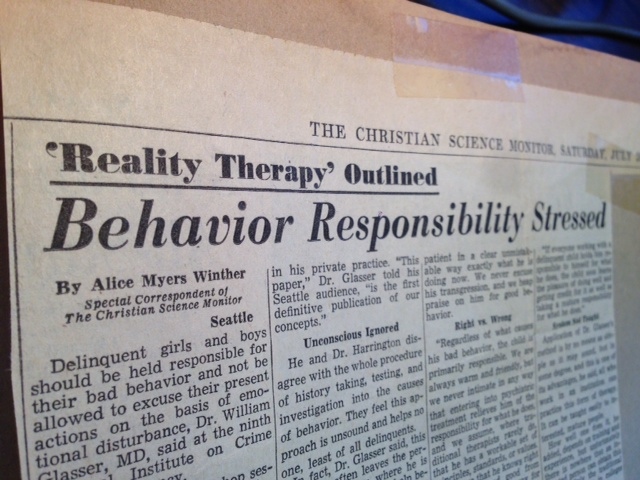
Newspaper article from 1962

Newspaper article from 1962

Early in Glasser’s career he emphasized the idea of being responsible. Reality Therapy (1965) echoed this theme a lot. Taken as part of the overall elements of reality therapy – elements like involvement, no punishment, and never give up – responsibility could be kept in perspective. However, Glasser soon discovered that teachers were taking the idea of responsibility and using it as a hammer to whip kids into shape. Seeing that people were misusing the idea he began to pull back from it.

Early on he was also known as an expert on classroom discipline and his “get tough” approach was advertised in national magazines. He let this happen for a while, but realized that such a message didn’t accurately capture what he was trying to do. Once again, he began to pull back from what people thought he was saying.

We still face this challenge today. We love the sound of choice theory and are drawn to its application, yet when we have marinated for so long in external control (reward/punishment) it is easy to go back to what we know. Teachers chuckle in agreement when I suggest that it is possible to use internal control strategies in an externally controlling way. As Glasser used to say, “It’s easy to believe in choice theory, but it’s hard to do.”

I thought about this during our recent Choice Theory Study Group as we focused on the concept of total behavior. Key pieces of total behavior include that 1) all behavior is purposeful and that 2) all behavior is made up of four parts – thinking, acting, feeling, and physiology. A key piece of total behavior is that two of the four parts – our thinking and our acting – are under our direct control.

And this is where a potential problem lurks. In the same way that teachers back in the 60s and 70s misunderstood and misapplied the idea of responsibility as Glasser intended, teachers today might be tempted to tell students that they are responsible for their own thinking and acting. If something is under our direct control, like how we act, then it may seem reasonable to emphasize this to students, even to bombard them with it.

IMG_1020

This is the thing, though. Gaining insight into total behavior and understanding how it applies to you personally doesn’t come from someone else telling you about it, especially during a tense moment when they may be telling you to get your act together. Such insight comes from being gently led toward the concept and being asked the right questions at the right moments.

One of my mentors, a man who taught me so much about supervising teachers, shared that

“It is better to get something out of someone’s mouth,
than it is to put it into their ear.”

As teachers and parents this can be our goal, too. Total behavior is correct, in my opinion, and our having direct control over our thinking and behavior is correct, too. Helping our children and students realize that, without damaging our relationship with them, is our challenge. Somehow we need to help them talk about what the idea of total behavior means to them, rather than just sticking the concept in one of their ears.

================