Posts tagged “choice theory

IMG_1198 IMG_1199 IMG_1200 IMG_1201 IMG_1202 IMG_1204

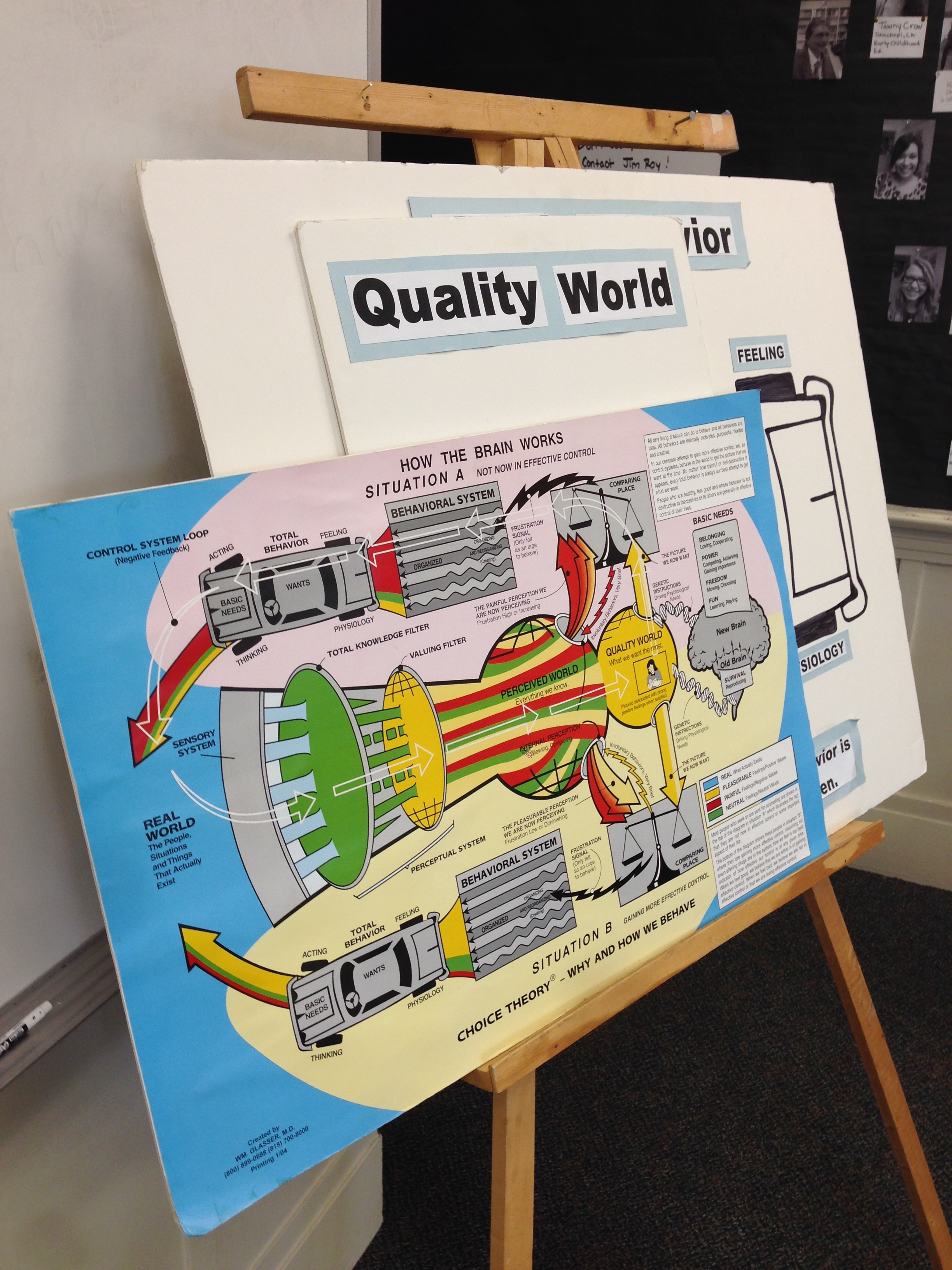
A quiet classroom begins to take shape in anticipation of the Soul Shapers workshop, which began yesterday. There is something special about a classroom before class begins. Potential hangs in the air and fills the space. Thinking will be affected and lives will be changed. It’s a sacred place to me.

IMG_1208 IMG_1209

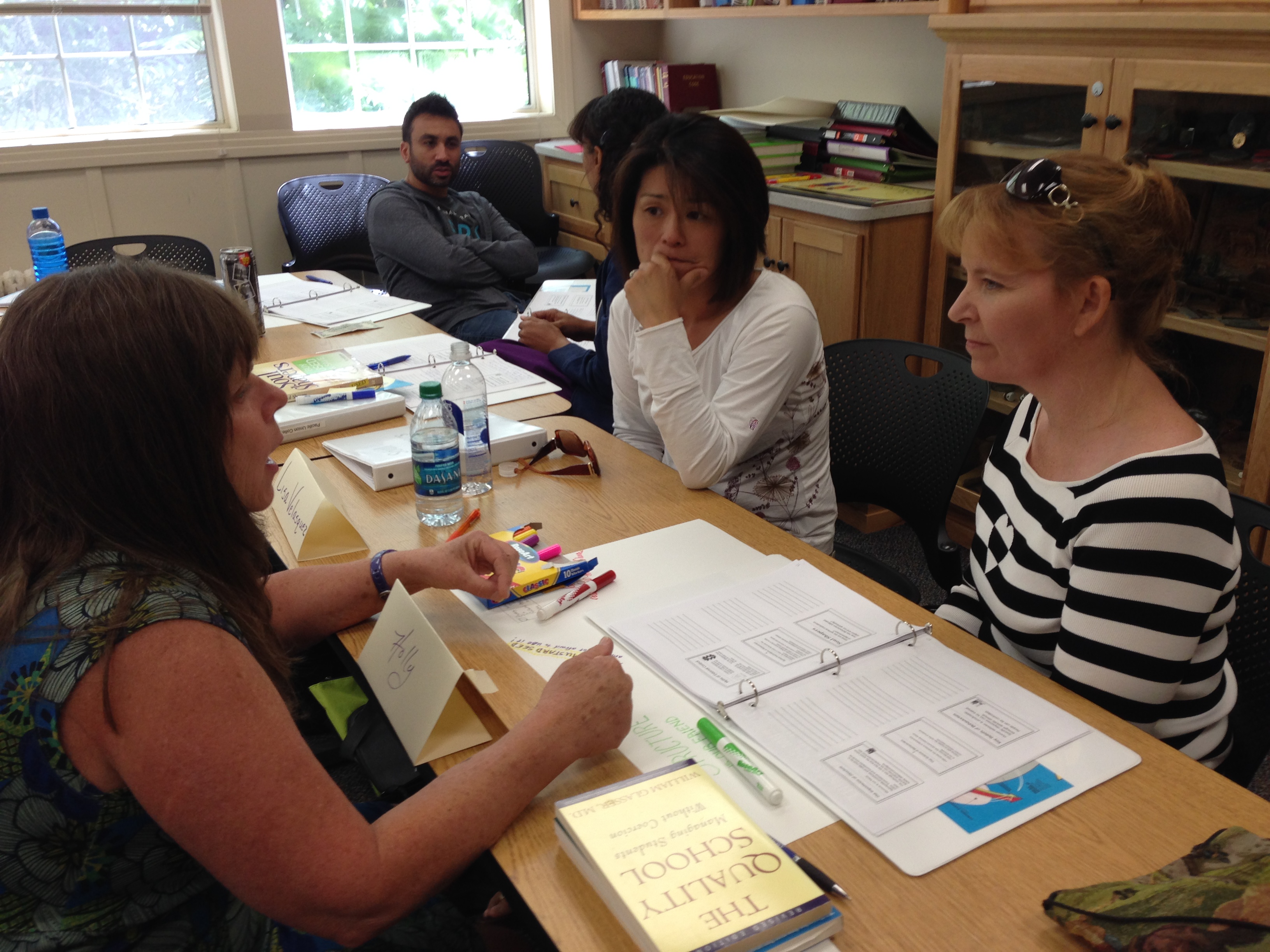
Soul Shapers 1 is off and running! The potential of the empty classroom turns into accomplishment and success as participants plan a skit that depicts how Behaviorism has infiltrated religion. (I should have recorded them. They were right on and hilarious at the same time. ) There is something very special about sharing the concepts of choice theory with people.

At the end of yesterday’s class, participants were asked to write out their ‘take-aways” from the day. Here are a few of the take-aways they shared:

+ The building of relationships is essential for students to do their best.

+ The effect that external control has on us and the actual degree of negativity it leaves on those we use it on.

+ External control reduces the quality of the product.

+ The most important thing is maintaining relationships!

+ “I’m a deadly habit user.”

+ Beware of the subtle ways in which we use stimulus-response strategies.

+ We must have a relationship or connection with our students in order to help or influence them for good.

+ I liked that Choice Theory is relevant to our spiritual life; that God gave us that choice and we need to incorporate choice in our relationships.

+ If there is a relationship, there’s influence.

+ We can manipulate, thinking we are doing a good thing. There’s no such thing as positive manipulation. It could be good influence, but manipulation involves enforcing something on another person without their approval. (I guess.) It made me think.

+ Learn to manage more with redemption.

+ Focus on being more supportive and caring to spark creativity and loving responses.

The Incredible Lemon Cake

A piece of cake from the Social Work consecration reception at PUC yesterday.

A piece of cake from the Social Work consecration reception at PUC yesterday.

A magical cake was served at yesterday’s Social Work reception and during the celebration and visiting I was reminded of the power of choice and how all behavior is purposeful. It is graduation weekend at Pacific Union College and several of the subject-area departments have special ceremonies for their graduates. The Social Work consecration yesterday also included farewell messages to Dr. Monte Butler, longtime faculty member of the department, who has accepted a position at Loma Linda University. So, back to the cake.

I guess it could be described as a lemon cake, but this simple label falls far short of how good this cake really is. It is so moist, and so just-right tart, with cream layers in between the lemon cake layers, that it can only be described as epic, even life-changing. It comes from somewhere in Canada and is shipped frozen to fortunate buyers across the country.

My wife organizes the reception and I was helping her and some students get the cake out on the serving tables. The first person to arrive at the reception area after the consecration service was a woman who came directly to the cake table and picked up one of the plates on which sat a beautiful piece of the magical lemon cake. I was close by and pointed out how her life was about to be changed by a cake that was beyond good. She mentioned how hungry she was, as she was about to bring it to her mouth, but I stopped her. I wanted her to fully appreciate the culinary excellence she was so close to enjoying. She paused, but then bit into the richness. “Wow!” she affirmed, with a faraway look of reflection on her face, taken to that place where only a few all-star food items can go. The she looked at me, though, and asked, “Is this citrus .  .  .?”

I replied, “It’s lemon.”

“Because I’m allergic to citrus,” she continued. “I’ll break out if I eat this.”

I pointed to the chocolate cake that was also on the serving table, thinking that this was a pretty good secondary option under the circumstances. However, she looked at that magical lemon cake again, then at me, then back to the lemon cake, and quietly admitted, “But this is too good. I’m gonna eat this anyway.”

She had exclaimed, “Wow!” just a moment before, and now I was privately thinking “Wow!” to myself as she walked off and continued to eat the incredible lemon cake. A part of me was curious as to how long it would take for the breaking-out process to occur, but I got busy with other reception duties and am unable to report on that.

What I can say is that our brains are wonderfully complex organs that at times defy logic. The human quest to satisfy our basic needs, and the uniquely personal ways we develop to meet those needs, is a powerful process. This lady’s decision to eat the cake, a thoughtful decision as she paused with the cake on her fork, in spite of her body’s negative reaction to it, is an important reminder of our ability to make choices. We each face similar decisions every day. Choice theory doesn’t make us make good decisions, but it does reveal our purposefulness in the decisions we make, which is a good thing, a very helpful thing. Choice theory is also empowering, sometimes frustratingly so, since we can’t blame circumstances, other people, or even an incredible lemon cake, for the choices we make.

This particular lemon cake came pretty close to being blame-able, though.


Cancer and the Tyranny of Positivity


Jeff Tirengel with Bill and Carleen at the International Glasser Conference in New York City, 2006.

Jeff Tirengel with Bill and Carleen at the International Glasser Conference in New York City, 2006.

The response to the video of Jeff Tirengel’s talk regarding his cancer journey, posted in the last blog, has been very positive. The video is almost an hour long, yet some of you were able to watch it right away and let me know how much the talk meant to you. Some of you related to Jeff’s message on a deeply personal level.

Last summer Jeff wrote an article for The Los Angeles Psychologist magazine that I have been thinking about ever since. Choice theory was never mentioned in the article, yet I have come to see it as full of the highest kind of freedom and love that we can give to another person, especially a loved one or friend engaged with cancer. It was titled “Cancer Survival and the Tyranny of Positivity,” two phrases that at first glance would not seen to go together. Check out the following excerpts from the article and reflect on how you relate to the tyranny of positivity. As you do I believe your concept of choice theory will be deepened

Cancer Survival and the Tyranny of Positivity
by Jeff Tirengel, Psy.D., MPH

I was diagnosed and hospitalized with an aggressive form of lymphoma, a type of blood cancer, in December 2009. While still in the hospital I began to hear from family members, friends, and colleagues, including fellow psychologists, that I was the kind of individual who was likely to do well under these circumstances. After all, they said, you are generally a positive and optimistic person, and you have the fighting spirit that characterizes those who are most resilient when dealing with cancer.

Although I fully understood that these messages were intended to be caring and supportive, it was clear to me immediately that they reflected a particular cultural viewpoint, “the triumph of character and attitude over biology” (Coyne and Tennen, 2010, p. 17). As I continued to hear similar sentiments expressed by physicians, nurses, and even other cancer patients, I began to sense the shadow side of these same messages, i.e., they discouraged open communication about the uncertainty, distress, and pessimism that were part of my actual mix of thoughts and feelings. I also wondered whether others might blame me for not being positive enough, or as psychologically resilient as they had believed me to be, if the cancer eluded effective treatment.

Jeff wrote about his career-long commitment to understand why people become ill, how they respond to treatment, and how people stay healthy in the first place, yet he admitted he knew relatively little about studies that had to do with cancer and cancer survival. As a result of his research, he listed a number of articles that addressed positivity and cancer, some pro, some con. The articles agreed that –

. . . there is concern about the seemingly relentless emphasis on mandating optimism, individual happiness, and personal growth no matter the circumstances, and a related concern that the general public may come to believe that one can conquer cancer by thinking positively and that if one is not getting a good response, one is not thinking positively enough, not laughing enough, or not being spiritual enough. Indeed, the explicit blame of people with serious illness for their failure to cure themselves in best-selling popular treatments of positive thinking is shocking and reprehensible (Aspinwall and Tedeschi, 2010, p.10).

Such views help us to see that there can be a kind of tyranny in positivity. Jeff’s conclusion helped me a great deal and taught me something very important about choice theory. He finished with –

My conclusion from my own experience with cancer and the tyranny of positivity is similar to a perspective that I have heard expressed by others, including Ehrenreich, who has herself been an oncology patient: Somewhere between “positive thinking and feeling” and “negative thinking and feeling” there is a space available for “realistic thinking and feeling.” In this “realistic” space, there is room for optimism and pessimism, hope and despair, gratitude and anger, courage and fear, gain and loss, certainty and uncertainty, etc. As I suspected when I was first diagnosed, the most evidence-based practice for supporting family members, friends, and colleagues with cancer is to allow them to express a full range of thoughts and feelings rather than require them, explicitly or implicitly, to be positive, deny their distress, or engage in particular behaviors for which there is no empirical evidence.

In this short article Jeff helped me to understand better that people with cancer, people in distress in general, need the freedom to express a full range of thoughts and feelings, rather than being somehow required to be positive or deny their feelings. Choice theory reminds us to give others this kind of space for realism, yet that doesn’t mean we can’t try to influence a loved one’s or friend’s outlook on the situation. Choice theory also reminds us that how we go about trying to influence is important. The following kinds of questions, for instance, would be important to a choice theorist –

Is my relationship in place with the person I am trying to support?

Have I received “permission” from the person to engage in supporting them?

Am I verbally and non-verbally allowing the person to express a full range of their thoughts and feelings?

Is our relationship staying connected even as we may disagree about the thoughts and feelings being expressed?

There are no easy answers when it comes to being a cancer patient ourselves or when it comes to supporting a loved one or friend who is a cancer patient, however Jeff’s article reminds us of the importance of a human being’s basic need for freedom. Maybe cancer patients are especially sensitive to this need.


Jeff Tirengel, PsyD, MPH is a Professor of Psychology at the California School of Professional Psychology at Alliant International University. He also directs psychological services for the Preventive and Rehabilitative Cardiac Center, Cedars-Sinai Heart Institute. Dr. Tirengel began his career in Washington, DC, serving public and private organizations including the U.S. Office of Disease Prevention and Health Promotion and the National Association of Community Health Centers.

=============

Soul Shapers 1, scheduled for June 16-19, is just around the corner. For more information or to sign up for the class, call Debra Murphy at (707) 965-6642. Those of you who have taken Soul Shapers 1, this is a good time to invite colleagues to consider taking the class. It really helps when there are several teachers from the same school who are on the choice theory journey together.

Soul Shapers 2 is scheduled for June 23-26. Remember that this class can be re-taken as a choice theory re-charger each summer.


Cancer and “How Should I Live My Life Now?”

I don’t know how many of you will take the time to watch Jeff Tirengel’s talk about his life as a cancer patient, but if you do you will be emotionally moved and your thinking about life will be deepened.

I thought about titling this blog post, Cancer and Choice Theory, but this talk can’t be pigeon-holed that neatly.

Pretty much all of us have been affected by cancer, either personally or by its affect on family and friends, and I believe Jeff’s story will be a help to each of us, whatever our involvement with it may be. His calmness, his humor, and his brutal candor all contribute to the power of the talk.

Jeff is a dear friend, so I was naturally drawn to his story. However, as I began to watch and listen it became more than a friend thing. The content is powerful on its own merit.

Jeff believes in the ideas of choice theory, yet there is no pressure in this talk, not even an invitation, for you to believe in choice theory, too. In giving this talk he is doing something much more important than preaching.

Jeff was a personal friend of Glasser and continues to be friends with Carleen Glasser, who was in attendance at the talk. I first met Jeff when we were in the same reality therapy/choice theory certification class in 2003 and we have stayed in touch ever since. He weaves choice theory principles throughout the talk, especially the basic needs.

I mentioned Jeff in a special blog from last year, the one entitled The Rest of the Story, Pt. 2, which was posted on Sept. 5, 2013. Check out this video and you will come to understand why I treasure Jeff. Many of you have loved ones and friends you treasure, too. I have a feeling Jeff’s story will resonate with you as deeply as it did with me.

============

Tirengel-2

Jeff Tirengel, PsyD, MPH is a Professor of Psychology at the California School of Professional Psychology at Alliant International University. He also directs psychological services for the Preventive and Rehabilitative Cardiac Center, Cedars-Sinai Heart Institute. Dr. Tirengel began his career in Washington, DC, serving public and private organizations including the U.S. Office of Disease Prevention and Health Promotion and the National Association of Community Health Centers.

External Standards vs. External Control

Do you want a doctor who “thinks” she has learned enough to do your surgery?

Writing from a coffee shop in Spokane, Washington, this morning. Margaret and I are on our way to Missoula, Montana, to see our son, Jordan, graduate from law school. More on Jordan and law school this weekend.

Tim Mitchell and Jim Weller brought up great questions regarding the process of evaluation and specifically, self-evaluation, and today, Bob Hoglund, senior faculty at William Glasser, Inc., and the chairperson of the Glasser board in the U.S., adds to our understanding in the following article –

External Expectations and Standards vs. External Control
Bob Hoglund, Senior Faculty, WGI

With Dr. Glasser’s emphasis on External Control Psychology vs. Choice Theory®, it seems necessary to distinguish between reasonable external expectations (standards) and external control. Consider the following:

  • Do you want a pilot who self-evaluated that he is able to fly a passenger jet?
  • Do you want a farmer to self-evaluate that his meat is acceptable for consumers?
  • Do you want a manager who NEVER gives you feedback or direction?
  • Do you want an auto company to decide on its own that the problem with the brakes isn’t that bad?
  • Do you want a doctor that “thinks” she’s learned enough to do your surgery?
  • Do you want a dentist that has “decided” he’s ready to do your root canal?
  • The flaw of self-evaluation is… If all you do is self-evaluate, how do you know what you don’t know?

Given the above questions and expected answers, it would seem that there is a place for external standards and evaluations. For example,

  • Teachers provide needed instruction and feedback to their students. Without this, students may not learn properly or may practice incorrect methods.
  • Coaches correct actions to improve skills the players have not yet mastered.
  • Parents provide instruction and limits to teach their children the values and behaviors that they expect.

Many professions require external certifications in order to ensure standards of safety are met; however, unless an individual finds some worth in the external expectations and evaluations, there is little likelihood that he will produce quality work. The key to external evaluation is involving the individual in finding value in expectations and evaluations.

Additionally, it is important for the workers to be taught exactly what is expected of them, prior to any self or external evaluation. Dr. Deming said, “It is not enough to do your best. You must first know what to do and then do your best.” When there are set processes, procedures or policies, rubrics, checklists and other quality tools are helpful to the teaching/learning process and to enhance the quality or self and external evaluations.

When external evaluations are required, there are three factors that increase the likelihood that external evaluation will produce the desired result. External evaluation and information is crucial to our learning and growth. The external evaluation doesn’t “make” us do, think or feel anything. We take the external information and use the “self-evaluation” process to determine if we will use the information we are getting.

The term learner is used from this point forward to represent anyone receiving feedback or evaluation information because successful external evaluation results in learning.

There are three factors that determine the effectiveness of external evaluation?

1. Does it benefit the learner?
a. How will the evaluation be used?
b. Does the learner have a chance to improve the rating/grade or score?

2. Is it wanted / asked for?
a. Does the learner “respect” the source of the evaluation?
b. Does the rating / grade / score mean anything to the learner?

3. Does the evaluation give the learner the information needed to make the necessary improvements?

“Does the evaluation give the learner the information needed to make the necessary improvements” is the crux of the Glasser Quality School Model. Reteach and retest.

Dr. Glasser’s emphasis on self-evaluation and co-verification can coexist with the expectations of external evaluation that are expected in many workplaces and schools. This coexistence can become positive by involving others in the evaluation process.

A suggestion for increasing meaningful methods of external evaluation is to survey the individual(s) who will be evaluated. Questions, such as the following, provide a base from which to build useful, meaningful evaluations.

1. What does your ideal performance review look or sound like?
a. What would you like it to say?
b. What knowledge and skills would be recognized?
c. What accomplishments would be included?

2. In what type of environment do you work best?
a. How do you get along with others?
b. How do you treat others?
c. How do others get along with you?
d. On a scale of 1 to 10, how autonomous would you prefer your job to be?
i. How often do you think you should report your progress?
ii. How would you like to report your progress?

3. What expectations do you have of yourself?
a. What expectations do you think that the company has of you?
b. What expectations seem reasonable to you?
c. What expectations don’t seem reasonable to you?
d. How do you reconcile any differences between the two?

4. What type of evaluation is most helpful for you?
a. When do you want to receive it?
b. How do you want to receive it?

In conclusion, The Three E’s (Hoglund, 2000) provide the framework for optimal benefit:
Environment:
The expectations and evaluations occur within a positive, supportive, trusting learning and working environment.
Expectations:
The expectations, even when external, have benefits for the learner or worker.
Evaluation:
The evaluation is helpful because it meets the above criteria.

=================



Is My Self-Evaluation the Only One That Matters?

self-assessment-1

My friend, Tim, who I respect a lot, questioned the idea that self-evaluation is the only evaluation that really matters. I think there is definitely room for discussion on this point. His comment follows below and my reply follows after that.

The irony–

I read this: “Glasser and Deming agreed that self-evaluation was really the only evaluation that mattered. We have to hold to this principle, pursue it, nurture it, if we are to create learning environments that are need-satisfying.”

While the seniors are filling out their evaluations of me and the various mini-courses in their religion class this year, I don’t think my self-evaluation is the only one that matters!

Even since writing the following reply I continue to think about the need for and process of evaluation. Here’s the response I came up with a couple of days ago, though.

Yes, student feedback is important, but the real question is what is the feedback for?
If it is for you, then how you evaluate or respond to their feedback is the key piece in the process.
Some teachers will have student feedback available, but not even look at it for fear of what it might say.
Other teachers will read the student data and comments, but dismiss them because the students really don’t understand what education is about or what the teacher is trying to accomplish.
Still others will read the comments and resent the students for their candor.
And finally, some teachers will read student comments and truly reflect on what they are saying and how those comments might help them improve their instruction.
Students can say all kinds of things, but what they say matters only in the ways the specific teacher relates to their comments.
In the end, the only evaluation that really matters is self-evaluation, or how I process the feedback from others.
I have a personality that can get positive feedback from nine people and feedback for improvement from one person and it will be that “negative” comment or feedback for improvement that I will obsess on. My self-evaluation is not helpful to me at that point. I would benefit from someone who could help me see things more accurately, both the positive and the areas for growth. I think this is a special area in which superintendents and principals could change the way in which teacher evaluations are done.
Ultimately, it is how I respond to being evaluated that is the important thing.
Presently, I don’t think that most evaluators or evaluatees get this at all.

Still a classic, no matter how many times I see it.

I see that my response might clarify things a bit, but not nearly enough. In the next blog post I will share an article that Bob Hoglund wrote a while back that offers further clarification when it comes to evaluation. He sees an important difference between reasonable external expectations (standards) and external control. For instance –

Do you want a pilot who self-evaluated that he is able to fly a passenger jet?

================

Just a reminder – The Choice Theory Study Group for this weekend has been cancelled.

Identity Theft

Although I am an adult, it feels like I am still trying to figure out who I am. Does that make sense? I’m not sure what I want or what I have to offer. It’s a bit depressing, actually.   Shane N.

Identity theft and the fraud often associated with it affect 15 million Americans a year at a cost approaching 50 billion dollars. It is maddening when a person usurps another person’s identity and then steals his victim’s income or savings. As a result, a lot of effort goes into protecting identities. As important as our financial identity is, though, it shrinks in importance when compared to our personal identity, which is the essence of how we see ourselves. If anything must be nurtured and protected, especially in children, it is this persona we refer to as identity.

identity-theft-bunny-kitten

As adults we forget this nurturing thing, a lot, and often shift towards emphasizing that our children assume a role, rather than helping them identify their identity. Roles are like “job descriptions” that an adult wants a child to fulfill or a mask that an adult wants a child to put on. When roles are forced on young people, rather than their identity being nurtured in freedom, to me, it is a form of identity theft. It is like stealing who a child really is and replacing it with a forgery of someone else’s design.

One of the greatest things my parents did for me was to help me become the person I wanted to be. I never felt pressure to become what they wanted me to be or to make them look good. Now that I am older I realize what an amazing thing that was for parents to do.   Raine W.

It is a great gift when adults support young people in every way possible, yet give them the space to become the best versions of themselves. As adults we may have a picture of what we want our child to become—a doctor, a pastor, a sports hero—or we may have pictures of what they should look like, what their hobby should be, who they will marry, and where they will live. And, once these pictures are in place, we tend to manipulate circumstances in such a way that reality will come to match those pictures. Manipulation is a part of the identity theft process. The gift lies in staying away from it.

id-theft-solutions-2

Choice theory is a big help when it comes to identity formation. It helps adults who are trying to fix themselves later in life; better yet, it helps parents and teachers keep from screwing kids up in the first place. The theory helps because it is based on the idea that the only person I can control is me. Rather than being externally controlled, we are internally guided. This internal guidance system starts to be formed at birth. When parents and teachers understand choice theory they behave in a way that honors the internal guidance systems in children. We come to recognize how ill-advised it is for us to be the guidance system for another person, and how necessary it is for children to develop their internal guidance as soon as possible.

Compass-Integrity

===========


William Glasser: Champion of Choice

is being discounted on Amazon!

Just sayin .  .  .

 IMG_1030

===========

The Choice Theory Study Group scheduled for May 24 has been cancelled. Stay tuned for next school year’s calendar.

===========

Those just joining The Better Plan check out the 2013 – Year At  a Glance link in the upper left hand corner of the page to easily discover articles from last year.

You’re Adding PURPOSE on Purpose?

The two most important days in your life are the day you are born and the day you realize your purpose.   Mark Twain

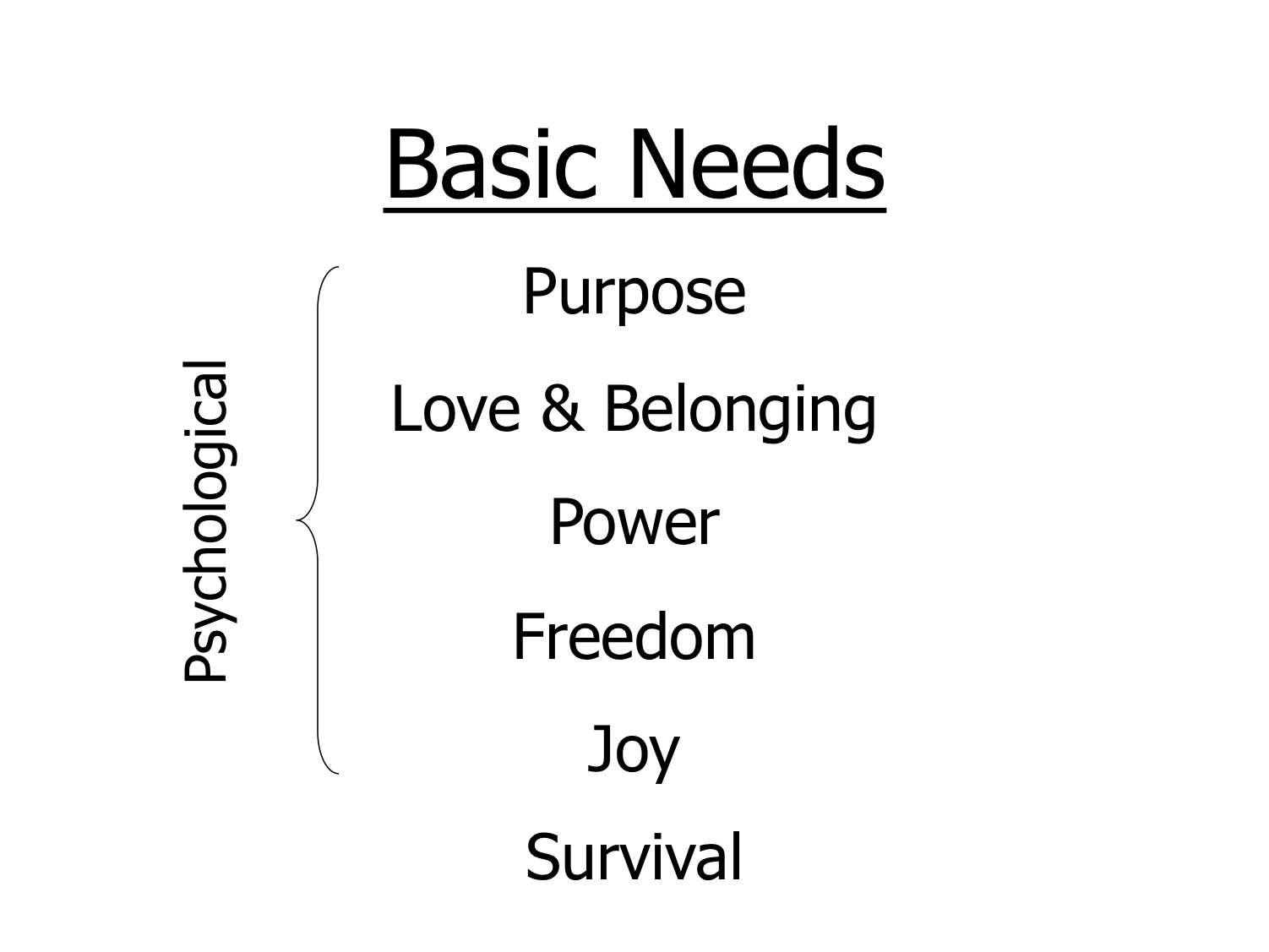
Some of you noticed that I have added Purpose as an additional need to the five Glasser identified. It is true, and I not only added it, I put it at the top of the list. I did not do this flippantly. Instead, my suggesting this new addition represents a very personal process involving a great deal of reflection.

Correct Basic Needs

The thing that started this personal process was my wondering where my spirituality fit into the Basic Needs. And by spirituality I mean something much deeper than religion or church orientation. My spirituality has to do with Who I really am and What are my deepest beliefs and What is the meaning of life (it’s beginning and it’s end) and ultimately, What is my purpose in the grand scheme of things?

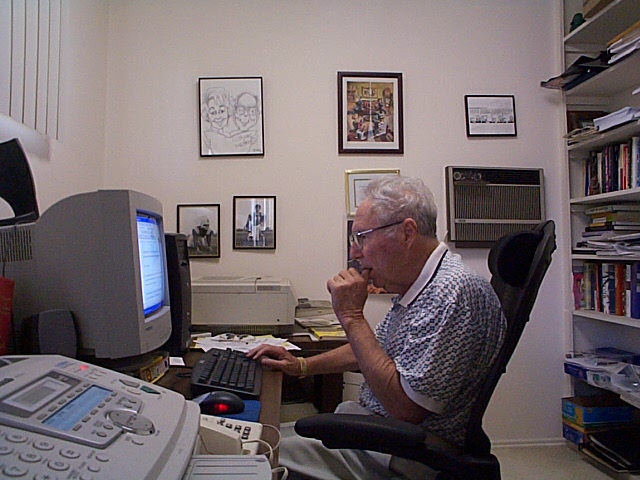
William Glasser at work in his home office. (2004) Jim Roy photo.

William Glasser at work in his home office. (2004) Jim Roy photo.

I tried to talk Glasser into endorsing this additional need, but he wouldn’t buy it. (When I first talked with him about it I referred to it as an Existential need, thinking he would be more comfortable with a “secular” wording.) I think he didn’t endorse the Purpose need for two reasons. The first reason had to do with not wanting to mess with the five needs he had emphasized for so long. Even though he had suggested the probability of their being more than five needs in his earlier writing (Control Theory, p. 16), he had settled into a firmness with his five. The second reason, I think, had to do with his seeing religion and spirituality as the same thing. He saw religious participation as a Quality World value or activity, and as such it didn’t qualify as a Basic Need. On top of this, in general, he didn’t view religion as a positive force throughout earth’s history. Without his endorsement I put my thoughts on this on a back burner and worked on other things. Even on a back burner, though, for me, the Purpose need wouldn’t go away.

I am convinced we are driven to understand our personal purpose and to make meaning of our lives, and that meeting this need is essential for the other needs to be fully met.

For a need to qualify as a Basic Need it would have to be needed, at least to a small degree, by all human beings. I believe the Purpose need meets this criteria as every human being has a deep need for personal meaning and the idea of coming into a sense of self. The self-help quest (books, seminars, videos, etc.) is an industry bringing in 2.5 billion dollars a year, so there are a lot of us seeking this thing called meaning.

I see college students that struggle because their life purpose is not clear to themselves. Their other needs are being met – they have friends and social connections, they are free to come and go, and they have some fun in their lives – but not having their identity and purpose clarified hampers their success. In fact, a lack of purpose can derail a college student’s academic success.

0613_superman_630x420

I am suggesting that the need for Purpose and Meaning is a universal need that people seek to meet in all kinds of ways. For many their involvement in a religion contributes to filling this need; others who are spiritual, although not into a religion, find meaning in their journeys as well. And even non-spiritual, non-religious people have their own ways of finding purpose and meaning. For instance, it is interesting how movies that depict superheroes, science fiction stories based on “a long, long time ago, in a faraway galaxy” themes, and end-of-the-world scenarios are so popular. It is like we have an innate curiosity about where we fit into the past, present, and future. It is like we have a consciousness void inside of us that can only be filled as our need for Purpose and Meaning are satisfied.

We are always monitoring the extent to which our Basic Needs are being met, something I do quite a bit when it comes to my own need for Purpose and Meaning. Maybe some of you can relate to that.

Every person has a purpose. Never give up.   Manual DeVie

==============

For those of you just getting started with following The Better Plan blog, a great way to catch up is to go the link toward the upper left hand corner labeled 2013 – Year At A Glance. Each of last year’s posts are in chronological order and just a click away from accessing.


The Stowaway

A 15 year old boy is loaded into an ambulance at the Maui airport.

A 15 year old boy is loaded into an ambulance at the Maui airport.

The remarkable story earlier this week of the young stowaway aboard a Hawaiian Airlines jet underscores the significance and power of the basic psychological needs. The wheel-well passenger, a fifteen year old boy from Somalia, climbed a security fence at the San Jose Airport, hoisted himself into a wheel-well of the closest parked jet, waited for seven hours as the plane readied for departure, tucked himself into the tiniest of spaces when the wheels lifted back into the fuselage, and then endured a five hour flight that included altitudes of over 36,000 feet and temperatures that approached 60 degrees below zero. After arriving in Maui, Hawaii,  an airport camera filmed legs dangling from the plane’s wheel well, which is almost 10 feet off of the pavement, and then witnessed the boy jump to the tarmac.

hawaiianairlinesAP

In the days following the young man’s miraculous flight across the Pacific there has been much written about the implications of his stunt on airport security and about the science of surviving in a sustained environment with so little oxygen and such bitterly cold temperatures. Fewer people, though, are talking about, what for me is, the more important question – that being – What would lead a teenage boy to seriously break the law (climbing over the perimeter fence of an international airport) and then risk his life flying in the wheel well of a passenger jet? Why did he do it?

dnews-files-2014-04-how-did-hawaii-stowaway-survive-in-jets-wheel-well-670x440-jpg

Understanding choice theory and the concept of the basic needs, along with a few more details about our young traveler, will help us answer the important Why question. The young man immigrated from Somalia four years ago. He lived in the San Diego area for awhile, but more recently relocated to the San Jose area. He struggled in school, as he had not attended school at all before coming to the U.S., especially in Math and Science, and he apparently did not get along with his father and stepmother that well, as an argument between him and them was one of the reasons he climbed over that security fence at 1:00 am in the morning. He missed Somalia and his grandparents, who lived there. And he wanted to visit with his mother, who he had not seen since he was two years old.

 Correct Basic Needs

As you listen to the details of this harrowing misadventure, a picture of the basic needs* of this teenage boy begin to emerge.

His need for love and belonging exerted a strong urge on him. He yearned to be with relatives that he felt loved him and cared about him, especially his mother, who he was separated from at a very young age. He did not feel, apparently, a strong sense of belonging here and he was motivated to find the human connection he needed.

His need for power was also unmet and also urged him to make a change. He didn’t know English very well and he wasn’t very successful in school. The feedback he may have gotten from his father and stepmother may have contributed to his lack of worth and accomplishment.

So powerful were these unmet psychological needs that it led him to risk his physical safety and overrule his basic need for survival.

That he did survive made for a compelling news story this week, and gives us a human drama from which to consider choice theory. We just need to remember that, while their stories may not make news headlines, we may be surrounded by young people struggling to meet their basic needs. Somehow we need the x-ray emotional vision that my friend, Tom Amato, talks about, that ability to see a situation through another person’s eyes.

Most people, upon hearing that a teenage boy climbed into the wheel well of a passenger jet and rode across the Pacific Ocean, would proclaim that the kid is nuts, a psych job. But when you consider the details through a choice theory lens you begin to see that his behavior was rational, thought out, risky, yes, and even ill planned, but his choice takes on meaning.

May we see the potential stowaway in our own children, and in our students, and focus on creating a need-satisfying environment that will prevent such stunts. May our children and students especially know that they are loved.

=========

Those of you in the PUC area, we are having a Choice Theory Study Group this Sabbath afternoon, April 26, at 3:00 pm. Please note the later 3:00 pm start time.

* I have added the need for purpose as one of the basic psychological needs. Glasser didn’t feel that it was a basic need, but he didn’t get worked up that I felt it was.

The Simon Cowell In Each of Us

$T2eC16h,!)EE9s2uiwPRBR)O6o2dG!~~60_35

At their core the 7 Deadly Habits are built on the foundation of judging others. Think about it.

The 7 Deadly Habits are –

1. Criticizing
2. Blaming
3. Complaining
4. Nagging
5. Threatening
6. Punishing
7. Rewarding to manipulate

Each of these habits involves the spirit of judgment. Criticizing, blaming, complaining, and nagging serve as tools for one person to apply behavioral pressure on a family member or colleague. Threatening and punishing take the spirit of judgment to a more intense level. And even rewarding to manipulate, which feels better than punishment, is still a form of manipulation.

This year's American Idol judges - Harry Connick, Jr., Jennifer Lopez, and Keith Urban.

This year’s American Idol judges – Harry Connick, Jr., Jennifer Lopez, and Keith Urban.

We marinate in a judging society, with TV shows like American Idol, Dancing with the Stars, Survivor, The Bachelor, America’s Next Top Model, The Voice, and Top Chef thriving and calling for our attention. Immersed in a society of judgment it shouldn’t be a surprise that we view others, even our family and friends, in this same way. And in this same way we begin to develop a little “Simon Cowell” in our brains, an overconfident, opinionated, supposedly “all knowing” presence that knows what’s best.

The choice theory axiom that Glasser put at the top of the list is –

The only person you can control is yourself.

This axiom, or principle as I would call it, really does speak to this issue. It’s not about judging and controlling others. It’s about knowing and directing ourselves. When we honor this axiom we become happier and our relationships become stronger and more intimate.

School Application

I think it can be said that –

Without intervention students will judge others.

Schools can make a significant positive social impact by minimizing, or even eliminating, activities that rely on students being ranked and compared to one another. Resist the temptation to turn activities into contests in which students are pitted against each other. We don’t need to determine the “best” essay or who is the “best” speller. Instead, our goal should be to design activities in which all of the students are drawn to participate in and engaged in the learning.

Even our recess games and rainy day indoor games can contribute to this spirit of inclusion. For instance, consider the following version of musical chairs.

In the normal version of musical chairs there are always fewer chairs than participants and the goal is to be quicker, stronger, and more aggressive than your playmates and get one of those remaining chairs. There is often a sneaky piano player or musical device to add to the drama, but the basic premise is you better get one of those chairs, even at the expense of someone else who has the same goal. The result is that very quickly most of the players are standing against the wall watching while the few remaining players push, pull, tackle, and attack their way to victory.

musical-chairs

In a cooperative version of musical chairs you still have the sneaky music (ya gotta have the music) and you still remove chairs as the game goes along. The difference is that you don’t remove players. This means that as the game goes on you have the same number of players having to sit, stand, and be suspended from fewer and fewer chairs. It gets pretty hilarious when 10 players have to somehow get situated on two chairs.

The message we send to children in the normal version is that in life there will always be fewer prizes than participants and that you better be quicker and more aggressive in getting your needs met, even if it keeps someone else from meeting theirs.

In the cooperative version children are introduced to the idea that we are in this thing called life together, and that if we hold on to one another and help each other we can all make it. There may be fewer chairs in life, but that doesn’t mean we can’t share what’s left.

=============

The Glasser biography can be had through the following link –

The Glasser Book Store
http://wglasserbooks.com/books.html

Zeig, Tucker & Thiesen Publishing
http://www.zeigtucker.com/product/william-glasser-champion-of-choice/

Amazon
http://www.amazon.com/William-Glasser-Champion-Jim-Roy/dp/193444247X/ref=sr_1_1?s=books&ie=UTF8&qid=1398205174&sr=1-1&keywords=william+glasser+champion+of+choice