How to Spot a Controlling Person (Even If It’s You)

I recently read a blog post by Donald Miller, the best-selling author of books like Blue Like Jazz (2003), Searching for God Knows What (2004), and A Million Miles in a Thousand Years (2009), and really want to share it with you. You can follow his blog at storylineblog.com. The list at the end of the post is especially insightful.

How to Spot A Controlling Person

by 


I don’t like it when people try to control me (especially indirectly through manipulation) and I would have sworn I didn’t do a thing to try to control others. But it turns out that isn’t true. For all I know, I might even be manipulating you right now. Raise your hand if you think I’m trying to control you. (I see that hand. Now put it down. Now scratch your nose.)

I realized I was a controlling person not long ago when a therapist caught me in the act. I was wondering out loud why a friend was doing what she was doing and the thearpist questioned why I was trying to get inside somebody else’s head.

“What does it matter why people do what they do? Are you trying to predict behavior to gain a sense of security?”

It was a terrific observation.

Trying to figure out why people are doing what they are doing is a preface to trying to control or influence them indirectly. If I really wanted to know why they were doing what they were doing, I could just ask. But I didn’t want to ask because it was none of my business. They had a right to think and do as they wished.

Photo Credit: Leo Hidalgo, Creative Commons

Photo Credit: Leo Hidalgo, Creative Commons

Turns out controlling tendencies can hide anywhere. And most of the time (if not all the time) we don’t know we’re doing it.

The therapist went on to explain how relationships should work.

She put three large couch pillows on the floor and stood on one of the outside cushions. She then had me stand on the other outside cushion so there was an empty cushion between us.

“This is my pillow” she said, “and that is yours. This is my life and that is yours. The pillow in the middle represents our relationship. So, my responsibility is all about the pillow I’m standing on and yours is about yours. Together, we are responsible for the relationship. But at no point should I be stepping on your pillow.”

What she meant by that was this:

I can’t change anybody. I can’t force them or guilt them or shame them into doing anything. All I can do is stay on my pillow and ask myself whether or not I like the relationship. If I don’t, I can tell the other person what I want in a relationship and see if they want the same thing.

If not, I move on, and so do they.

In marriage, of course, it’s much harder. You can’t just walk away. But in business relationships and friendships, and even in dating, the model works quite well.

I found the metaphor freeing, actually.

No more wishing people would change or explaining “if they only did it this way we would be better friends.” Instead, I just say “this relationship doesn’t work” and there’s nothing I can do about it. If I’ve explained what I want in a relationship but the other person isn’t on board, no harm no foul.

It’s difficult in some relationships, I know, because sometimes you have to watch people destroy their lives, but that’s just the point.

Their lives are theirs to destroy.

I found the principle to be true in business, too.

When somebody tries to sell a little too hard, they are on my pillow so I back off or set better boundaries. It’s also a great way to find and enter into relationships with clients. If they want what you’re selling, great, and if not, that’s also great.

Business relationships work better when they’re natural and not forced and everybody stays on their pillow.

And in my spiritual life it’s the same.

If somebody is giving me a guilt trip, they’re on my pillow. I believe much of evangelicalism is influenced by leaders who don’t realize they are standing all over their congregation’s pillows. Some leaders feel incredibly insecure unless they are managing the lives of everybody around them.

Make no mistake, this isn’t strength, it’s incredible weakness. Just tell the truth, explain the consequences, and let people make their own decisions.

Here are a few ways to know whether you might be a controlling person:

1. You imagine a life in which somebody else was different, and indirectly try to affect their change.
2. You get angry when things aren’t going your way and you let people know it.
3. You can only be surrounded by people who are submissive to you.
4. You give the silent treatment to people you are angry with.
5. You are often tempted to show somebody the errors they don’t see in themselves.

What ways do you tend to step on other people’s pillows? Do you shame people (I’m guilty of that) or give them the silent treatment? How do you try to influence others without being direct or when their lives are none of your business?


How To Parent Like An FBI Agent

I don’t make this stuff up. One of the sidebar titles in the recent edition of Time magazine (January 25, 2016) read How to Parent Like an FBI Agent. “Some spycraft techniques also work for parenting,” says a former FBI special agent in his new book, The Like Switch: An Ex-FBI Agent’s Guide to Influencing, Attracting, and Winning People Over.

IMG_0310

The sidebar listed four main techniques –

1
Create the illusion of control
FBI agents de-escalate drama by letting subjects call some shots.
Offer kids a list of options, all of which you already like.

2
Use the scarcity principle
FBI profiling shows that people like things they can’t get much of.
Parents should factor that in when banning an activity or a friend.

3
Ask indirect questions
Kids (and perps) hate being interrogated.
Instead, try queries like “My friend’s son was drinking. What should his parents do?”

4
Hang in there
The more time you spend with a person, the more influence you have on each other.
Yes, even on teenagers.

IMG_0311

Parenting might be the most challenging of all human endeavors, and remarkably we don’t have to receive any training or pass any performance assessments to become one. As a result, parents are usually pretty desperate for tips and ideas on how to parent better, even when the advice is from law enforcement agencies. (Maybe especially when the tips are from law enforcement.) So what are we to make of these four FBI recommendations? What follows are thoughts through the lens of choice theory.

Create the illusion of control
Choice theory is about truly empowering others. Parents and teachers must share power in age-appropriate ways that leads children to ultimately become able self-managers. There are no illusion strategies in choice theory, no tricky ways to exert control, even as you are acting otherwise. Kids seem to possess excellent “manipulation detectors” and will sooner-rather-than-later sense when they are being coerced into certain behaviors.

“Creating the illusion of control” underscores one of the challenges for teachers. It is no easy thing to shift from wanting to control kids to wanting to coach them into controlling themselves. Choice theory offers understanding and a skill set to help with this shift, but old habits do not die easily.

Oh, my goodness! What can I say? When we talked about this in the Soul Shaper class I didn’t really think it applied to me. I recognized how external control I had been up to that point and I was fully convinced of the value of choice theory and the need for me to make a change – both at home and in the classroom. But thinking this way within the confines of the Soul Shaper classroom and applying it a couple of months later in my own classroom are two different things. I just didn’t appreciate how steeped I was in my need to control! During the Soul Shaper class, Jim Roy would talk about teachers taking the internal control ideas of choice theory and then using them in externally controlling ways in their classroom. We all laughed at the irony of that possibility, never thinking for a second that we were capable of that. Now I know different. I am capable of it, in fact, very capable of it. I started seeing the ways in which I shared the least amount of control possible. In other words, I gave out just enough for the kids to maybe think I was giving them a choice, when I was keeping all of the real keys to power. One thing I have learned during this process is that choice theory really gets to the heart of who I am and what makes me tick.   Sophie T.

Choice theory is not about illusion; it is about authenticity and honesty. It isn’t about fake power; it is about really empowering others.

Use the scarcity principle
Instead of saying “use the scarcity principle,” a choice theory parent or teacher would say “be aware of the scarcity principle.” I agree that withholding something or taking something away from a person tends to increase the desire for that very thing. This is one of the drawbacks of traditional punishment strategies that are based on the removal of privileges, and if that doesn’t work “we’ll just remove more privileges.” Trying to control a person through punishment almost always backfires. Choice theory reminds us, whenever possible, to replace things that have been taken away with viable alternatives. Without new things or alternatives to take the old behavior’s place, it is much more difficult to introduce and maintain the new replacement behavior.

When my kid basically left home at 19 I was shocked. I thought things were pretty good between us. What I didn’t realize was how accommodating he was as a child. I was controlling and even angry, but for years he did what I told him to do. When he got old enough to do what he wanted to do, he kind of flipped me off and left. It killed me, but I couldn’t really blame him. It was my way or the highway and he took the highway.   Carl M.

Ask indirect questions
Questions are good, especially artful questions that help a child or student to self-evaluate and then form a new behavior plan. As I have said before, it is better to get something out of someone’s mouth than it is to put it into their ear. The key lies in the spirit of our questioning. Are our questions more accusation than inquiry; more interrogation than problem-solving? Are we listening to correct and censure or are we listening to understand? Indirect questions are by nature less confrontational and seem to invite discussion rather than argument.

Hang in there
When I saw the phrase “hang in there” I was reminded of the Reality Therapy principle of Never Give Up. This principle, though, has more to do with than simply spending time together, as the FBI approach seems to indicate. Our ability to influence is more about the quality of our connection with our child or student than about the amount of time we spend together. When asked how long “never give up” means, Glasser wrote that “each of us must define ‘never’ for ourselves, but a good basic rule of thumb is to hang in there longer than the student thinks you will.” I don’t know if this is the best explanation for never give up. For me, it means just what it says. As long as another person is willing to keep trying, to consider a new plan, I think I would want to keep trying, too.

==================

The words kids and perps appearing in the same sentence should alert us to a possible conflict, although a good sentence might be – The better we treat kids, the fewer perps there will be.


Can Children Really Handle Choice Theory?

IMG_2007

The following question was posted in response to The Ship Is Turning, the recent post from Jan. 10. What ideas or insights can you share with Anonymous?

My brother is a social worker who started in education at Lincoln High School. He is now in charge of taking this program to other schools in the district. When talking to him over Christmas, he expressed frustration in dealing with the younger students – 5th and below – that aren’t really self-aware yet. I have expressed this frustration to him before, but it fell on deaf ears until he experienced it himself. We concluded that while we might not be able to get them be self-aware and see the choices they are making, we are planting those seeds and giving them tools and strategies and a mental framework that they can build upon as they become self-aware. I’ve found that some of my 5th graders really struggle to reflect and think about themselves and their choices and actions – in my opinion it is because they are developmentally not “there” yet. Do you have suggestions or resources in helping the younger students in this process? I start with relationship, and continue with relationship, but are there other ways to help the students to think through their thinking and their choices?

===========================

Dear Anonymous,

You have asked a great question, an important question. How soon can children understand the concepts of choice theory and how can adults – both at home and at school – help them understand and practice these concepts?

Glasser used to say that there is nothing about choice theory that a six year old cannot understand. For the last five years I have been closely observing my two grandchildren, now ages 2 and 5, and I can say that I agree with him on this point. I have watched as one of them has an emotional meltdown over a perceived slight or problem – maybe the French toast was pre-cut, rather than allowing them to try and cut it, or maybe the syrup was poured for them, rather than them being allowed to pour it, or something else of a similarly serious nature – and then been impressed as my daughter or my wife patiently teaches them to put their frustration into words. Rather than responding to their seeming unreasonableness with anger or disgust – “Stop crying or I’ll give you something to cry about” – their feelings were acknowledged and they were coached toward stating what they wanted. They were beginning to learn the Caring Habit step of negotiating.

If a fifth-grader is struggling with the process of reflecting and making a good choice, I don’t think it is because he is developmentally “not there yet.” I think it has more to do with not having been given a chance to learn and practice the skill sets of self-evaluation, communicating, and being responsible for his own behavior. So what about these skill sets and how can we pass them on?

What You Think Matters
My daughter, who I think is an incredible parent, even though she disagrees (what does she know?), at one time described to me how she wants to come across to her boys – whether they were babies, toddlers, or young children – in a way that conveys her openness to being influenced by them. In other words, she wants them to know that she can learn from them, that she is open to what they think and what they believe. Wow! I thought. Imagine the implications of this way of being on the life of a young child.

Transparently Live Internal Control
There are few things as powerful as living by example. Along these lines, Ellen White wrote that “We must be what we want our students to become.” And more than just silently living the principles of choice theory, we need to explain how we are working through a challenge or what we are thinking as we self-evaluate. When it comes to reading and critical thinking skills, there is a teaching technique called Think Aloud. A teacher doing a Think Aloud will read from a text or reading selection, but will stop and comment on hard to understand passages or evasive vocabulary and literally show students how they process as they read. We assume that students know how to be thoughtful readers, but this often isn’t the case at all. Along the same lines, children will benefit greatly as we Think Aloud about the ideas of choice theory.

Class members demonstrate how puppets can be used to help students learn about choice theory and process their behavioral choices. (From the summer class at PUC, 2014)

Class members demonstrate how puppets can be used to help young children learn about choice theory and process their behavioral choices. (From the summer class at PUC, 2014)

Invite and Nurture Self-Evaluation
Children are used to being told what to do, others planning for them, and others grading them on their performance. Someone decided what they will learn and how they will learn it. We shouldn’t be too surprised if children seem to balk at the idea of responsibility and reflecting on the course of action to take. We have sought to control children, often with the idea of doing what is best for them and protecting them, but it leaves them with no practice at self-evaluating their situation and deciding where to go from there. I think children can be very fast learners when it comes to self-evaluation if we give them chances to do so. Even toddlers can be asked what they think the best solution is. In the school setting, a scoring rubric is an excellent tool to promote self-evaluation. Along with listing the assignment criteria and benchmarks for levels of performance, think about adding to two columns for feedback scores – one for the student to self-evaluate and one for the teacher to make an evaluation as well. When students turn in assignments we need to get in the habit of having them express what they did well or describe how they worked through a difficulty. Invite them to self-evaluate. Get them in the habit of thinking about their own work.

Eliminate Rewards and Punishment
Lastly (for now), create a management plan that is based on prevention, rather than cure; and on problem-solving, rather than punishment. Boundaries and expectations need to be clear, and specific procedures for classroom operation need to be taught and rehearsed. As I have emphasized before, structure is our friend as choice theorists, not an enemy. Children need structure. They just need it to be redemptive and restorative. When misbehavior occurs in the classroom there is no better time to show children how self-evaluation and problem-solving work. Wean students off of being controlled and manipulated by others, to being controlled and governed by themselves.

====================

We have covered some of these topics in past blogs. I will list some of them below for your convenience. Click on the links for quick access.

Influence vs. Control

Lead Management and Car Washing

Gentle Parenting

IMG_1020

Sticking It In Their Ear

25 Ways to Ask Your Kids “How Was School Today?”

2014-08-29-25ways-890x395_c

=====================

An important resource is Carleen Glasser’s primary grade workbook on the Quality World, which is an easy and fun way to teach young children about choice theory.

IMG_0880

You can order the Quality World Workbook from the Glasser Inc. bookstore by clicking on the workbook above.

====================

Anonymous would love to hear your ideas on how to share choice theory with children. Actually, I would like to hear your ideas, too.


The Ship Is Turning

Connection - Brene Brown

Large ships, like oil supertankers, are not very nimble. Their size (1,200′ and longer) and their weight (some carrying almost two million gallons of crude oil) and their speed (over 20 knots) combine to create momentum that requires serious planning ahead when it comes to stops and turns.  Stopping a loaded supertanker can take five miles or more (even with the gears in full reverse) and turning requires a radius of five to ten miles.

1646820-former-shell-oil-chief-engineer-supertankers-could-save-the-gulf-so-why-wont-bp-listen-rotator

The education system can be compared to a supertanker in that it seems to take so long for meaningful change to take place. Based on several recent articles, though, it appears the supertanker of education is turning! Of special interest, these significant changes are directly tied to the principles of choice theory.

An article (May, 2015) in Phi Delta Kappan – Relationships: The Fundamental R in Education – is an example of a recurring theme in educational journals for several years now. “Adolescents need to feel cared for,” the article opened, “if they are to succeed in school.” More than warm fuzziness, caring relationships are based on tangible action. Important for young children, certainly, however more and more it is being recognized just how important caring, supportive relationships are for teenagers. The article emphasized points many of us could rattle off without even reading it: 1) establishing a safe, academically-focused culture, 2) helping each student to see their own role as a classroom stakeholder, 3) teaching students how to effectively communicate, both in what and how they say things, as well as the importance of listening, 4) fostering friendships between students, 5) inspiring students to embrace respect and to express respect to one another, and 6) encouraging and expecting responsibility.

Use personal pronouns. “I care enough about you to be involved, to be your friend.” Spend a few seconds throughout the day reinforcing involvement.  William Glasser (1974)

These are the kinds of ideas and behaviors that Dr. Glasser emphasized throughout his life. He started off talking about the need for involvement between therapist and client or between teacher and student. For him, involvement was about a warm, caring regard that therapist or teacher would have toward the client or the child with whom they worked. This caring connection, for him, was vital to success. Only as students felt connected to their teachers and to their fellow students could they thrive in a classroom setting.

IMG_0286

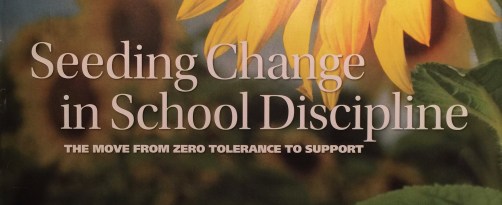
It got my attention even more when I saw some of the headlines in the most recent edition of American Educator. On the cover it proclaimed, “Seeding Change in School Discipline: The Move from Zero Tolerance to Support,” while the first article’s headline read, “From Reaction to Prevention: Turning the Page on School Discipline.” The opening paragraphs describe this change well –

We stand today in the middle of an important debate on the role, function, and practice of school discipline. There can be no question that any approach we implement should strive to create a school climate that is safe, orderly, and civil, and that teaches our children basic values of respect and cooperation. The key question revolves around the best way to accomplish that goal.
For some 20 years, numerous policymakers responded to concerns about school safety and disruption with a “get tough” philosophy relying upon zero-tolerance policies and frequent out-of-school suspensions and expulsions. But research has overwhelmingly shown that such approaches are ineffective and increase the risk for negative social and academic outcomes, especially for children from historically disadvantaged groups. In response to these findings, educational leaders and professional associations have led a shift toward alternative models and practices in school discipline. District, state, and federal policymakers have pressed for more constructive alternatives that foster a productive and healthy instructional climate without depriving large numbers of students the opportunity to learn.

IMG_0285

I have written about this before, but it needs to be said again. When Glasser was working at the Ventura School for Girls (a prison school) he learned from the girls that rather than their troubled homes being the cause of their path to getting into trouble and eventually into prison, they explained that it was getting into trouble at school, and then being suspended or expelled that put them onto the streets and ultimately into prison.

IMG_0289

“From Reaction to Prevention” – written over 50 years later – strongly confirms that suspension and expulsion are “in themselves risk factors for negative long term outcomes,” which affect not only the student but also society as a whole. To put this in clearer terms –

The Council of State Governments’ report Breaking Schools’ Rules: A Statewide Study of How School Discipline Relates to Students’ Success and Juvenile Justice Involvement found that suspension and expulsion for a discretionary school violation, such as a dress code violation or disrupting class, nearly tripled a student’s likelihood of involvement with the juvenile justice system within the subsequent year.

A get tough approach based on external control rewards and punishments wasn’t the answer 50 years ago and it isn’t the answer today. The article states that three keys are needed toward the creation of effective discipline alternatives: 1) relationship building, 2) social-emotional learning, and 3) structural interventions. Choice theorists can readily embrace relationship building and social-emotional learning, as these are the essence of what choice theory is about. Choice theory, in fact, has much to offer in these two areas. The third key, structural interventions, is not so easily embraced. By structural interventions the article is talking about management models based on a humane, choice-oriented format.

IMG_0293

Glasser’s Ten Step Approach to School Discipline            (circa 1974)

Glasser began to be uncomfortable with school discipline models in 1990 and completely rejected them in 1996, citing his belief that by their very nature discipline models focused on changing the kid, rather than on changing the system that led to the misbehavior in the first place. Additionally, he cited that he didn’t like things that were “cooky-booky.” He even rejected his own 10-Step Plan, though it didn’t contain even a shred of external control. I agree with Glasser’s concerns, as I have witnessed first hand how hard it is for teachers to really shift from external control, with its rewards and punishments, to internal control, with its focus on all individual behavior being purposeful. In spite of this agreement, though, I think it may be time to re-look at what choice theory has to offer when it comes to classroom management.

Choice theory, while present in some school districts, is not a major player on a national scale when it comes to school leadership and classroom management. It should be. In its absence, other models – like Positive Behavioral Intervention & Supports (PBIS) and The Responsive Classroom – are more than happy to fill the void. Teachers need the theory of choice theory, but they also need the key steps in the application of the theory. A model, framework, or structure is needed for those just beginning the journey. There is a danger in adopting a structure, as it can be misunderstood and misapplied, but it seems like there is also a danger in not having one, that being the danger of becoming irrelevant.

Regardless, though, the ship is turning! We can celebrate that school systems are more ready than ever for change when it comes to classroom management. Educators and researchers agree that get-tough approaches based on reward/punishment don’t work. With schools in desperate need of classroom management alternatives, what can choice theory offer them? Certainly a wonderful theory and compelling ideas. A framework? A model? Hmm . . .

==============================

Brene’ Brown and William Glasser are right – we are hardwired to connect with others. Management plans that don’t acknowledge and embrace this truth cannot succeed.

IMG_0294

===============================

Don’t become too preoccupied with what is happening around you.
Pay more attention to what is going on within you.
Mary Frances Winters

A Quick Take on 2015

Choice Theory (and Reality Therapy, the counseling approach based on its principles) isn’t that keen about focusing on the past. The past is .  .  .  well .  .  . past, and we can’t go back and live it again. We can focus on the present moment, though, and our plan for the future. In spite of Choice Theory’s emphasis on the now and on the future, I thought I would take a brief moment and share some data from The Better Plan blog site. Here are some overall numbers for 2015 –

IMG_0103

2015 marked the third full year that The Better Plan has been in existence. The blog began in December, 2012, and has been sharing ideas related to Choice Theory ever since. The blog continues to grow, albeit slowly. The site had more visitors in 2015 and also had increased views. A view takes place whenever someone links to any of the articles on the blog.

While the number of Visitors and Views increased in 2015, the number of Likes and Comments went down. The number of Likes was almost the same as last year, but the number of Comments is significantly lower. Regarding the comments I am not sure what that represents. Several of you are regular “commenters,” which I appreciate a lot. I try to respond to each of the comments, as it is a good way for us to stay in touch. When you comment remember to check the small box that says you want to be alerted when someone responds. There have been some rich discussions on the blog posts and I would like to see these increase even more.

Regarding the Likes, it would be very helpful to the blog if more of you clicked on the Like button at the end of each post. The following picture shows what the end of a blog post looks like.

Screenshot 2016-01-02 10.42.06

Notice the box with the blue star and the word Like. Clicking on this can ultimately alert other readers and bloggers to the concepts of Choice Theory, so it is an easy way to help the Choice Theory community grow. As I understand it, to be able to Like a blog post you need to be registered on WordPress, the blogging site that runs The Better Plan blog, but registering is very simple. Create a user name and password and it is done. I think a lot of you are liking the blog posts, however you may not understand how to Like a post. WordPress has a huge Internet presence (I have heard that WordPress accounts for up to 20% of all daily Internet use) and Likes will alert others to a post’s importance.

==============

In the order of their level of popularity the top Better Plan posts for 2015 were –

global20diversity

How To Make Schools Better for Kids, Sept. 2, 2015 (click on the title to quickly access the article)

Time magazine suggested practical strategies for school improvement, including 1) ditch traditional homework, 2) make recess mandatory, 3) screen kids for mental illness, 4) prioritize diversity, 5) turn discipline into dialogue, 6) let students customize their curriculums, 7) start classes at 8:30 am, and 8) design cafeterias that encourage healthy eating.

happiness

GREAT DREAM – Acronym for Happiness  Mar. 9, 2014

One of the most popular articles for 2015 was the GREAT DREAM post from 2014. It must have sticking power.

Glasser writing at home. (Photo by Jim Roy)

Glasser writing at home. (Photo by Jim Roy)

Unpublished Glasser Article on Pain   Jan. 21, 2015

Probably written in 2004, yet never published, it is good to hear Glasser’s voice again in this short, but important article.

The picture that came to represent the devastation of Middletown during the first night of the fire.

The picture that came to represent the devastation of Middletown during the first night of the fire.

The Valley Fire and Fitting Your Life Into a Car   Sept. 15, 2015

This was such a terrible and tragic event that came very close to our small community in 2015. Many of you were interested in this article and many of you responded with comments of empathy and support.

Blaming Might Be Funny If It Wasn’t So Darned Destructive   Mar. 12, 2015

I was glad that this post was one of the popular ones for 2015, as I think it represented some good writing, even though it was based on a truly mortifying event in my personal life. The post also included a great video clip from Brene Brown, the shame researcher.

I think all the posts were great, but the five listed above had the most views during the past year.

==============

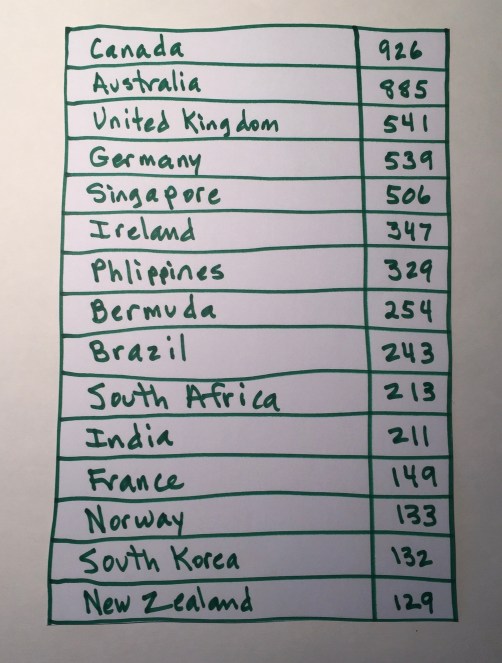
Most of the people accessing The Better Plan blog were from the U.S. (almost 16,000 views), but people from 129 other countries around the world accessed the blog, too. The following list identifies the top countries, other than the U.S., and the number of views during the past year.

IMG_0104

It is amazing how something like The Better Plan blog can reach so many with choice theory and hopefully connect us to each other in the process. That is the goal!

Enough already regarding the data, right? The Better Plan will keep on keeping on during 2016. I am glad you are a part of it. I have a request of you, though. Could you help The Better Plan get more Followers in 2016. We closed 2015 with 383 people following the blog, which is up from 300 the year before. We can do better, though, and it can be as simple as inviting another person to look at a post or to join the blog. If you are a teacher you might consider letting your colleagues and student parents know about the blog. If you are a principal or superintendent you can share the blog link with your teachers. Increasing the number of people following the blog will help the word get out regarding the value of Choice Theory. Just invite them to go to –

http://thebetterplan.org

Follow The Better Plan on Twitter as well –

images

@thebetterplan

This Is Your Life

New-Year-Eve-2016

The two days labeled as December 31 and January 1 are two of the biggest choice theory days of the year! We make a big deal out of these two days – one day representing a reflective farewell, the other representing a determined new beginning. There can be other important days in our calendar year, unexpected challenges that call on our choice theory prowess, but these two days roll around every year. And every year they seem to invite us to take a look back, to take stock of ourselves, to self-evaluate, and then to make a plan and set a course toward goals we see as important.

A song called This Is Your Life seems to capture the most important element of this reflection and self-evaluation. The lyrics acknowledge yesterday – the new wrinkle on our forehead and the way in which we may have let others down – but they emphasize that today is really all we have. “This is your life” the lyrics remind, and then just as powerfully ask, “Are you who you want to be?”

Our minds may be thinking about a lot of different things – how to eat better, exercise more, love others more fully, be less selfish, reach out to others more, do something for yourself once in a while, do better at arriving at appointments on time, talk with your mother without getting upset, watch less TV, to name a few. We can get so caught up in these “symptom” behaviors that we lose sight of the bigger picture. All these smaller behaviors revolve around the big question, “Am I who I want to be?”

One thing choice theory points out is that it is possible, in fact, likely, that we will have conflicting pictures in our Quality World. The Quality World represents the area in our brains where we store pictures of any person or any thing that satisfies a Basic Need. There is nothing that says we can’t place things in our Quality World that satisfy a need, yet aren’t good for us. I can have a picture in my Quality World of not eating high fat, high sugar food, and I can have a picture of cake in there, too. (Maybe the incredible lemon cake I described in the June 14, 2014 blog post.) Both of these pictures are need-satisfying in some way. I like the idea of eating healthy food, and I like the idea of eating unhealthy food.

A piece of cake from the Social Work consecration reception at PUC yesterday.

The apostle Paul seemed to really capture the angst of conflicting pictures in his letter to the Romans when he wrote that –

I want to do what is right, but I can’t.
I want to do what is good, but I don’t.
I don’t want to do what is wrong, but I do it anyway. Romans 7:18, 19

A lot of us can relate to this angst.

switchfoot

Choice Theory agrees with Switchfoot, the band who wrote This Is Your Life, in that today is indeed all we have. Fuming about the past or worrying about the future will not empower us to answer the important question, Are you who you want to be? With this in mind, here are a few things to keep in mind as we let go of 2015 and plan for 2016.

Admit It
It’s good to admit that for some reason ineffective behavior is need-satisfying. Ineffective behaviors are often (maybe always) self-medicating. Healthy or unhealthy we do these behaviors for a reason.

Make a Plan
Make a plan that is realistic and reachable. Overnight, complete makeovers don’t qualify as realistic or reachable. A good starting point might be just selecting a time during the day when you can center, balance, and focus on the important. Call it meditation, call it devotional time, call it whatever, but set a private time for centering and strengthening.

change-old-street-sign-bigst

Replace Ineffective Pictures
Instantly eradicating a need-satisfying behavior, even one that is destructive, is hard to do. It is more doable when we come up with a new or different behavior to take its place. This takes some creativity, but it is worth the time.

Small Steps Are Fine
Taking small, consistent steps toward a goal is a good way to make significant change. Huge, immediate victories are great, but such a mindset can lead to huge defeats, too.

Don’t Let Slip-Ups Derail You
Don’t let slip-ups and mistakes keep you from re-evaluating and re-engaging in the plan. Slip-ups are common and are to be expected. You will sleep in instead of going to the gym; you will criticize a loved one; you will eat the lemon cake. Instead of guilting yourself and throwing out the plan because of your mistake, celebrate that it didn’t feel right when you behaved the way you did – whether it was overeating or vegging out in front of the television – and get back on track with a new plan.

Never give up
Never give up on yourself and never give up on the important people in your life. Every day of the year can be a December 31 when it comes to self-evaluation and change.

never-give-up-7-638


For those who may be interested, here are the lyrics for This Is Your Life:

Yesterday is a wrinkle on your forehead
Yesterday is a promise that you’ve broken
Don’t close your eyes, don’t close your eyes
This is your life and today is all you’ve got now
Yeah, and today is all you’ll ever have
Don’t close your eyes
This is your life, are you who you want to be?
This is your life, is it everything you dreamed that it would be?
When the world was younger and you had everything to lose
Yesterday is a kid in the corner
Yesterday is dead and over
This is your life, are you who you want to be?
This is your life, is it everything you dreamed that it would be?
When the world was younger and you had everything to lose
Don’t close your eyes
This is your life are you who you want to be?
This is your life, are you who you want to be?
This is your life, is it everything you dreamed it would be
When the world was younger and you had everything to lose
And you had everything to lose

========================

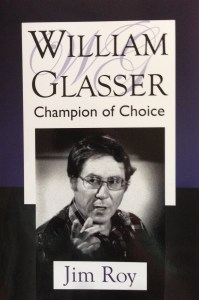
If you have read the Glasser biography, Champion of Choice, I encourage you to post a brief review on Amazon. More reviews will encourage others to check out Glasser’s ideas.

The book that connects the dots of William Glasser's ideas and his career.

The book that connects the dots of William Glasser’s ideas and his career.

Wisdom from Christmas’s Past

s-l225

The holidays are uniquely wonderful, in that they are (to name a few) a reminder of that which is most important in life, they bring loved ones and families together, there is a lot of giving going on, and the music and decorations are cool. (Well, most of the music and decorations.) The holidays are uniquely challenging, too, in that they remind us (to also name a few) how far we have drifted from that which is most important in life, they bring families together, in spite of the anger and pain directed at each other during the past year, there is a lot of taking going on, and the music and decorations are .  .  . well .  .  . cheesy. Over the last several years, The Better Plan blog has addressed the holidays through the lens of choice theory. The links to these posts are included below. May they be a help during this wonderful time of the year!


new-years-resolutions-204044-530-569_large


New Year Resolutions were covered in –

I’m Makin a Change, Dagnabit! Pt. 1

Dagnabit! Pt. 2


star-of-bethlehem


Keeping our eyes on the Reason for the Season was covered in –

Choice Theory and Christmas


The S actually stands for Self-Control.

The S actually stands for Self-Control.


The challenges that so many face during the holidays, and how choice theory can help, was covered in –

The Holidays Require All of Our Choice Theory Superpowers


cv13


Here’s a heads up on a link worthy of your attention. Dr. David Hanscom, the spine surgeon who writes so effectively about the Mind Body Connection, shares his thoughts on, what for many is, the pain of the holidays –

Happy Holidays – Not

Choice theory certainly affirms the importance of the mind body connection. We are, as the Bible says, “fearfully and wonderfully made.” How the mind affects the body, and vice versa, continues to be studied, even as answers remain elusive. For me, it is clear that our ability to make choices when it comes to our thoughts and our behavior is a key to our living in balance. Life is difficult, and there is no way around it. For some, the holidays distract us from the difficulty, while for others they do just the opposite. In either case, choice theory can help. Check out the links above. Keep putting one foot in front of the other. Seek gratitude. Reach out to others.

==============

The Glasser biography, Champion of Choice, is a good read. Really. The book traces the development of Reality Therapy and its connection to Control Theory, as well as control theory ultimately becoming Choice Theory. A unique self-help book!

The book that connects the dots of William Glasser's ideas and his career.

The book that connects the dots of William Glasser’s ideas and his career.


Before the Seminar Even Began

“How do you think I can make my wife do what I want her to do?” He said it louder than he needed to, but he wanted to get the attention of the man on the other side of the registration table.

“I don’t know. How do you get her to do what you want her to do?” The man behind the table replied.

“No, I’m asking, how can I make my wife, and my kids for that matter, do what I want them to do? That is what this seminar is about, isn’t it?”

LEAVE-695x361

The man behind the table looked at the questioner for a moment, studied him actually, and finally replied, “Well, the seminar is about having a better marriage . . .”

“Exactly,” the questioner interrupted. “That’s why I’m here. I want a better marriage.”

“How did you find out about the seminar?” the table man asked.

“A friend told me about it, said I should check it out. I had been complaining to him about my wife and kids and he said this seminar might help. So here I am.”

“That’s interesting,” the table man replied.

“How so? What’s interesting?”

“Well, the seminar is about having a better marriage and a better home; it’s really about having better relationships, in general.” No interruptions this time, so the man behind the table continued. “This seminar is about freedom and power and joy . . .”

smiling-face-to-face-300x200

“I like the sound of power,” the questioner again interrupted. “That’s why I’m here, like I said.”

“Power can be a very good thing . . .”

“Exactly,” the questioner affirmed.

“ . . . although this power, the power we’re learning about this evening, is about the power we have within us to not be controlled by our negative thoughts and feelings . . .”

“Excuse me,” the questioner questioned.

“It’s about being free to be who we really want to be, rather than being controlled by circumstances.”

“So what are you saying? You’re not going to show me some tricks to make my wife do what I want her to do?” The questioner’s concern was evident.

“The trick lies in being the best version of yourself, while supporting your wife as she becomes the best version of herself.” Their eyes locked, the man behind the table could see the questioner thinking this through.

Eyes still locked, “Can I get my money back?” The questioner thought he had heard enough.

images-6

The countenance of the man behind the table changed and his tone changed as well, “Look, sir, I’ve had enough! No, you may not have your money back. Now get yourself into the meeting room and find a seat on the front row!” With anger and disgust he moved toward the questioner and handed him a packet of materials. “Go on, get moving!”

The questioner was taken back, for just a moment on his heels and retreating, yet he quickly recovered, his face becoming set in his own anger and defiance. The two of them now were only feet apart, both obviously frustrated and angry, the packet being held out by one of them, the other refusing to reach out and receive it. Their eyes again locked, the silence between them spoke volumes.

The table man let the moment continue, the anger palpable, the silence screaming, and then suddenly he changed. His face relaxed and a slight smile appeared. “I want you to remember this moment,” he said calmly to the questioner. “I want you to remember how you feel right now.”

The questioner was trying to process what was happening to him. His mind and body, which quickly had gone into an angry, defensive mode, now slowly began to relax. Yet he wasn’t sure he wanted to relax, wasn’t sure it was safe to relax. “What are you talking about?” he replied with a touch of disgust in his voice.

“I just tried to make you do what I wanted you to do. How did that work . . . do you think?

The questioner thought about this, a light ever so slowly dawning somewhere in his mind.

“Deep inside you, in the depths of your soul, you want to be close, really close, to your wife, and you want your kids to want you and to want what you can offer them. You just experienced how a person thinks and feels when force and power are used on them.” The man behind the table quit talking as he saw the questioner’s eyes become filled with liquid sadness.

0bd6b3d20ffb7bf72d3f9b1106d62801-2


“You’re right,” the questioner responded as he wiped his eyes. “I do want to be close to my wife. She is a special person. And I do want to be close to my children. I love them so much.” Again, his eyes filled.

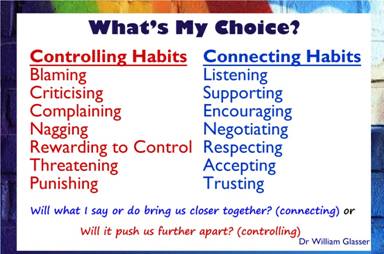
“Look, we don’t need to go through the whole seminar before it even starts. But I’ll just share a few of the key ideas we’ll be learning about. One of the things you will learn is that the only person you can control is you. That idea alone has pretty incredible implications. We’ll learn about habits that bring us closer to the ones we love and on the other hand, habits that hurt our relationships with others. And another thing we will learn, and this will be of special interest to you, is that as long as we are connected we have influence. That’s why our connection to our children is so important.”

The questioner was listening now, bringing it all in.

“A few moments ago,” the table man continued, “when I tried to make you do something, the connection between us was definitely hurt, on the verge of being broken.”

The questioner nodded in agreement.

“I wanted you to attend the seminar, but you wanted the exact opposite.”

“I was outta here,” the questioner agreed. “I was getting angrier by the second.”

“So that’s the point. The seminar is about how ineffective it is to try and make people do what we want them to do. It hurts our relationship in the process and we usually don’t get what we really want.” The table man thought for a moment. “The fact is that if you want your money back, and not attend the seminar, well, you can make that choice. You have that option. But I just want you to know how much I want you to be a part of it. I think you will benefit, however it strikes me that the rest of us would benefit from your being here as well.”

The questioner now smiled just a bit himself and reached out and took the packet of materials. “It looks like there is still front row seats available,” he said as he looked toward the almost empty meeting room.

=======================

Glasser’s biography, Champion of Choice, can be a great holiday gift. Amazon is a quick way to get copies. Let me know if you want a signed copy of the book.

The book that connects the dots of William Glasser's ideas and his career.

The book that connects the dots of William Glasser’s ideas and his career.

No Sense of Agency

atlantic

The cover of this month’s (Dec 2105) Atlantic is compelling. Set against a blank white background a teenager stands, his head down, one hand up covering his eyes. Next to him the headline The Silicon Valley Suicides, along with the gut-wrenching subtitle Why are so many kids killing themselves in Palo Alto?

The article explores the impact that student deaths have on local high schools and middle schools, as well as the nightmare that families and communities must work through when a child makes this final decision. While it was difficult to ask Why? in the midst of such indescribable loss, parents, classmates, and community members did comment on possible factors. A re-occurring theme has to do with pressure students feel to succeed. This pressure can begin at home through the high and very specific expectations of parents and then is applied and intensified at school both academically (the push for honors classes and grades) and non-academically (though non-curricular activities like sports, music, drama, leadership positions, internships, etc.).

1447942767197

The amount of work that teenagers are attempting to accomplish, both inside and outside of the classroom, is simply overwhelming. Lack of sleep and anxiety are constant companions of kids trying to live like this. The situation is made more complex since students themselves outwardly seem in agreement with their lifestyles. They often express a desire to do better, to be more organized, to study harder, and to accomplish more. Who are we, as adults, to get in the way of their goals?

It may be, though, that we do need to get in the way of their goals. We must not forget, for instance, that students are trying to succeed within a system that those preceding them have created. They can’t be blamed for wanting to get over a bar that adults have set for them.

doing-school-1-196x300

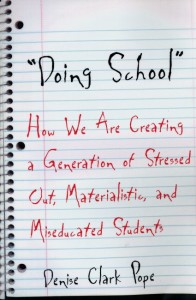
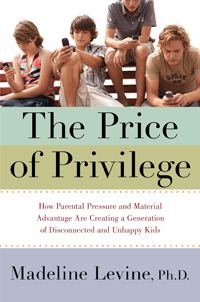
I was first alerted to this problem through the work of Tom Amato, director of the Napa Valley Youth Advocacy Center, and his connection to Denise Clark Pope, author of Doing School: How We Are Creating a Generation of Stressed-Out, Materialistic, and Miseducated Students (2003). Pope, a professor at Stanford, described students who were caught up in the chase for success, a chase that had almost nothing to do with actual learning and everything to do with looking good and getting into an elite university. Amato also introduced me to Madeline Levine, a child psychologist from the Bay Area, and her book, The Price of Privilege (2006), which described how kids awash in wealth can be so alone and feel so misunderstood.

TPoPcover

Levine was quoted in the recent Atlantic and I think the point she makes is crucial. Of Levine the article shares that –

What disturbs her the most is that the teenagers she sees no longer rebel. A decade ago, she used to referee family fights in her office, where the teens would tell their parents, “This is bad for me! I’m not doing this.” Now, she reports, the teenagers have no sense of agency. They still complain bitterly about all the same things, but they feel they have no choice.

The phrase no sense of agency originally struck me because of its creativity, but as I thought about its meaning it began to strike me because of its awful implications. I became filled with sadness as I thought about teenagers with an identity and sense of purpose crafted and forced on them by their parents or the school system. I came to realize that no sense of agency is another way of saying giving up. As much as we may have goals for our students, I am confident none of us intentionally wants to direct them in such a way that they give up. This isn’t about us forcing students to adopt our pictures of success or even about doing what’s good for them. It’s about the Caring Habits of listening, supporting, and accepting, and staying in a connected relationship with students no matter what.

your-choices

It was hard reading the article and hearing parents of a child who committed suicide wonder aloud about how they could have missed the signs. I have no easy answer for that. Based on the ideas of choice theory, though, I can offer the following –

+ Stay connected. Positive relationships are everything. As Glasser would say, “As long as you’re connected you have influence.” This is why the Caring Habits are so important.

+ Seek to help children and students form their own identity and create their own life purpose. It is all too easy for us to attempt to meet our own need for Power and Success through the success of our children. This agenda is unfair to the life journey of our child or student. And it is unhealthy for us.

+ Stop being enamored by the elusive chase for the top, especially when the end in itself seems to be an elite university and a high-paying job. School shouldn’t be a competition, but instead should involve the engaging, joyful pursuit of learning, real learning.

================

Without faultfinding, Glasser would have had much to say after reading The Silicon Valley Suicides. Find out why in his biography, Champion of Choice.

The book that connects the dots of William Glasser's ideas and his career.

The book that connects the dots of William Glasser’s ideas and his career.

Joy for Thanks

There’s something very healthy about being thankful.

Fortunately, being thankful isn’t something that hits us once in a while; instead it is a state of mind that we choose and that we nurture. The effects of thankfulness are profound, as our minds are happier and our bodies have more energy.

Thankfulness-featured-wide

Thankfulness as a state of mind is a powerful example of Choice Theory in action. Total Behavior – one of the key elements of Choice Theory – describes how our behavior is made up of four parts – 1) the thinking part, 2) the acting part, 3) the feeling part, and 4) the body or physiology part. It further describes how two of these parts – our thinking and our acting – are under our direct control, while the other two parts – our feelings and our physiology- are under our indirect control. In other words, when it comes to our thoughts, we decide the patterns and topics on which we will dwell. This does not mean that we won’t have thoughts of sadness, resentment, fear, or anger. It just means that instead of allowing these negative thought patterns to settle in and take up residence in our heads, that we will choose to think differently, to maybe identify reasons for which to be thankful, and to focus on the people and things that are need-satisfying in our lives.

I tried what you talked about in class, the idea that we can choose to be grateful, instead of marinating in the sad and angry stuff. It was mostly dark when I first woke up this morning. I laid in bed and kind of got my bearings, thinking about the day ahead, thinking about my life, in general. I started thinking the usual thoughts, the my-day-is-going-to-suck stuff, which then led to my relationship with my wife sucks, my relationship with my kids sucks, my job is driving me crazy, my spiritual life is dead-end, etc. You get the point. The thing is, maybe because of our discussion in class, I actually became aware of my thinking and took a kind of inventory of it. I actually thought a little prayer to myself that went like, “Jesus, I am thinking crappy thoughts right now, thoughts that I think are a distortion of my life. I ask for your help in recognizing the good in my life.” I then chose to reject the crap and think about the blessings – my relationship with my wife is better than I give it credit for; my kids are amazing human beings that I treasure; my job can be hard, but I have a job; the day did look challenging, but I realized that solutions would come and I would survive. My outlook shifted, my spirit, perilously close to becoming sour, became more optimistic instead. I guess I just wanted you to know that what we talked about in class works. At least it worked for me.   Gabe

6a00d83451cc5c69e2019b00bb31bf970b-550wi

It is amazing that we have this kind of thought power! As much as anything else this power demonstrates the truth about Choice Theory, a truth that is also pointed out in Scripture and the Spirit of Prophecy. The book Education (1903), a classic, states that –

It is within the power of everyone to choose the topics that shall occupy the thoughts and shape the character.     p. 127

And in his letter to the Philippians, the apostle Paul describes how –

I have learned to be content with whatever I have. I know how to live on almost nothing or with everything. I have learned the secret of living in every situation, whether it is with a full stomach or empty, with plenty or little. For I can do everything through Christ, who gives me strength. Phil. 4:11-13

“Learning to be content” is such a great phrase! It seems to capture an element of the Choice Theory journey. To me, it reveals the process of learning to make particular choices, like the kind of choices Gabe made in the dim light of dawn as he laid in bed at the start of the day.

10229-ea_joy_thrives thankfulness soil design - Copy.png

I recently read something pretty powerful in its own right, an insight from the November 24 entry of the Jesus Calling book. The author, Sarah Young, imagining Jesus talking to us, writes –

Thankfulness takes the sting out of adversity. That is why I have instructed you to give thanks for everything. There is an element of mystery in this transaction: You give Me thanks (regardless of your feelings), and I give you Joy (regardless of your circumstances).

Whether we choose to be thankful as an act of faith or not, such a choice will 100% of the time improve our lives. There are few things in life with 100% guarantees, but this is one of them.

On this day of Thanksgiving 2015 may we choose to think about the people and things in our lives for which we can be grateful.

Happy Thankfulness Day!!

====================

A recent article from Tiny Buddha: Simple Wisdom for Complex Lives highlighted 9 Things Grateful People Believe. Those nine things are –

1 – Everyone has something to teach or offer me.

2 – There’s something valuable in every challenge.

3 – Even if I don’t have what I want, I’m fortunate to have what I need.

4 – The “little things” are the big things.

5 – I don’t have to have it all or do it all to be happy.

6 – Everyone’s blessings are different, and that’s okay.

7 – Things can – and will – change.

8 – It could always be worse.

9 – Life itself is a gift.

====================

The Glasser biography – Champion of Choice – can be a great holiday gift! Get copies through Amazon and through the Glasser bookstore. Get signed copies from me at jimroyglasserbio@gmail.com.

The book that connects the dots of William Glasser's ideas and his career.

The book that connects the dots of William Glasser’s ideas and his career.