Posts by Jim Roy

There Was This Teacher

image1

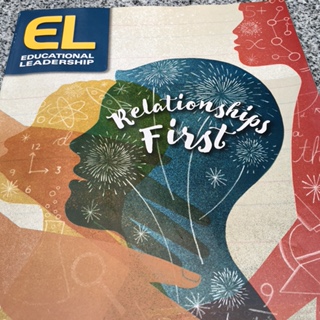
The current cover of Educational Leadership, the journal for the Association for Supervision and Curriculum Development, headlines just two words – Relationships First. I love it that thousands of teachers across the U.S. and beyond are being reminded of this essential learning element. There is no getting around it, no shortcuts to it, and no technology that replaces it. When it comes to learning, relationships matter.

Care is in the eyes of the receiver; care doesn’t exist unless those being cared for truly experience it.   Elizabeth Bondy

IMG_0465

Glasser emphasized the importance of 3 Rs when it comes to kids learning in schools – Relationships, Relevance, and Relf-Evaluation. (Ok, it was really two Rs and an S, but it isn’t as catchy as 3 Rs.) From the outset of his career and his work at the Ventura School for Girls, basically a prison school, he recognized the absolute importance of positive connection. This connection is especially needed with any of the students we work with who have struggled with school, who have been traumatized in their past, or who are English Language Learners. One of the keys to Reality Therapy’s success, Glasser’s approach to counseling, was his emphasis on what he called involvement between patient and therapist. By involvement he meant a warm, caring connection. In 1965, when he introduced Reality Therapy to the world, this therapeutic emphasis on connection was fairly unique. The point here, though, is that whether in the classroom or the therapist’s office a positive relationship is vital.

The most urgent questions students ask as they begin a new school year are Am I safe? and Do I belong?   Rick Wormeli

I began attending workshops in cooperative learning from David and Roger Johnson almost 30 years ago, yet I still remember some of their key points like it was yesterday. They explained that there are three important relationships in every classroom – 1) the relationship between the students and the material, 2) the relationship between the students and the teacher, and 3) the relationship between the students themselves. Not to devalue the importance of the other two, especially the relationship between students and teacher, but the Johnson’s felt the most important relationship that exists in any classroom is the relationship between the students. This stuck with me and during my years as teacher, principal, and superintendent, I came to agree with them. Students enter a classroom unsure about how they will fit in and unsure about how they will be treated by others. Until they experience a classroom environment where they feel safe, learning takes a backseat. Threats and sanctions regarding lower grades or trips to the vice-principals office only contributes to their performance being worse.

If you find yourself frustrated with a student, try to find something that you genuinely like and respect about that student and repeat it to yourself.   Lisa Medoff

Rick Wormeli, who contributed the lead article, What to Do in Week 1?, in the recent Educational Leadership, shared something that Rabbi Harold Kushner said during a 1998 interview –

Often I will read about someone from the most unpromising circumstances – inner city ghetto, drug family, single-parent home, abandoned by father, abandoned by both parents sometimes – and the child will have grown up to be a star athlete, a successful politician, or a doctor. The reporter will ask, “How did you get to be who you are?” And the answer will always begin with the same four words: “There was this teacher.”

It’s true. Whether it’s about our relationship with students as teachers or their relationship as students with each other, relationships matter. And rather than relationships being touchy-feely fluff, they directly impact learning.

I realized very early in my career that to successfully and thoughtfully teach my students, I needed to imagine life through their eyes.   Cherish Skinker

In Choice Theory Speak, as teachers we want students to place us in their Quality World and we want them to place our subject matter and our classroom in their Quality World, as well. We can’t inject ourselves into their Quality World. We can only behave in a way that invites students to place us there. We can only create classrooms that students come to value. Coercion has no place within this dynamic.

=====================

As I write this it is early in the morning in Cicero, Indiana, where I am giving a two-day in-service on choice theory to the staff at Indiana Academy. They had already read Soul Shapers: A Better Plan for Parents and Educators, so I am now joining them in their journey toward a non-coercive life and a non-coercive classroom. Yesterday we focused on Glasser’s Big Four – the Basic Needs, the Quality World, Creativity, and Total Behavior. Today we’ll focus on application of the ideas here at the academy.

image2-1

The Indiana Academy campus is well kept with sprawling lawns leading to classic brick buildings. It feels peaceful here.

image1-2

The school is located north of Indianapolis and is the academic home for 129 students.

image3

A quiet hallway at the end of the day. So busy between classes. So empty now.

Stop and Turn Around

On the heels of Genius or Toxic? and the note a working mother placed on the refrigerator comes a sign taped to the front door of a school.

Sign on the front door at a Catholic high school for boys in Little Rock, Arkansas.

Sign on the front door at a Catholic high school for boys in Little Rock, Arkansas.

Genius or Toxic: Part II

“If you are a parent,” the Washington Post article begins, “racing to deliver your son’s forgotten Algebra assignment to Catholic High School for Boys in Little Rock, Arkansas, principal Steve Straessle has a little advice: stop and turn around.

The article goes on to describe how the school prohibits parents from delivering forgotten lunches or assignments for their sons, an expectation the school needs to remind parents off at the beginning of each new school year.

The school’s Facebook page posted a picture of the sign and within days the post had been shared nearly 120,000 times, as well as received 3,700 comments from parents “debating whether it was ethical, fair, or wise to punish teens when their memories fail.”

For its part, the school just wants to teach students to be independent and self-reliant. Straessle explained that they want the boys to think “beyond the default switch of relying on their parents when they need help. We just want a boy to figure out what comes next when mom or dad are not there to guide them. We’ve been amazed that a school teaching self-reliance and personal responsibility seems like a novel idea.”

The school’s strategy has proven controversial and polarizing online. One comment stated that “children don’t learn well on an empty stomach . . . so this is stupid.” Another comment called the strategy “child abuse.” The principal explained that if a lunch is forgotten the student can get an IOU from the cafeteria or borrow money from a friend. He admitted, though, that late assignments can earn less points. Many commenters felt the strategy was very appropriate and that students would learn responsibility as they faced natural consequences.

So what do we think of this school’s “stop and turn around” policy? Genius or toxic? This one seems a bit easier to call than the refrigerator note. This strategy can be genius as long as the school maintains a compassionate spirit in the policy’s implementation. The school seems to really want to help the boys to learn to be responsible, not necessarily to simply focus on catching the boys’ mistakes and teaching them a lesson. They provided for solutions in case the boys forgot something at home, although the solution was never quite as good as if they remembered the stuff in the first place.

What do you think?

==============================

A mother taped this note to the refrigerator for her children.

A mother taped this note to the refrigerator for her children.

The refrigerator note featured in the last blog really generated interest. The responses were very insightful and contributed to a great online discussion involving choice theorists around the world. I could say more about the refrigerator note, but several people with a lot of experience and expertise in choice theory shared their insights in their responses to the blog post. I encourage you to read their letters.

=============================

The view from the mens' bathroom, if you can believe that.

The view from the mens’ bathroom, if you can believe that.

My stay in Japan has been so positive and such a learning experience! As I write I am looking out across Lake Biwako in the Shiga Prefecture. Beautiful white clouds are slowly floating across the sky; sailboats dot the water; and beautiful buildings meet the shore for as far as the eye can see. The Choice Theory Conference, sponsored by the William Glasser Institute – Japan, is over, yet the memories of new friends are strong and clear in my mind. More on my Japan experience soon.

Genius or Toxic?

A mother taped this note to the refrigerator for her children.

A mother taped this note to the refrigerator for her children.

Genius or Toxic?

So what do you think, fellow choice theorists? Many external control motivators are obvious, easily analyzed, and quickly labeled as hurtful or destructive. What about this note, though? Is it genius or are there elements of being toxic in the approach? The mother adds a “proof of life” element that you see in movies about kidnappings, and she tries to make it feel more lighthearted with “Thank you for playing.”

If we see genius, are we overlooking something manipulative that always come back to haunt or hurt relationships, and if we see toxic, are we making too big a deal out of a parent having fun with incentivizing the chore of cleaning the kitchen?

Genius and Toxic?

Maybe it isn’t either/or; maybe it’s both genius and toxic. Help me with this one; what do you think?

==========================

This is where I will be landing in Japan - Kansai International Airport - an incredible airfield built in the middle of a bay on landfill.

This is where I will be landing in Japan – Kansai International Airport – an incredible airfield built in the middle of a bay on landfill.

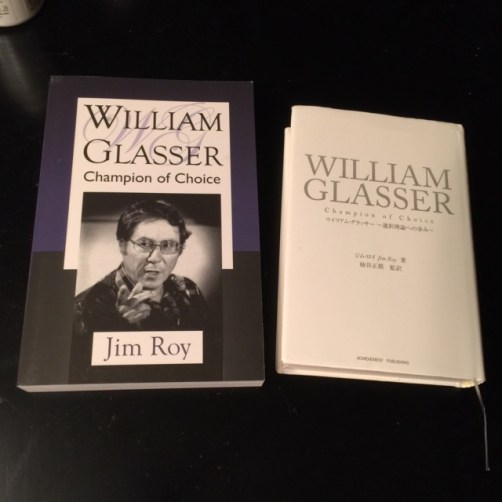
Heading for Japan tomorrow. Looking forward to giving presentations on the writing of the Glasser biography. As I mentioned in an earlier post, the biography, Champion of Choice, has been translated into Japanese. And for good reason since there is a very strong Glasser organization and choice theory presence in Japan.

Glasser's story and his ideas in English and in Japanese.

Glasser’s story and his ideas in English and in Japanese.

4 Powerful Ideas, Like North Dakota Lightning!

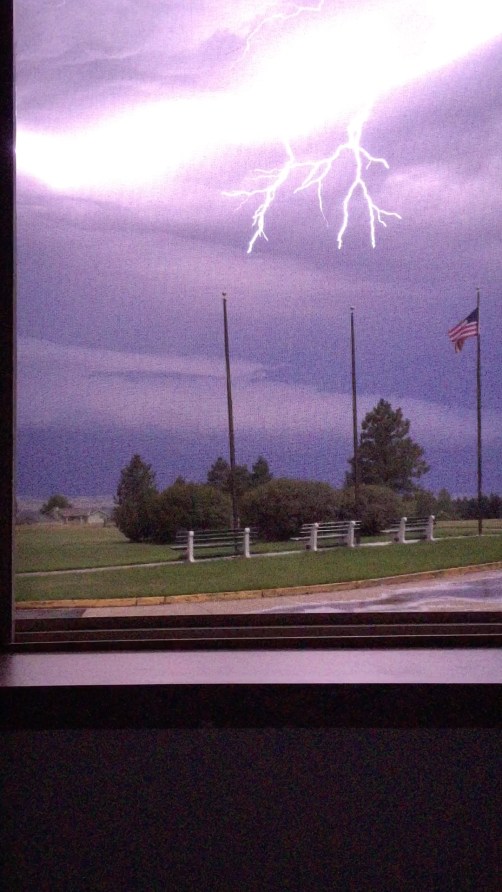
One of the lightning strikes during my North Dakota stay this week. It was totally dark, yet now it is almost like daytime, the flag flying proudly during the storm.

One of the lightning strikes during my North Dakota stay this week. It was totally dark, yet now it is almost like daytime, the flag flying proudly during the storm. (Photo by Jim Roy)

Incredible explosions in the North Dakota sky!

Incredible explosions in the North Dakota sky! (Photo by Jim Roy)

A North Dakota lightning storm provided quite a send off this past Tuesday evening. Wow! From far in the distance to very close, the lightning flashes for a while exceeded 40 per minute. Talk about a show!

More North Dakota lightning!

More North Dakota lightning! (Jim Roy photo)

I headed home on Wednesday from Dakota Adventist Academy where I led out in a choice theory in-service for teachers in the Dakota Conference. I appreciate the spirit in which the teachers tackled and considered a non-coercive approach to managing students. For them, school begins in just a few days, though, so I wondered (as I flew home at 550 mph) about how much choice theory they will be able to bring into their classrooms.

With the reality of school beginning for so many of you right about now, here are FOUR things to keep in mind, especially for those of you who took your first choice theory class this past summer, as another school kicks into gear.

ONE – Focus on creating a need-satisfying environment
Rather than worrying about what you still don’t totally understand about choice theory, focus on coming up with ways to intentionally meet students’ Basic Needs. Meeting students’ physical and psychological needs isn’t rocket surgery. It’s more about shifting our mindset to consciously consider that each of our students, like each of us, has a unique set of Basic Needs that want to be met. For instance, rather than resenting or even “fighting” students that have a high need for power, come up with activities or strategies that help them meet their need for power. Such activities can include students having meaningful classroom jobs, being asked to plan classroom events, older students helping younger students, teaching a concept to fellow classmates, or being given a chance to master a new skill. Each of the Basic Needs – Purpose, Love, Power, Freedom, Joy, and Survival – are not difficult to address when we turn our attention to them.

Just think about the goal of creating an environment that students want to be a part of every day. Instead of ignoring whatever needs students may have, and expecting them to fit the needs of the work, how about doing everything we can do to fit the work to the needs of the student.

Some might reply, Well, that’s not the real world! We’ve got to get kids ready for reality. Reality doesn’t make allowances! Actually, that isn’t necessarily true. I agree there are companies or jobs in which management doesn’t care about employee welfare and that expects employees to show up and do their best regardless of the circumstances. But I would also contend that such companies wrestle with employee morale and performance. Such companies struggle to produce a quality product and it isn’t unusual for them to go out of business, unable to satisfy customers. The reality is that there are model companies that do a lot to provide perks for their employees – flexible scheduling, working from home, on-site day care, on-site exercise centers, generous maternity leaves, creativity days, support teams, and leadership sharing, to name just a few. These companies are highly successful, partly because they want to create a place in which employees want to come to work and give their all. Shouldn’t schools be like the companies that care about supporting their employees and that look for ways to have their work be need-satisfying?

TWO – Private and Public
Invest the time to more deeply understand the principles of choice theory. Workshops and in-services can be an important part of improving our understanding, but you will need to do more on your own. Books are a good way to marinate in the ideas and strategies of choice theory. Reading on your own provides a safe place for reflection and change. What I am trying to say is that our private choice theory journey is as important, if not more important, than our public choice theory journeys. Implementing a transforming idea in our classroom can be so satisfying, but often we need to spend the time privately in connection with our public efforts.

THREE – Begin practicing the Caring Habits
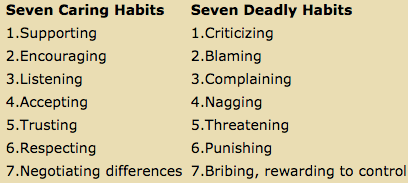
One of the best things we can begin practicing privately is using the Caring Habits in our interactions with family, colleagues, and students. Remember, Caring Habits are behaviors that maintain or improve our relationships with the important people in our lives. These behaviors include: encouraging, accepting, respecting, trusting, supporting, listening, and negotiating differences. Try replacing a Deadly Habit, like criticizing or blaming, with Caring Habits like listening and supporting. You can begin these early choice theory steps without making a grand announcement or proclaiming your undying commitment to choice theory. You just practice the Caring Habits, maybe even trying the approach skeptically. Just trust the process and see what you think.

FOUR – Share something about choice theory with your students
It can be as simple as introducing students to the Basic Needs, or having them do the Quality World picture activity. Maybe you can present the idea of the classroom being a Caring Habit Zone and then having them do some role plays that demonstrate the difference between the Deadly Habits and the Caring Habits. Choice theory isn’t something we do TO kids or use ON kids; it’s something we share with them and then engage them in the process. Don’t put off step four. Remember the cooperative learning maxim: He who does the teaching does the learning. If you want to learn choice theory better yourself, I guess teach it.

========================

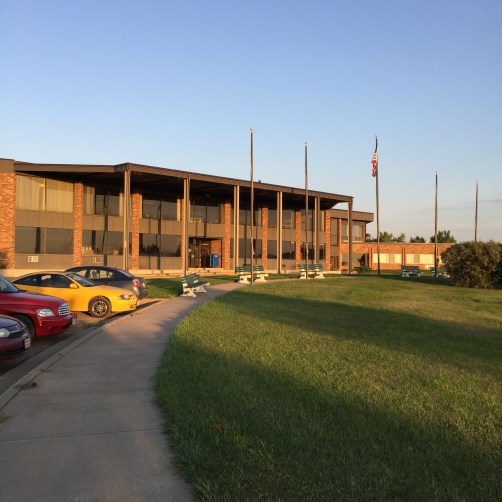
Dakota Adventist Academy in the early evening light.

Dakota Adventist Academy in the early evening light.

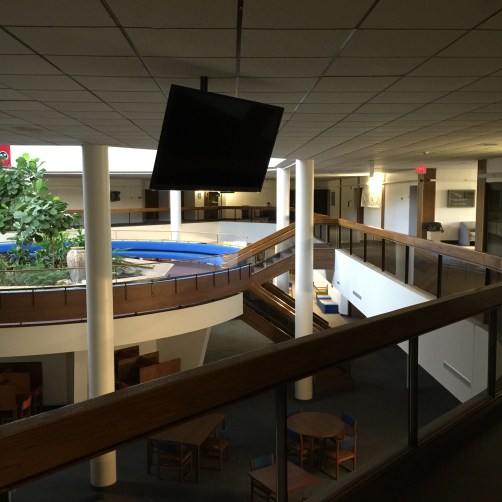
The administration and classroom area atrium. The entire school - classrooms, dorms, and gym - is under one roof.

The administration and classroom area atrium. The entire school – classrooms, dorms, and gym – is under one roof.

Working with a partner on the Basic Needs self-evaluation sheets.

Working with a partner on the Basic Needs self-evaluation sheets.

The Quality World picture activity.

The Quality World picture activity.

To my new North Dakota friends, thank you for a good in-service. I have thought about you a lot since saying good-by on Wednesday. My thoughts will continue to be with you as you start the new school year this next week. Let me know if I can be of help.

=====================

When a flower doesn’t bloom
you fix the environment in which it grows,
not the flower.
Alexander Den Heijer

You Can Steer Yourself Any Direction You Choose

She stood in the classroom, alone, and took in its details as light from the setting sun filtered in through half-open window blinds. For a moment she considered turning on the overhead lights, but her eyes adjusted quickly and she decided to stick with the light as it was. There was a smell, although like the light it was slight and not unpleasant. She wondered at its source, something singular or was it a composite of multiple remainders from the school year recently concluded? The room was quiet, although she could hear voices, muffled, far away, probably from the interview that was supposed to follow hers.

She wasn’t sure what to think or feel yet about her interview. How long had it lasted – 45 minutes, give or take? How had she come across she wondered? Would she like to see the classroom, just in case she was the one invited to take the position, she had been asked? The principal was friendly enough, the whole personnel committee was friendly enough, she thought as she accepted the offer. Friendly enough, but she still wasn’t sure if she was ready for a move. At the moment she was just concerned about whether or not she had come across as competent as she responded to their questions.

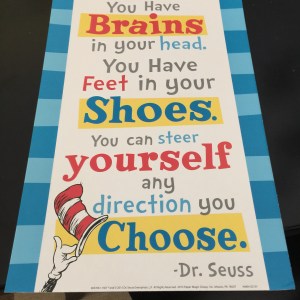
Her eyes fell on the poster on the wall not far from her and for some reason her mind locked onto it. The light was on the less-than-adequate side, the dimness pronounced, yet the poster erupted from the wall anyways. The colors appeared bold, the message of the poster even more so.

IMG_0836

There was more classroom to see, more posters on the walls, more writing on the dry erase boards, more books on shelves, and more windows through which to explore, yet none of them seemed to matter for the moment. She remained locked on the poster.

She had never been provided books by Dr. Seuss when she was a child, in fact, she had not been allowed to read those kind of books, and even now so many years later, so long after she had recognized the wisdom of Seuss, she felt a tiny pang of guilt. Her mother was in the room now, too, even though she had passed five years earlier, God rest her soul, and was wondering aloud to her what she found so valuable in Seuss’s craziness. We wanted to keep you from such things as a child, she reminded her recently-interviewed daughter, so why would you start paying attention to them now? She thanked her mother, her own lips pursed in frustration, and escorted her from the dimming classroom. Her concentration returned in full focus to the poster.

Its message struck her, jostled her enough that insights were knocked about like a metal ball in a pinball machine. Thoughts came into focus.

You can steer yourself any direction you choose.

She’d seen this poster before, agreed with its message totally, loved the creativity of Dr. Seuss, in spite of her upbringing and her mother. But seeing it those other times was before the in-service a couple of months earlier, before the stuff she had learned about choice theory. The thought occurred to her that she should really be thinking about the interview she had just completed and about her life in general, not about a poster on a dimly lit classroom wall, but the thought left as quickly as it had come. The poster mattered for some reason, and like a surfer she would ride this thought wave until it arrived gently on a shore.

We agree so readily with Seuss and the idea that children can steer themselves wherever they choose, she thought, using the ‘we’ pronoun as she spoke on behalf of every other teacher in the world, yet we don’t really agree with it, not really. We want kids to steer where we choose, since we know better, right? We’ll go with any direction they choose, as long as it’s the same direction we would have chosen. Choosing, making a decision, is a skill. Like writing a five-paragraph essay, being able to choose well comes more quickly to some than to others, but with good feedback and coaching everyone can do it.

How can I not only give my students choices, but teach them to make choices, she asked on behalf of teachers everywhere. Real choices, she added, not the fake ones we toss to them daily. Little scenarios flashed across the movie screen in her head –

+ project rubrics from which students could choose their level of performance;

+ flexible scheduling that allows students to give input as to how much time is needed for certain assignments;

+ planning for special events like open house, class parties, and even field trips that include student input;

+ solving classroom problems that come up, maybe even solving a problem between two students, by addressing the problem as a class;

+ curriculum planning that takes into consideration what students are interested in;

+ asking a student what needs to happen for him to be better able to cooperate with a classroom procedure.

She caught herself, a little amazed at the detail of the scenarios in her head, a little amazed, too, that these scenarios were inspired by this children’s poster and the silly author that came up with these silly sayings. Please, mother, will you ever quit?

The classroom had grown dimmer still, dark enough that she turned to the light switches and toggled one up, instantly illuminating the space in artificial light. Other things caught her attention now, other posters on walls, items hanging from the ceiling, student artwork posted, a schedule on the board, a portion of it slightly erased. It struck her how similar classrooms can look, yet even in their similarities a specialness lurks. How can a space that looks so much like other classroom spaces be so special and even unique? The space is sacred! This revelation hit her, not because of the look of the decorations, but because of what the decorations represented. The space is sacred, she replayed it again. What could be more special and important, for instance, than students learning to make choices and learning to grapple with the common problems of life?

She glanced around the room once more, tipping her mind’s hat to the Seuss poster as she quickly took it in again, and then switched the light off as she moved back into the well-lit hallway. The voices, somewhat stronger, but still muffled, reminded her of her own reason for being in this place. For a moment she sent up a little prayer for the person being interviewed at that moment, hoping he or she was doing well, putting their best foot forward. Some, she thought, would see the person being interviewed as her competitor, but she didn’t see him or her that way at all. She wasn’t sure who best would thrive at this school, in that classroom. Did she want to beat another teacher out of a job that really wasn’t for her? No, she thought, and instead embraced the idea that she wanted the right person to “win” this job, which may or may not be her.

She began to walk toward the school offices and the lobby that would lead to the parking lot where her car awaited. What if she was asked to fill this vacancy and teach at this school she wondered? How to choose? She smiled as she thought about this common life situation and the way in which she might struggle to decide. She smiled as she admitted that learning to make choices had not really been a part of her life until after she was done with school. More than a pity, she thought. That would be changing, though, whether she stayed in her present school or accepted a call to this new one, that would be changing. I wonder where I can buy that poster, she thought, as she walked across the parking lot, the cool evening air feeling just right.

========================

Looking forward to heading to Dakota Adventist Academy next week and sharing choice theory concepts with Dakota Conference educators. I’m anticipating a great time together!

========================

You have brains in your head.
You have feet in your shoes.
You can steer yourself any direction you choose.
Dr. Seuss

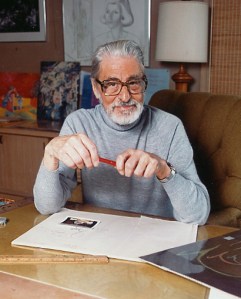
Theodor Seuss Geisel wrote books for children, several of them being the most popular of all time, which sold more than 600 million copies and were translated into 20 different languages.

Dr. Seuss

Dr. Seuss

It’s the 7 Principles of the Thing

The Japanese translation of Glasser's biography, Champion of Choice.

The Japanese translation of Glasser’s biography, Champion of Choice.

I am looking forward next month to traveling to Japan and speaking at their Glasser conference on Reality Therapy and Choice Theory. The Glasser biography, Champion of Choice (2014) has been translated in Japanese (thanks to Masaki Kakitani and Achievement Publishing) and is selling well there. Some of you are aware of Choice Theory’s presence in countries around the world, with several countries – Australia, Ireland, Canada, and Japan, to name a few – having active and influential Choice Theory organizations.

Like a number of other cultures, Japanese read from right to left, and they also read from top to bottom. Again, thank you Masaki Kakitani.

Like a number of other cultures, Japanese read from right to left, and they also read from top to bottom. Again, thank you Masaki Kakitani.

Choice Theory’s worldwide presence and appeal underscores a point that shouldn’t be lost on us, the point being that Choice Theory is based on principles. Think about it, we define a principle as a foundational, fundamental truth, not restricted by time or place. In other words, a principle of human behavior would be as relevant in Singapore as it is in Scotland; as relevant in 1500 BC as it is in 2016.

Glasser referred to Choice Theory having axioms, which is a pretty good word, too, but not everyone really knows what an axiom is. If you are curious, an axiom is a self-evident truth that requires no evidence or a universally accepted principle. So the two words – principle and axiom – are close. (I am not sure I like the idea that an axiom requires no evidence. It seems, even when it comes to an important principle we are constantly reviewing it for accuracy.)

Principles provide compass points for our lives.
(They’re that dependable.)

So, given that Choice Theory is being studied and practiced around the world, what are the principles of human behavior that Choice Theory desires to honor and promote?

ONE – Every human being behaves for totally personal reasons.
We don’t behave for some reasons that are personal, or for reasons that are mostly personal. We behave for reasons that are totally personal. All of our motivation comes from within. We may change our behavior in response to a threat from someone else, or we may disregard the threat and do what we want, but either way we are deciding for reasons inside of us. We may accept a bribe and do what we are being paid to do, or we may reject the bribe and follow our own path, but again, we are deciding for internal reasons. We weigh outside circumstances; those circumstances don’t control us.

TWO – The only person we have a chance to control is ourselves.
Since every human being is internally motivated and controlled, it follows that “external control” or “outside control” really isn’t possible. We are not designed to be controlled by another person; nor are we designed to control others.

THREE – All behavior is purposeful.
I like Glasser’s explanation that any behavior is an attempt at that moment to meet a Basic Need. (Glasser would add that it is our “best” attempt to meet a need, but I am still thinking about that.) If we believe that people are internally controlled, then we must also believe that we behave for a reason, including the behavior of choosing to be miserable. (It’s fascinating to consider how being miserable could somehow be need-satisfying.)

FOUR – Attempts to control another person’s behavior will end poorly.
Because we are not designed to be controlled by others, or to control others, all our efforts to do so will harm the relationship between the controller and the controlee, and will also harm the quality of the task or product being demanded.

FIVE – Positive changes in behavior always come from tapping into a person’s strengths, not from trying to eliminate a person’s weakness.
Weaknesses represent areas in which we lack, sometimes significantly, so expecting changes to be based on areas in which do not have an affinity for or the needed skills seems a bit ill-advised. When working with a student (or teacher for that matter) who is performing marginally, the key lies in identifying areas of strength and building a success plan based on those strengths.

SIX – Positive changes are fueled by positive relationships with key individuals.
This may sound obvious, but it is striking how often this is ignored. Students, for instance, will work for a teacher with whom they enjoy a positive relationship, even in a content area the student doesn’t particularly like. And the opposite is just as true where students will do marginally in a content area they like because they are at odds with the teacher. One of the things that happens because of a good relationship is trust, and very little of value happens without trust.

SEVEN – Effective assessment is standards-based and always includes self-evaluation.
Measuring against a standard, especially when it comes to professional licensing (e.g.- passenger plane pilot, brain surgeon, lawyer, etc.), is important. However, the essential piece in the assessment process always comes back to how the individual being evaluated evaluates himself. Whether a student is working through a behavior problem on one hand or considering his level of performance on a Biology project on another, the goal is to help him/her accurately self-evaluate and then, if needed, to make a plan for improvement.

This list is not exhaustive, but it does state seven important principles of human behavior. My view is these principles have been around since the dawn of time and that they apply regardless of where you live. I have shared the elements of Choice Theory in places like Bangkok, Beirut, and Bermuda, disparate cultures that view the implications of Choice Theory differently. Of course, we here in the U.S. and Canada have our own cultural challenges, too, when it comes to Choice Theory. Yet principles are . . . well . . . principles. They don’t go away because we don’t understand them or don’t want to honor them.

Would you word any of the seven principles differently? Can you add any to the list?

===============================

IMG_0831

For those of you who read from left to right, remember the English version of Glasser’s biography is also available.

You can buy the paperback version through William Glasser Books at http://wglasserbooks.com.
It is also available through Amazon.

Electronic versions of the biography are available through Zeig, Tucker Publishing at https://www.zeigtucker.com/product/ebooks/william-glasser-champion-of-choice-ebook/


Flipping the Script

A fascinating podcast from Invisibilia (and shared recently on NPR’s Morning Edition) reminds us about what can happen when we flip the script. In this short video clip (is eight and a half minutes short?) we learn what happens when a gun-toting robber interrupts a dinner party, only to be offered a glass of wine.


As the NPR article explains, psychologists call it noncomplementarity, or in other words, responding in an unexpected way to prompt a positive response.

Complementarity exists when like begets like – for instance, when we give another person the cold shoulder when they slight us, or when we respond angrily when someone gets in our face. Of course, complementarity also exists when friendly behavior results in a warm response.

your-choices

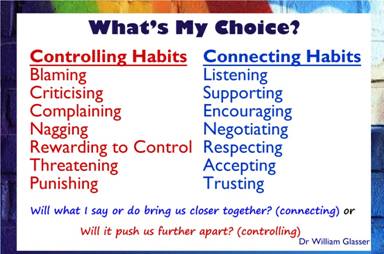
The Caring Habits and the Deadly Habits are such clear examples of this theory of communication. Glasser believed that using the Caring Habits would keep us connected to others, be they loved ones, colleagues, or maybe even intruders at a dinner party. It is powerful, even disarming, when we respond with a Caring Habit to a person who is using a Deadly Habit on us.

For a wonderful example of a person using a Caring Habit in the face of an intense Deadly Habit check out this story about –  Mama G

Teachers have opportunities to put this communication theory to use every day. Students may use a Deadly Habit in the classroom in an attempt to control a classmate or the teacher, but their anger or frustration is taken down a notch as the teacher (and maybe even a classmate) responds in a caring way.

uyibvdzzs2i73c7ztabt

Posting the Caring Habits and the Deadly Habits in the classroom is a simple way to teach and remind students of the importance of how we choose to relate to others. With the Habits posted it will be easier to tap into teachable moments as they arise, and help students really begin to understand their significance. The Habits being posted will be a good reminder for us as teachers, too, as we continually attempt to model a choice theory life.

From a spiritual perspective, Jesus described a perfect love as being able, like His Father, to love even those who are unfriendly to you, and maybe even your enemy. (Matthew 5:43-48) Can you think of examples from the Gospels in which Jesus behaved in a noncomplementary manner?


(The NPR piece can be accessed at http://www.npr.org/sections/health-shots/2016/07/15/485843453/it-was-a-mellow-summer-dinner-party-then-the-gunman-appeared)


Grades and High School Credit for Choice Theory

13615406_1051051708276214_7448974254202279866_n

I recently shared this meme on Facebook, so a number of you may have seen it there already. If not, this digital poster is a good reminder to all of us that kids need specific lifeskill help.

The daily headlines reveal a world that is (in Glasser’s words) “hanging by a thread.” From unspeakable acts of hatred to opioid addiction (both in today’s news), humans struggle with how to cope and how to get what they want. We leave school only to throw ourselves into self-improvement – knowledge about good food choices and how to prepare it; knowledge about staying fit and how to create and maintain a fitness plan; and insight and skills when it comes to psychological health, to name a few. Billions are spent each year on learning what are really basic life skills. So why are we not focusing on these areas in school? Wouldn’t these areas represent essential learnings?

More and more I am seeing school districts and schools focusing on the deeper needs of students, acknowledging in the process that learning occurs at a much lower rate when emotional needs aren’t met. Educational journals are documenting the success of schools and students that are benefiting from Social & Emotional Learning (SEL). It has become clear to many that the “soft skills” (collaboration, emotional literacy, empathy, social intelligence, etc.) are anything but.

Within this updated context, that context being a new awareness of the need for social and emotional skills, including the ability to monitor and improve our own psychological health, the principles of Choice Theory have so much to offer. Those of us who have a knowledge of Choice Theory just have to share the ideas with our students. Even just a simple focus on the Basic Needs and the concept of the Quality World would go a long way toward students becoming more self-governing.

As I write this I am struck by the need for a semester long Choice Theory curriculum to be created. Somehow, I have a feeling that this has already been done, so I am anxious to hear from those of you who have created such a unit plan yourself or who have discovered a Choice Theory curriculum that somebody else created. Chris Sequeira has done something like this in Oregon and certainly Ivan Honey has created a Choice Theory curriculum in Australia. Let’s share a bit on this. I know a lot of you are hesitating to teach your students Choice Theory because you don’t feel like you are a Choice Theory expert. Choice Theory ideas are too important to hold back on. And don’t forget that –

He who does the teaching, does the learning.

How Can I Be Wrong when I Think I’m Right?

An 11 minute TED talk provides insights into how people can get to the point of being so wrong, all the while thinking they are so right. It turns out motivated reasoning is to blame.

I first wrote about motivated reasoning in November of 2013 in a blog post titled Why Are So Many Christians So Un-Christian? One of the key points of the post is that people choose what to believe. Choice Theory proposes that we are always involved in the process of creating and maintaining a reality that works for us. Check out that post below –

Why Are So Many Christians So Un-Christian?

slide.001

Two other blog posts also commented on our being “right” and our having a direct pipeline to Truth.

Three Types of People – Awesome, Dangerous, and Run

Melting Self-Justification

Three Types of People

Julia Galef, the TED talk speaker, explained the difference between a warrior mindset and a scout mindset. The warrior is driven toward one goal, to survive through defending or attacking, while the scout is driven to understand and to gain a complete and accurate picture of the facts. The book I recently completed, The Anatomy of Peace, explained the difference between a heart at war and a heart at peace. As choice theorists we can be thankful that more and more people are coming into an awareness of the human ability to create our perception of reality, and more importantly, our ability to choose a more effective reality.


What Makes Choice Theory So Hard To Do?

It has been said that Choice Theory is easy to understand, but hard to do. What do you think? And if this is true, what makes it so hard?

There’s good news in Choice Theory, like the fact that it means –

+ I no longer have to control everyone around me.

+ I can talk to people in a way that helps us work through a problem and stay connected in the process.

+ I can self-evaluate my own behavior and make a new plan for the future.

So what makes these three “good news” pieces of Choice Theory hard to do? Consider the following –

+ I no longer have to control everyone around me.
This Choice Theory truism should come as a relief, and when you first hear it in a workshop setting or read it in a book, it does feel like a relief. Then you drive home after the workshop or head to your classroom the following day and suddenly it feels more like a restriction than a relief. Control, we come to realize, isn’t something from which we really want to be relieved. Of course, it’s more about the feeling of control, since Choice Theory reminds us the only person we can control is ourselves. This feeling of control is more than alluring, though; it can become a part of our identity.
It is hard to let go of something that means as much to us as being in control, even if it is pseudo-control. It is hard, too, if we don’t yet feel skilled in how to live without controlling others. The skill lies in identifying our own needs and boundaries and then living a caring, connecting life within them.

+ I can talk to people in a way that helps us work through a problem and stay connected in the process.
It is easy for us to agree that using the Caring Habits (accepting, trusting, listening, encouraging, supporting, respecting, and negotiating differences) is better than using the Deadly Habits (criticizing, blaming, complaining, nagging, threatening, punishing, and rewarding to manipulate) when it comes to how we relate to others, but it is still hard to do. One of the things that is hard is to really listen, to really focus on understanding what your child, your student, your spouse, or your colleague is saying. We listen to reply, rather than listening to understand. As a result, we are quick to tell a child or student what to do, rather than helping them arrive at and verbalize a plan. Maybe a desire for expediency urges us to tell and direct her/his behavior; maybe it is a way to meet our own need for influence and power. Whatever the case, it is hard to focus on asking good questions, rather than telling what we think are good answers.

+ I can self-evaluate my own behavior and make a new plan for the future.
For me, this is one of Glasser’s most important contributions to the field of mental health, that being that people can learn to monitor their own psychological health and make choices to maintain or improve it. It is hard, though, to escape the gravitational pull of stimulus-response thinking. Stimulus-response is an outside-in world. In other words, we are what the circumstances around us make us. There is a strong appeal to this way of thinking because somehow we are drawn to being the victim. Somehow there is something need-satisfying in victimhood.
Choice Theory is about an inside-out world in which people choose their course of action and choose their responses to circumstances, whatever they may be. Living in an inside-out world means recognizing our own responsibility for our thinking and our actions. This, you may have noticed, is hard to do.
It is easy to blame and to criticize, especially when we do it silently and resentfully, all the while building a case for our rightness. It is harder to look into our own psychological mirror and admit that we are criticizing or blaming to try and get what we want. It is harder to choose to be positive and caring, regardless of what people do in return.

It is hard to escape
the gravitational pull
of stimulus-response thinking.

It is hard to switch from a stimulus-response approach to a Choice Theory approach to life. Glasser felt that it took him two years to make the switch. I think it is taking longer for me. In fact, I think I think I will always need to stay intentional about this switch. More and more I come into an awareness of the ways in which I choose irresponsible misery, rather than responsible joy, and I want to change that. If a Choice Theory approach is taking longer for you, I want to encourage you to stay on the journey. Insights will continue to dawn in your thinking; breakthroughs will emerge in your experience. Resist the pull of stimulus-response.

==============================

I finished the Anatomy of Peace book, by The Arbinger Institute. I can very much recommend it. It describes a Choice Theory approach to life from a unique angle that even experienced choice theorists will benefit from. Again, I want to thank my friends at Livingstone Adventist Academy for sharing the book with me.

41lgMx-kqiL._SX295_BO1,204,203,200_

==============================

I’ve recently been alerted to the message of Michele Borba and her work surrounding the topic of empathy. Have you heard of her? Looks very good to me so far. More on her work later.