Posts tagged “basic needs

You’re Adding PURPOSE on Purpose?

The two most important days in your life are the day you are born and the day you realize your purpose.   Mark Twain

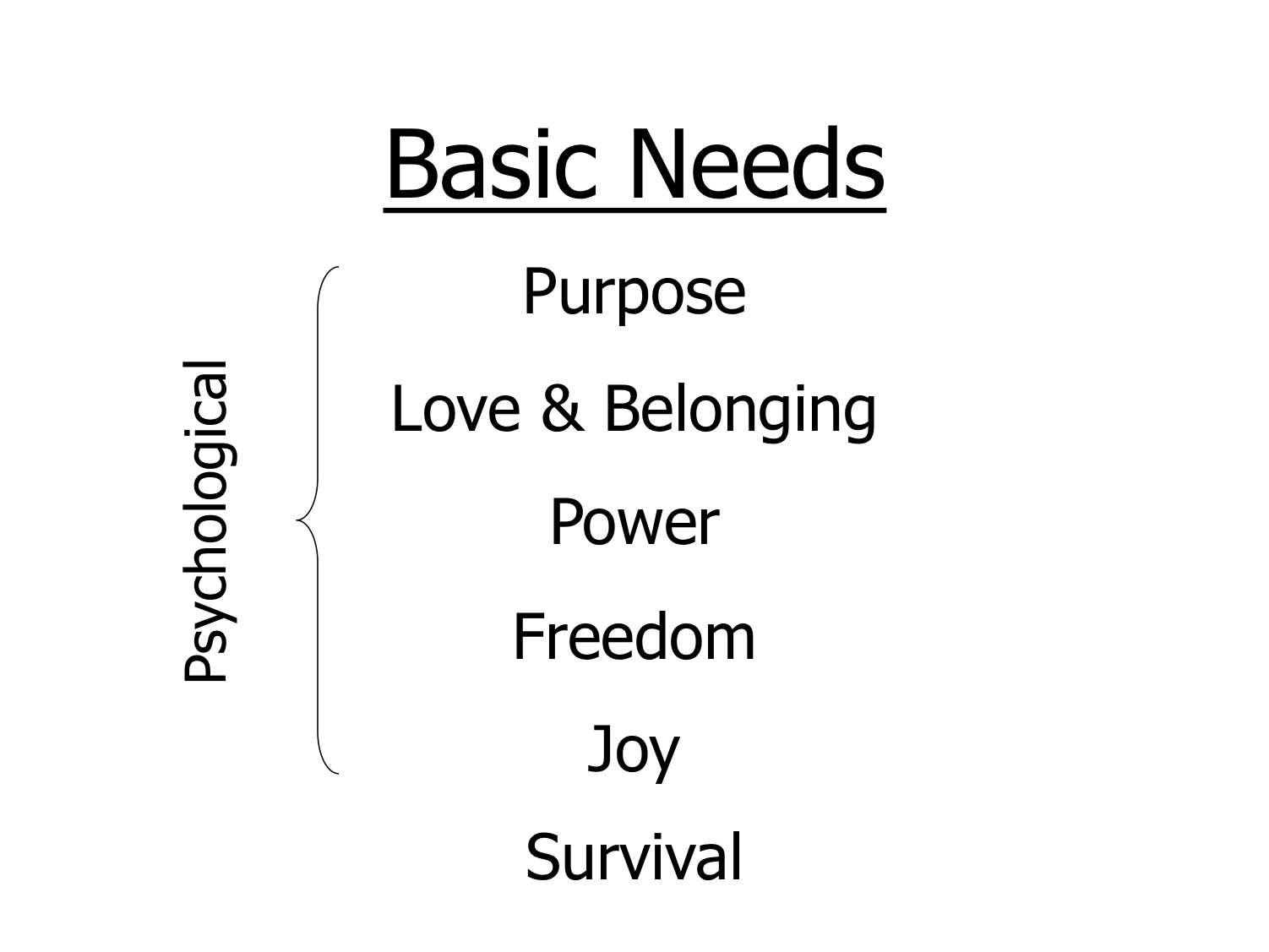
Some of you noticed that I have added Purpose as an additional need to the five Glasser identified. It is true, and I not only added it, I put it at the top of the list. I did not do this flippantly. Instead, my suggesting this new addition represents a very personal process involving a great deal of reflection.
Correct Basic Needs

The thing that started this personal process was my wondering where my spirituality fit into the Basic Needs. And by spirituality I mean something much deeper than religion or church orientation. My spirituality has to do with Who I really am and What are my deepest beliefs and What is the meaning of life (it’s beginning and it’s end) and ultimately, What is my purpose in the grand scheme of things?
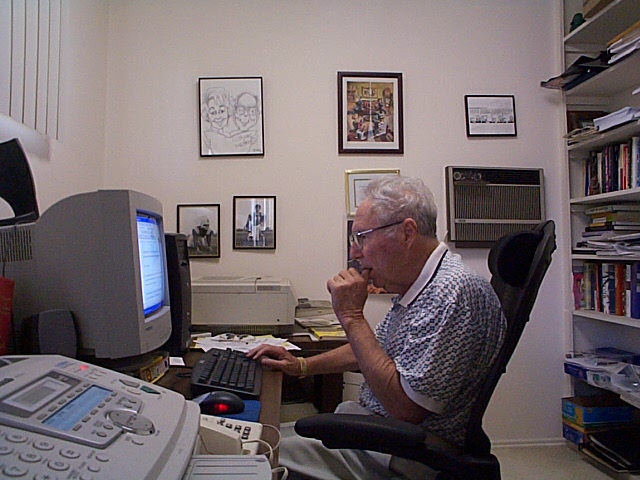
William Glasser at work in his home office. (2004) Jim Roy photo.

William Glasser at work in his home office. (2004) Jim Roy photo.

I tried to talk Glasser into endorsing this additional need, but he wouldn’t buy it. (When I first talked with him about it I referred to it as an Existential need, thinking he would be more comfortable with a “secular” wording.) I think he didn’t endorse the Purpose need for two reasons. The first reason had to do with not wanting to mess with the five needs he had emphasized for so long. Even though he had suggested the probability of their being more than five needs in his earlier writing (Control Theory, p. 16), he had settled into a firmness with his five. The second reason, I think, had to do with his seeing religion and spirituality as the same thing. He saw religious participation as a Quality World value or activity, and as such it didn’t qualify as a Basic Need. On top of this, in general, he didn’t view religion as a positive force throughout earth’s history. Without his endorsement I put my thoughts on this on a back burner and worked on other things. Even on a back burner, though, for me, the Purpose need wouldn’t go away.

I am convinced we are driven to understand our personal purpose and to make meaning of our lives, and that meeting this need is essential for the other needs to be fully met.

For a need to qualify as a Basic Need it would have to be needed, at least to a small degree, by all human beings. I believe the Purpose need meets this criteria as every human being has a deep need for personal meaning and the idea of coming into a sense of self. The self-help quest (books, seminars, videos, etc.) is an industry bringing in 2.5 billion dollars a year, so there are a lot of us seeking this thing called meaning.

I see college students that struggle because their life purpose is not clear to themselves. Their other needs are being met – they have friends and social connections, they are free to come and go, and they have some fun in their lives – but not having their identity and purpose clarified hampers their success. In fact, a lack of purpose can derail a college student’s academic success.

0613_superman_630x420

I am suggesting that the need for Purpose and Meaning is a universal need that people seek to meet in all kinds of ways. For many their involvement in a religion contributes to filling this need; others who are spiritual, although not into a religion, find meaning in their journeys as well. And even non-spiritual, non-religious people have their own ways of finding purpose and meaning. For instance, it is interesting how movies that depict superheroes, science fiction stories based on “a long, long time ago, in a faraway galaxy” themes, and end-of-the-world scenarios are so popular. It is like we have an innate curiosity about where we fit into the past, present, and future. It is like we have a consciousness void inside of us that can only be filled as our need for Purpose and Meaning are satisfied.

We are always monitoring the extent to which our Basic Needs are being met, something I do quite a bit when it comes to my own need for Purpose and Meaning. Maybe some of you can relate to that.

Every person has a purpose. Never give up.   Manual DeVie

==============

For those of you just getting started with following The Better Plan blog, a great way to catch up is to go the link toward the upper left hand corner labeled 2013 – Year At A Glance. Each of last year’s posts are in chronological order and just a click away from accessing.



The Stowaway

A 15 year old boy is loaded into an ambulance at the Maui airport.

A 15 year old boy is loaded into an ambulance at the Maui airport.

The remarkable story earlier this week of the young stowaway aboard a Hawaiian Airlines jet underscores the significance and power of the basic psychological needs. The wheel-well passenger, a fifteen year old boy from Somalia, climbed a security fence at the San Jose Airport, hoisted himself into a wheel-well of the closest parked jet, waited for seven hours as the plane readied for departure, tucked himself into the tiniest of spaces when the wheels lifted back into the fuselage, and then endured a five hour flight that included altitudes of over 36,000 feet and temperatures that approached 60 degrees below zero. After arriving in Maui, Hawaii,  an airport camera filmed legs dangling from the plane’s wheel well, which is almost 10 feet off of the pavement, and then witnessed the boy jump to the tarmac.

hawaiianairlinesAP

In the days following the young man’s miraculous flight across the Pacific there has been much written about the implications of his stunt on airport security and about the science of surviving in a sustained environment with so little oxygen and such bitterly cold temperatures. Fewer people, though, are talking about, what for me is, the more important question – that being – What would lead a teenage boy to seriously break the law (climbing over the perimeter fence of an international airport) and then risk his life flying in the wheel well of a passenger jet? Why did he do it?

dnews-files-2014-04-how-did-hawaii-stowaway-survive-in-jets-wheel-well-670x440-jpg

Understanding choice theory and the concept of the basic needs, along with a few more details about our young traveler, will help us answer the important Why question. The young man immigrated from Somalia four years ago. He lived in the San Diego area for awhile, but more recently relocated to the San Jose area. He struggled in school, as he had not attended school at all before coming to the U.S., especially in Math and Science, and he apparently did not get along with his father and stepmother that well, as an argument between him and them was one of the reasons he climbed over that security fence at 1:00 am in the morning. He missed Somalia and his grandparents, who lived there. And he wanted to visit with his mother, who he had not seen since he was two years old.

 Correct Basic Needs

As you listen to the details of this harrowing misadventure, a picture of the basic needs* of this teenage boy begin to emerge.

His need for love and belonging exerted a strong urge on him. He yearned to be with relatives that he felt loved him and cared about him, especially his mother, who he was separated from at a very young age. He did not feel, apparently, a strong sense of belonging here and he was motivated to find the human connection he needed.

His need for power was also unmet and also urged him to make a change. He didn’t know English very well and he wasn’t very successful in school. The feedback he may have gotten from his father and stepmother may have contributed to his lack of worth and accomplishment.

So powerful were these unmet psychological needs that it led him to risk his physical safety and overrule his basic need for survival.

That he did survive made for a compelling news story this week, and gives us a human drama from which to consider choice theory. We just need to remember that, while their stories may not make news headlines, we may be surrounded by young people struggling to meet their basic needs. Somehow we need the x-ray emotional vision that my friend, Tom Amato, talks about, that ability to see a situation through another person’s eyes.

Most people, upon hearing that a teenage boy climbed into the wheel well of a passenger jet and rode across the Pacific Ocean, would proclaim that the kid is nuts, a psych job. But when you consider the details through a choice theory lens you begin to see that his behavior was rational, thought out, risky, yes, and even ill planned, but his choice takes on meaning.

May we see the potential stowaway in our own children, and in our students, and focus on creating a need-satisfying environment that will prevent such stunts. May our children and students especially know that they are loved.

=========

Those of you in the PUC area, we are having a Choice Theory Study Group this Sabbath afternoon, April 26, at 3:00 pm. Please note the later 3:00 pm start time.

* I have added the need for purpose as one of the basic psychological needs. Glasser didn’t feel that it was a basic need, but he didn’t get worked up that I felt it was.

The Glasser Four

Glasser giving a talk in Ventura, California, in 2006.

Glasser giving a talk in Ventura, California, in 2006.

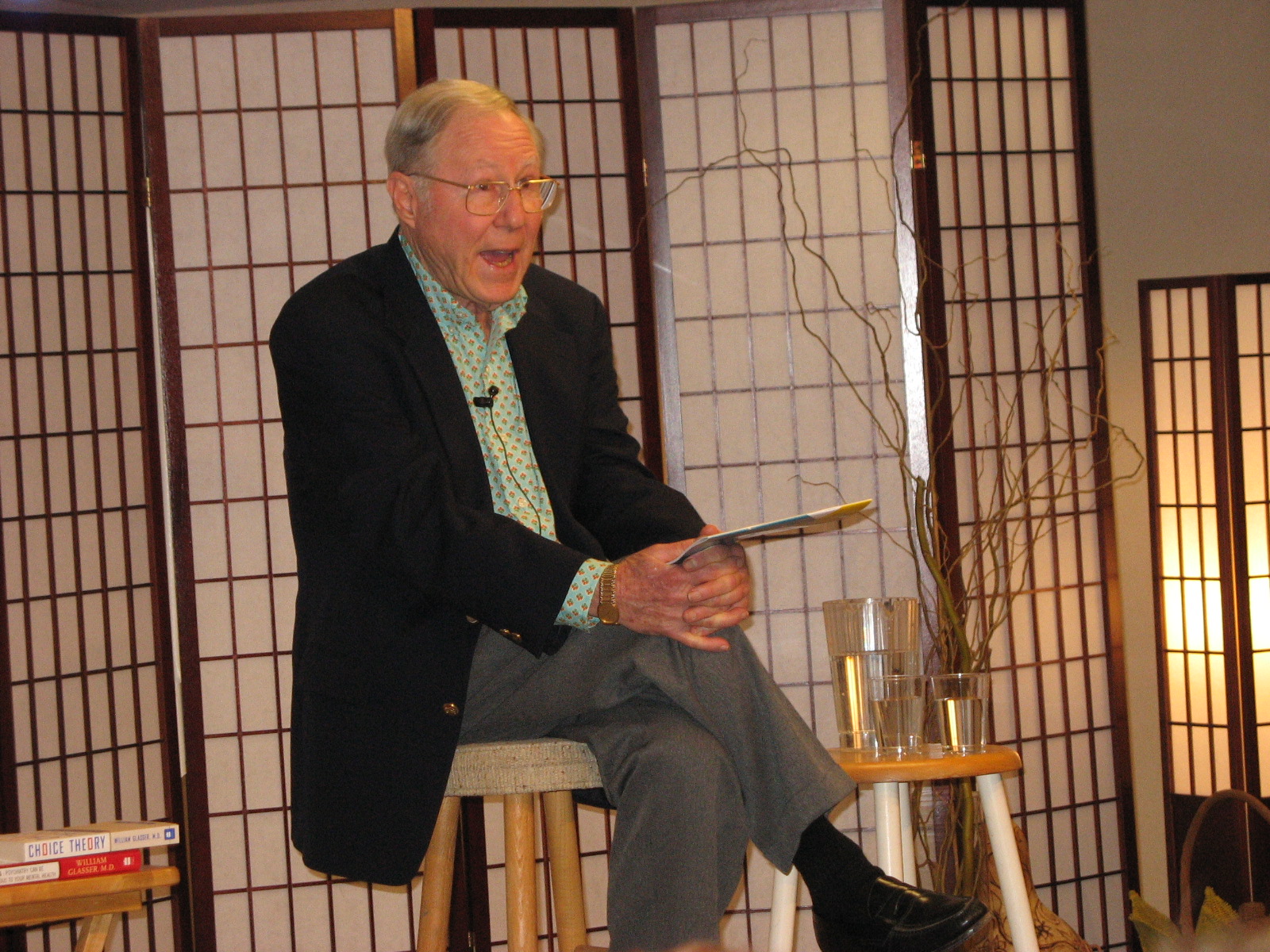
William Glasser was well-known for being able to speak to large audiences for hours without a script or even notes. And it wasn’t just that he could speak to an audience; he could teach and entertain in a way that people seemed to become unaware of the time. It was common for the stage or platform from which he was going to speak to have a few simple items – a chair or stool, a small table with a glass or pitcher of water, and a microphone. That was it. No lectern, no screen, and no media to help him get his points across. And yet, people listened, by the thousands, and by the hour.

I asked him during one of our interviews if he had an outline in his head of what he wanted to cover and he said that he did. Basically, he wanted to cover what he saw as the four essentials –

1. Basic needs

2. The quality world

3. Creativity

4. Total behavior

Other than this simple outline there was no script or set presentation. To some extent, each time he presented he wondered himself what he was going to come up with. If the talk was shorter, then he had to make his points quickly; if it was longer, then he could explain more deeply and share more anecdotes. Either way the success of his talks was dependent on his own creativity. He also described how much the audience’s interest and energy promoted or hindered his creativity. He tried to put into words how his creativity could almost be on fire when an audience was supportive.

This short outline gave him what he needed to share informative and impressive presentations. Chances are, though, an outline this short wouldn’t be enough for the rest of us. For the rest of us it would help if these essential areas were filled out a bit. So, let’s do that. Let’s fill them out and add some detail. I will start the process, however I would like a lot of you to send me additional bullet points that I can add to each of them.

In other words, for each of the Four Essentials think of a word or phrase that defines or describes that Essential in a way that helps to make it more clear. For instance –

Basic Needs
+ A unique set of urges / needs that constantly exert pressure on us to be met
+ Genetically passed on to us
+ Do not change over time
+ Are comprised of five psychological needs – purpose and meaning, love and belonging, power and success, freedom and autonomy, joy and fun – and one physiological need – survival and safety. (Glasser believed there are four psychological needs – love and belonging, power, freedom, and fun.)

Quality World
+ A place in our head where we store pictures of anyone or anything that helps us to satisfy one or more of the basic needs.
+ QW pictures can be of people, places, objects, activities, and beliefs
+ The QW is an amoral picture book. In other words, we may collect pictures that help us to temporarily feel good, but that may not be good for us.

Creativity
+ Our brain is always creating potential behaviors in response to the changing circumstances around us.
+ Some behaviors become “old stand-by” behaviors for us and we store these for use as needed.
+ It is much preferable to depend on the Caring Habits as our go-to, “old stand-by’ behavior. The Caring Habits include supporting, encouraging, listening, accepting, trusting, respecting, negotiating differences.
+ It is common, though, to use one or more of the Deadly Habits when our circumstances change in a way that we don’t like. Deadly Habits include criticizing, blaming, complaining, nagging, threatening, punishing, and rewarding to manipulate.
+ We create behaviors that we think will satisfy our needs at the moment. A behavior we choose might not bring a lot of satisfaction, but it doesn’t take much for us to make this choice. For instance, we might choose one of the Deadly Habits because it gives us a very small feeling of control.

Total Behavior Car

Total Behavior
+ All behavior is purposeful.
+ Every behavior is made up of four parts that are best described by the words thinking, acting, feeling, and physiology.
+ We have direct control over two of the parts – thinking and acting.
+ We only have indirect control over the other two parts – feeling and physiology.

Help me improve these bulleted lists by adding things I have left out or by correcting any mistakes I may have made. Maybe some of them could be worded better. Let me know.

===============

One of the things we’ll be talking about during the Choice Theory Study Group tomorrow afternoon, March 15, is the concept of total behavior. We start in the PUC Education Building at 2:00 pm. I hope you can be there.

===============

Being honest may not get you a lot of friends,
but it will get you the right ones.
John Lennon

The Amazing Grid on the Carpet

Professor Tom Lee and his amazing grid on the carpet.

Professor Tom Lee and his amazing grid on the carpet.

I was walking by one of the classrooms in our department recently and caught a glimpse of something going on that lured me into the room to find out more. It turned out to be Tom Lee’s middle school methods class. Tom is one of my colleagues in the teacher education program at PUC and is famous for coming up with learning activities that are engaging and relevant.

What I saw when I entered the room was a grid that Tom had taped onto the carpet. He had moved tables in the room to create a large space for this grid, which had Gardner’s eight multiple intelligences along the vertical axis and Bloom’s taxonomy categories across the horizontal axis.

As a reminder, Gardner’s intelligences included –

1) Verbal/Linguistic

2) Logical/Mathematical

3) Visual/Spatial

4) Rhythmic/Musical

5) Body/Kinesthetic

6) Intrapersonal

7) Interpersonal

8) Naturalistic

Bloom’s taxonomy (the new version) includes –

1) Remembering

2) Understanding

3) Applying

4) Analyzing

5) Evaluating

6) Creating

The students were asked to place a marker on one of the grid spaces and then describe a lesson focus or activity based on that grid space’s “address.” For instance, a student could place a marker on the space that combined Body/Kinesthetic (vertical) and Applying (horizontal), and then, on-the-spot, create a lesson focus based on a combination of those two categories.

A blogger in search of a bird's eye view of the grid.

A blogger in search of a bird’s eye view of the grid.

Instead of placing a marker in a grid space students could also throw a marker onto the grid for a more random challenge. Students just needed to keep in mind that a row or column could not contain more than two markers. Initially, students would be able to comment on areas in which they felt more confident, however as the game went on they would need to comment on every area of the grid, regardless of their level of prior knowledge.

I joined in the activity and enjoyed listening as students displayed their creative understanding of Gardner’s intelligences and Bloom’s taxonomy. There was a special energy in the room as students engaged in the activity.

What does Tom Lee’s lesson have to do with choice theory? From a classroom perspective, quite a bit. Choice theory explains the importance of school being a need-satisfying place. Tom’s lesson was need-satisfying on several levels.

Purpose/Meaning – Students were allowed to make personal meaning from the experience. The activity was very relevant to them and challenged them to take previous learning (Gardner and Bloom) and add new layers to their own understanding.

Love/Belonging – There was an obvious camaraderie that developed during the activity. Students rooted for one another and offered comments in support of each other. This camaraderie existed between students and teachers as well.

Power/Success – You could tell students felt satisfaction as they came up with their own lesson objectives. Their ideas were ultimately affirmed by classmates and by Tom.

Freedom/Autonomy – Students had so many choices to make during this activity. They could choose the grid space to attack, and afterward they would choose the kind of lesson they wanted to teach.

Joy/Fun – Joy and fun were both present throughout this activity. Students were engaged with the learning and with each other.

Safety/Survival – I think the students, to some extent, looked into the future and saw themselves as teachers working through the same kind of challenge. Doing the activity well had something to do with their professional survival.

I love the “grid on the carpet” that Tom came up with. In future Soul Shaper / choice theory workshops that I teach I want to steal this great idea. For instance, I can see having the Basic Needs across the top (the columns) and content areas on the side (the rows). By content areas I mean Social Studies, Math, Science, Language Arts, etc. I will then have participants select a grid space (either intentionally or randomly)  – let’s say the grid space combining Social Studies and Freedom/Autonomy – and then describe how lesson objectives in that content area could address or meet that basic need. This idea is really growing on me!

Can you think of ways in which you could use the “grid on the carpet” idea? And could you take a moment and share your idea with the rest of us?

———————————–

Remember to invite a friend to join us on The Better Plan blog. It’s easy. Just go to –

http://thebetterplan.org

————————————

If you like today’s blog, click on the LIKE button below. Your support will help The Better Plan grow. (If you haven’t done so yet, you may need to register with WordPress to be able to LIKE a blog, but the process is very easy.)

————————————-

Our next Choice Theory Study Group is December 7!

The Fisherman and the Monkey

The restaurant beside the small harbor.

The restaurant beside the small harbor.

During my last day in Lebanon, I was reminded about just how powerful the basic need for freedom can be in a person’s life. I had visited a very unique and important school in Tyre (yes, the Tyre talked about in the Bible) and afterward was taken to a seaside restaurant where I was able to talk more with the school’s principal about the history of the school and its future mission. The story of the school must be told, as it is an amazing tale of faith and courage, but for now I will share something (else) I observed as I sat by the water’s edge.

Mending nets.

Mending nets.

There was a sea wall that protected a marina area that was home to many small fishing boats. Nets were piled on the sterns of many of the boats, or piled along the docks just behind the boats. This was a working marina, if you will. I noticed one man sitting in his boat working on one of his nets. He had white hair pulled back tightly into a short ponytail and was shirtless, revealing his weathered, overly tanned skin. It struck me as I watched him concentrating on a portion of fishing net on his lap how that might have been Peter’s exact position when Jesus walked up and asked Peter to join him. (When the school principal saw me looking at the white-haired fisherman he told me about how this fisherman was so distinctive that when documentaries are made about Tyre, as National Geographic did, the film makers always want scenes that include this man.)

A literal monkey on his back.

A literal monkey on his back.

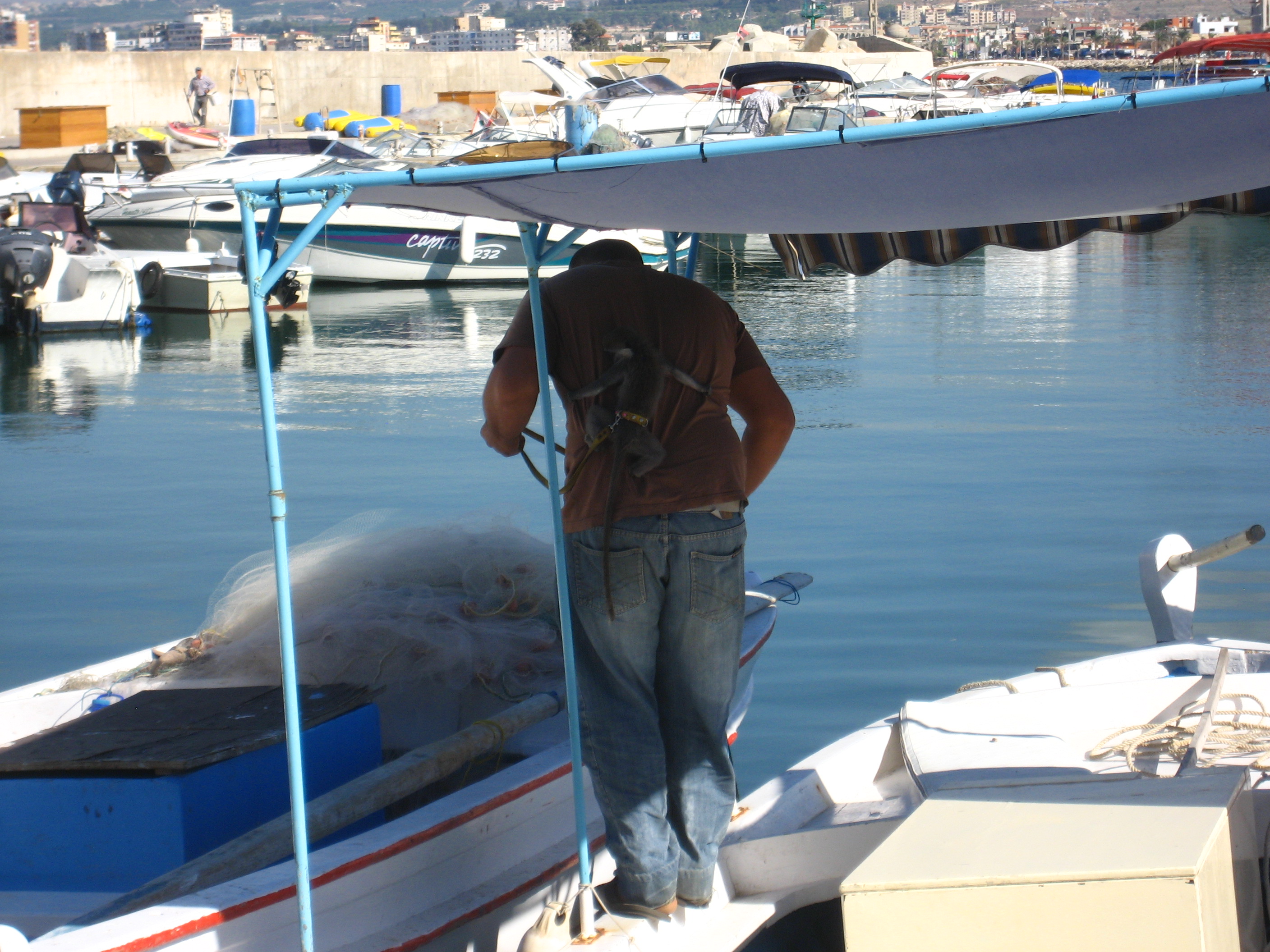
A few moments later a younger man (younger than 35) walked onto another boat near where I was sitting. He was in jeans and an old t-shirt, and he had a little monkey on his back. Literally. This got my attention and I continued to watch this interesting duo. The man struggled to get the monkey off his back, literally, but eventually did. The monkey was on a leash and the man attached the leash to one of the metal uprights supporting a small roof for the boat. The monkey settled in, at times climbing the upright for a better view, at times just sitting on the deck and watching his companion work on nets. When the principal saw that I was focused on this younger fisherman and the monkey he told me something that expanded my understanding of the basic need that people have for freedom.

Another day at the office for the monkey.

Another day at the office for the monkey.

The young fisherman, the principal explained, had a good job as a pilot of a large boat or yacht for some rich person in the area, but that he didn’t like being under someone’s supervision or direction, and that he preferred the life of a simple fisherman, not knowing how much his income would be, but being in total control of his actions and destiny. Instead of good-sized paycheck, and having to answer to someone else, he chose a smaller, sporadic paycheck, and having total say over the details of his life. Once, the principal continued, the young fisherman caught a huge lobster, easily worth $50 if he sold it. “But he didn’t sell it,” the principal said with some passion in his voice. “When I asked him what he did with the lobster if he didn’t sell it, he told me, I ate it!

Somewhere Frank Sinatra is singing "I Did It My Way."

Somewhere Frank Sinatra is singing “I Did It My Way.”

This story reminds us of the power of the basic needs, in this case the need for freedom. He acted on his need for autonomy, which strikes some of us as gutsy. He could have stayed with the good paying job, which provided security, but for him the trade-off wasn’t worth it. Apparently, he has a lower survival need. The need for freedom doesn’t force a person to give up good paying jobs. Sometimes people work in what for them is a less than ideal situation because it pays them enough money to satisfy their need for freedom in other ways besides their jobs – maybe they travel or have expensive hobbies. If we have a high need for freedom, though, and don’t satisfy that need we will most likely be unhappy. The basic needs don’t just go away. We were born with them and they are with us for life.

The young fisherman struggled to get the monkey off his back when he wanted to start working on his nets. That moment may have captured what the fisherman felt as he wrestled with what to do with his life. Maybe his good paying job felt like a monkey on his back, too. Monkeys can be like that for all of us.

—————————————-

 The Choice Theory Study Group is meeting this coming Sabbath, November 2, at 2:00 pm in room 212 of the Education building at Pacific Union College in Angwin, California.

$10 and Push Ups

Working with partners during one of the morning session activities.

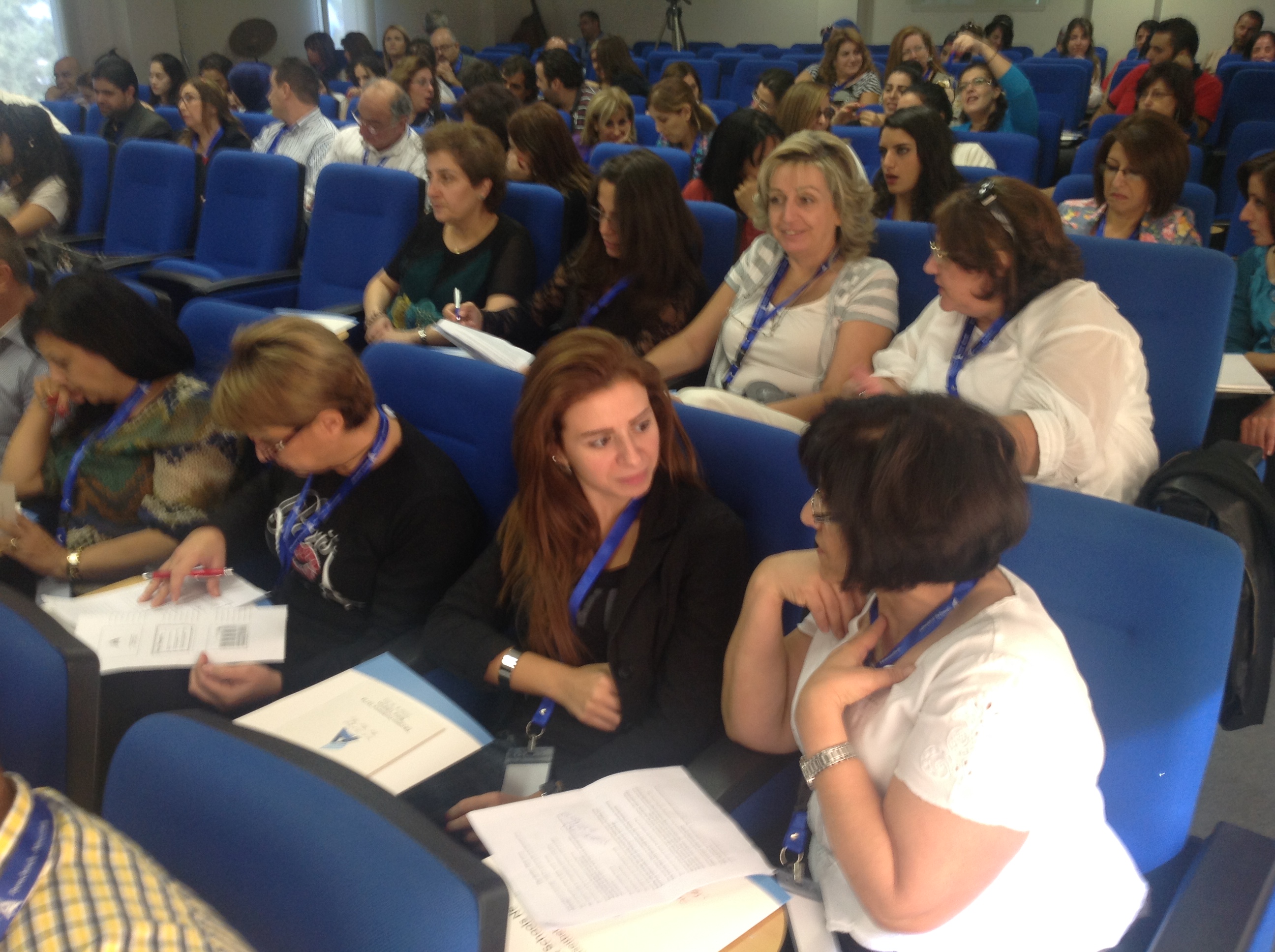
Working with partners during one of the morning session activities.

Some anecdotes from the Beirut conference, Sunday, October 20, 2013:

My view of the Middle East culture, now that I am a veteran of a few days here, is that they are reserved with someone they don’t know that well, but not reserved at all with each other. By the end of the conference, people were greeting me and even saying thank you, but not much more than that. They seemed to be into the topics that were covered, especially if the learning involved an activity, but I didn’t get a lot of direct feedback from them one way or another. There was positive energy in the room; I could definitely feel that. One woman who attended came up to me during a break and thanked me rather strongly, ultimately sharing with me that I had come to the Middle East just so she could here about choice theory.  Made my day, actually.

it's about 67 cents per push up.

It’s about 67 cents per push up.

I do an activity where I hold up a $10 bill and say that I will give it to the person who comes to the front of the room and does 15 legal push ups. Usually, there will be some who start waving their hands to be chosen as I slowly approach others and one by one offer them the money for the pushups. People will decline; some refuse even to give me any eye contact for fear I will ask them. I continue trying to get someone (not waving his/her hands) to go for it. Eventually, I select a person and he/she does the push ups, whereupon I congratulate them and hand them the money. This activity is a lead-in to a discussion on behaviorism and stimulus-response approaches to motivation. I ask them “What just happened here? Did the $10 make the person do the push ups?” It didn’t seem to work with those who declined, some of whom could have done the push ups. Ultimately, the group realizes that external motivators work for some people, some of the time, and always for reasons that are inside of them. The reason I share this is that when I did this activity in Beirut I had fewer responses than at any other place I have used it. Absolutely no women were interested in doing the push ups, and basically none of the men were either. One raised his hand briefly, but then his hand kind of disappeared. An American student missionary eventually said he would do it, which he did, and he got the $10. I am curious, though, if this is a cultural thing or if I just didn’t do it right. I’ve been doing it for a long time, so I don’t think it is the latter, but you never know. (Most of the participants who have done the push ups and won the $10 over the last, say three or four years, have been women.)

Great rendition, from the heart, of the Lebanese national anthem.

Great rendition, from the heart, of the Lebanese national anthem.

For variety, I also offer $10 to the person who will come to the front and sing the national anthem, a cappella. People seemed even less interested in doing this than they did in doing the push ups. I offered and invited, but no takers. Finally, a gentleman said he would do it and moved to the piano on the stage to play as he sang. I said, no, it needed to be a cappella. He complied, took the microphone, and begin to sing the Lebanese national anthem. He sang with conviction and gusto. Very quickly after he began to sing, one by one audience members stood to their feet and began to sing as well. Rather than simply being entertained by this impromptu solo, they felt compelled to stand in honor of their country and join in singing their national anthem. It was an impressive moment, a touching moment. I was out another $10, but it was totally worth it, though.

An afternoon problem-solving group solving problems.

An afternoon problem-solving group solving problems.

After lunch, problem-solving groups were created that were asked to apply information from the morning session to real classroom settings. For instance, one of the questions asked group members to identify a need-satisfying classroom strategy or activity for each of the Basic Needs. I was very impressed as group reporters from each of the groups went to the microphone and explained their choice theory strategies for a better classroom environment.  Examples included –

Purpose and Meaning– explaining assignments better; allowing students to ask and explore “why” questions; helping students to research career possibilities without pressuring them in a certain direction

Love and Belonging – greeting students personally at the start of the school day and asking them how they are doing; teaching them to work with partners or in small groups more effectively; looking out for the student who may not feel as connected; modeling positive relationships by being supportive of each other as staff members

Power and Achievement – having students present to the class or to teach the class a skill that they do well; allowing students to re-do an assignment until they get it; giving students roles or jobs in the classroom; try to provide students with choices when it comes to how they fulfill assignments

Freedom and Autonomy – trust students more and expect them to live up to that trust; allow to give input into how an assignment could best be done; allow students to give input into the selection and wording of some of the class procedures and rules

Joy and Fun – read funny stories or share jokes; create an environment that is emotionally and physically safe, where creativity can flourish; be optimistic with students; express belief in their ability

Survival and Safety – design and implement a structured school program that protects students physically, emotionally, and academically; be aware of any students displaying bullying behaviors; repair damaged or broken equipment or furniture quickly; prioritize the emotional well-being of every student

————————————

Check your calendar, because if you were really responsible and organized you would have Sabbath afternoon, November 2, from 2:00-4:00 pm already scheduled for the next Choice Theory Study Group. If you haven’t scheduled it yet, you can go ahead and do that now. Hope you can be there!

————————————

Let me know if you have questions or topics for The Better Plan blog to address. Get in touch with me at thebetterplan@gmail.com or through the blog contact form.

Sandy Hook, Choice Theory, and Forgiveness

sandy_hook_birthers-620x412

It is one of the most significant of all human qualities – that being the ability to forgive. I was reminded of this truth from a remarkable source – Newtown, Connecticut.

My cousin, a school administrator in New York City, knowing of my interest in choice theory, recently sent me an article* written by Dr. Anthony Salvatore, president of the Newtown Association of School Administrators. It turns out that Newtown schools, including Sandy Hook Elementary School, have been studying and implementing the ideas of William Glasser and choice theory since the early 1990s. As a result, Newtown has sought to be a needs-satisfying school system for students.

In the aftermath of the unspeakable tragedy that occurred at Sandy Hook Elementary, Dr. Salvatore represents a voice of healing. Even his comments about the shooter reflect compassion.

“Although I will never know the answer,” he begins, “I keep thinking of what the conversation was that was going on in Adam Lanza’s head. How can we do better in school to help avoid this behavior again, even knowing we can’t control someone else’s behavior, but we can control the conditions around that person. And that takes a whole global community, not just a school or a classroom. Suicide is a final act and one that tells me he saw no other option for meeting his basic human needs. Did he feel like he was loved and belonged to his family or community? I don’t know. Did he feel like he had power in his life to feel competent about who he was? I don’t know. Did he feel like he had a choice in his life besides taking his own life? I don’t know. Did he feel like his life was filled with fun? I don’t know.”

Salvatore emphasized the need for schools to build positive relationships with students “so they can learn how to make the best choice for meeting their own needs and for helping others in society meet theirs as well. Building on the value of relationships and choice, he closed the article on a note I will not soon forget. His vision of forgiveness is more than inspiring!

“It’s time to focus on cooperation instead of competition in our society. It won’t bring back the lives of the 28 victims who died on Dec. 14, 2012, but it will honor the sacrifice they made that day. My fear is we will make the same mistake other communities have made and not recognize that Adam Lanza also was a victim that day. This is where Newtown can truly be a leader toward a new vision and new understanding. We need forgiveness on so many levels, but we first need healing. We already know from research that isolating bullies in school is harmful to the individual and to the school climate. Alienating someone from a community only exacerbates the feeling of powerlessness and not belonging. We must forgive mistakes and nurture our capacity to do good. We have control over that.”

May Dr. Salvatore’s words be an invitation and inspiration to each of us. May the Spirit work in us to prepare our hearts to respond to others, even those who do us harm, with similar compassion.

——————————-

Forgiveness is such an essential part of good mental health. Within the scheme of choice theory, though, where does it fit in? Which of the basic needs, for instance, are being satisfied when we forgive someone?

My mind quickly goes to the need for love and belonging. Forgiveness has to do with our relationships. We seek forgiveness, whether from an earthly friend or our heavenly Father, to restore a relationship. And we offer forgiveness for the same reason – to restore or maintain a relationship.

What about the other needs, though. Does forgiveness satisfy the need for power in some way? How about the need for freedom? How about the need for joy and fun? And we shouldn’t leave out the physiological need for survival. Does forgiveness impact us on a physiological level?

I would like to hear from you regarding forgiveness and the basic needs. How does forgiveness help us meet our psychological or physical needs?

——————————-

A few of us have started a Facebook page also called The Better Plan. We want it to be a collecting point for choice theory ideas and strategies. I invite you to join us. An article was posted today from a primary grade teacher who has just learned about choice theory on how her management is going to change this coming school year. Great stuff! Check it out.

* This article appeared in the Summer, 2013, edition of The Leader, the newsletter of the American Federation of School Administrators.

Give Me Victory, or Give Me Death

I just finished reading The Secret Race, by Tyler Hamilton and Daniel Coyle, which was an incredibly interesting read that candidly addresses the state of elite cycling and the use of performance-enhancing drugs. With the start of another Tour de France just around the corner, I thought I would re-post a blog I did in January, which looks at PEDs through the lens of choice theory.

Jim Roy's avatarThe Better Plan . .

SI cover

It was haunting, stark, in-your-face. The cover of the April 14, 1997, Sports Illustrated, drew your attention to an image that dramatically captured, in one stroke, the state of affairs in athletics, indeed, the state of affairs in society. An arm, a strong arm with bulging bicep, fist clenched, wrist cupped, formed the bulk of the image, yet placed between the cupped wrist and bulging bicep was a syringe, it’s needle plunging into the taunt muscle. That was it, just an arm and a needle, yet you couldn’t look away. Although it appeared 16 years ago I have never forgotten that image.

The lead article, titled Over the Edge, opened with survey results that were, it doesn’t seem possible, even more haunting than the cover image. Quoting the article’s opening statement, it reads –

A scenario, from a 1995 poll of 198 sprinters, swimmers, power lifters and other assorted athletes…

View original post 1,178 more words

Is Choice Theory in the Bible?

Choice Theory and Scripture

The ideas of choice theory have appealed to me a lot. Initially, I the appeal had to do with my belief that choice theory ideas would improve the school at which I was a principal. As I learned more about the ideas, though, I came to see that they were deeper than mere school improvement, as important as that goal is, and that similar to a C.S. Lewis phrase out of Narnia, choice theory involved “deeper magic.” In other words, unintentionally, Glasser had stumbled onto spiritual principles as his therapeutic strategies took form.

I have thought about choice theory and its comparison to spiritual principles a great deal and thus far it has appeared to me that they consistently strengthen and support one another. Choice theory is not a gospel in itself. Choice theory describes and explains human behavior, but it doesn’t empower. It can explain, as our last blog did, how a person can repeatedly choose an unhealthy way to meet a need, yet this insight does not necessarily bring about change. Scripture is full of choice theory, yet religionists have missed it. So many of us church-attenders have not come into a knowledge and appreciation for our own role in making good choices, in believing, in having a saving faith. Many are waiting for God to change them from the outside-in, like a giant puppeteer, but alas, they’re still waiting. So, anyway, I think the two – the principles of choice theory and the principles of Scripture – can help each other.

Over the years I have been collecting Biblical texts that speak to or support choice theory components. What follows are texts that speak to each of the basic needs. Glasser settled on five basic needs – survival, love and belonging, power, freedom, and fun – although in Control Theory (1984) he allowed for flexibility in this list. My list of basic needs looks slightly different and includes – Purpose and Meaning, Love and Belonging, Power and Achievement, Freedom and Autonomy, Joy and Fun, and Security and Safety. I invite you to add to this list. What Scriptures have you found that support the basic needs?

Purpose and Meaning

“For I know the plans I have for you,” says the Lord. “They are plans for good and not for disaster, to give you a future and a hope.”   Jer. 29:11

“The thief’s purpose is to steal and kill and destroy. My purpose is to give life in all its fullness.”   John 10:10

Love and Belonging

But when the Pharisees heard that he had silenced the Sadducees with his reply, they met together to question him again. One of them, an expert in religious law, tried to trap him with this question: “Teacher, which is the most important commandment in the law of Moses?”
Jesus replied, “‘You must love the Lord your God with all your heart, all your soul, and all your mind.’This is the first and greatest commandment. A second is equally important: ‘Love your neighbor as yourself.’The entire law and all the demands of the prophets are based on these two commandments.”    Matthew 22:34-40

Dear friends, since God loved us that much, we surely ought to love each other. No one has ever seen God. But if we love each other, God lives in us, and his love is brought to full expression in us.   1 John 4:11, 12

Power and Achievement

Trust in the Lord and do good.
Then you will live safely in the land and prosper.
Take delight in the Lord,
and he will give you your heart’s desire.   Ps. 37:3, 4

“I also pray that you will understand the incredible greatness of God’s power for us who believe him.”   Ephesians 1:19

Freedom and Autonomy

“The Spirit of the Sovereign Lord is upon me, because the Lord has appointed me to bring good news to the poor.  He has sent me to comfort the brokenhearted and to announce that captives will be released and prisoners will be freed.”   Isaiah 61:1

Now, the Lord is the Spirit, and wherever the Spirit of the Lord is, he gives freedom.  2 Cor. 3:17

Joy and Fun

Taste and see that the Lord is good.
Oh, the joys of those who take refuge in him!   Psalms 34:8

“I have loved you even as the Father has loved me. Remain in my love. When you obey me, you remain in my love, just as I obey my Father and remain in his love. I have told you this so that you will be filled with joy. Yes, your joy will overflow!”  John 15:9-11

Security and Safety

“Fearing people is a dangerous trap, but to trust the Lord means safety.”   Proverbs 29:25

“I am leaving you with a gift — peace of mind and heart.  And the peace I give isn’t like the peace the world gives.  So don’t be troubled or afraid.”   John 14:27

—————————————–

I am comfortable with the concept of the basic needs. I cannot prove their existence, and if we agree on their existence we cannot prove exactly what a person’s basic need strengths are. Yet theory of the basic needs provides a very good starting point when considering personality and motivation. To know ourselves seems to be a life-long process. Sometimes when I pray I ask the Spirit to show me me. Over time I have come to see myself a little differently. I used to think that I have a very high power need; now it seems to me that my power need is somewhat average, while my love and belonging need is very high. Regardless, the premise of the basic needs is supported in Scripture. And it is so cool that God cares about our needs so much. As Paul wrote – “And this same God who takes care of me will supply all your needs from his glorious riches, which have been given to us in Christ Jesus.”   Philippians 4:19

I Know What’s Best for My Kid! Don’t I?

This past week was a bit full for me. The beginning of the week had very important appointments for our Education Department at PUC, and then I headed out on the road on Thursday through Sabbath, visiting teachers in Santa Cruz and Mountain View and then preaching in Lodi for their Education Sabbath. Last weekend I worked on trying to improve the access to the blog through Google, but now I am wondering if I did more harm than good. Let me know if anything has changed for the worse as far as The Better Plan blog on your end. With that said, let’s move on to #3 on the 7 Worst Things Good Parents Do list – Push your child into too many activities.

The 7 Worst Things Good Parents Do

1. Baby your child.

2. Put your marriage last.

3. Push your child into too many activities.

For me, #3 and #7 are related, however there are differences between them, too. I will try to keep my comments separated for these two important areas and focus on the essence of each of them.

Much has been written on this phenomena, which is a more recent development in terms of sociology and culture, as those of us from the Boomer generation did not have to deal with this as kids. Maybe we had a parent who “forced” us to practice our piano lessons, but for the most part we were left to our devices to form friendships and engage in neighborhood play in all of its various forms. I am not sure of the official starting point when parents began to become so active in involving their children in so many planned activities, but at some point this shift occurred. At some point, too, maybe at the same time, we started assigning labels to the different parenting styles. We have come to view a tough, non-negotiating style as being a Tiger Mom; to a hovering, over-involved style as being a Helicopter parent; and to a more hands-off  approach as being a Free-Range parent. These are just a few of the labels. There are many more. Rather than dissect each of these approaches, which isn’t possible in my short comments here, I will try to focus on the essence of #3, the Agenda parent, through a choice theory lens. (I will use feminine pronouns exclusively to make the writing smoother, but masculine pronouns could be used just as easily.)

Like all human beings, an Agenda parent is urged by her basic needs to fulfill the quality world pictures she has identified and stored in her quality world mental scrapbook. I could see several basic need possibilities here. I could see the survival need, which has a lot to do with safety, urge a parent to be more vigilant in supervision. Rather than allowing a child to roam the neighborhood, like so many of us Boomers did, parents, still wanting a full life for their children, parents are willing to plan a full-plate of organized and supervised activities. I can see the power need (which we will talk about a lot more when we cover #7) urge a parent to place their children in what they think will be the best position for future success. And I can see the love and belonging need urge parents to get and keep their child involved with other children. It might be a way for parents to stay connected to other parents who are also bringing their students to soccer games and ballet practice and art class.

It would be instructive for an Agenda parent to honestly (maybe brutally honestly) reflect on whose quality world pictures are being targeted and pursued – the parent’s or the child’s? A parent might ask, “How does my child being in so many activities and having such a grueling schedule meet my needs?” The parent might respond with “It’s not about my needs! I am doing all this driving around and paying all the money for these activities for my child. It’s for her that I am doing this!” But choice theory would gently, but firmly, question that and suggest otherwise. Ultimately, it is highly, highly likely that an Agenda parent is creating full agendas for her child because of needs she has as a parent, rather than for the genuine needs of her child.

Are some activities good for our children to experience? Of course. Is it ever appropriate to push our children into things they don’t think they want to do? It might be, however I would be careful on this one. I think it is possible, even with young children, to begin to include their input when it comes to forming the agenda for their lives. The goal is to recognize that they are in the process of forming their own quality world picture books and to respect their individuality and uniqueness as they identify the things and skills they really want to embrace. As adults we just need to admit that our quality world pictures for our children are just that, OUR quality world pictures. It may be that we will influence them to embrace our quality world pictures – children often do follow in the footsteps of their parents – but it may be that they do not. Allowing them that freedom and supporting them in their discovery is such a huge gift!

I don’t know if this anecdote from my past will help clarify regarding the agenda issue, but we will end with this nonetheless –

When our children were younger we lived on the west coast, while my parents and sister’s family lived in the Orlando area. For a period of quite a few years my family would travel to Florida to spend time with loved ones and, well .  .  . play. There is so much to do in the Orlando area – Disney, Marineworld, Universal Studios, etc., etc. – which is great, however it all costs quite a bit. The Orlando part of the family all had season passes to the various attractions. We, on the other hand, had to come up admission fees. For several years, I took it upon myself, “knowing” that my family wanted to go these places, and knowing that I wanted to go to these places, to find the money to pay for the entrance passes. It was my kids and wife that eventually brought it to my attention that, if was up to them, they would just as soon spend more time at the (east coast) beaches (for free) than at the amusement parks. I had assumed they wanted to go the parks, when in fact that really wasn’t what they wanted. My agenda had ruled supreme, and cost me more money in the process. Our kids often want a simpler life than we assume. Mostly, they just want us.

4. Ignore your emotional or spiritual life.

5. Be your child’s best friend.

6. Fail to give your child structure.

7. Expect your child to fulfill your dreams.

Friel, J. and Friel, L. (1999). The 7 worst things good parents do. New York: Barnes & Noble.