Posts tagged “parenting

There Is Something About Grandparents

Grandma Maggie and Charlie, who is several hours old in this picture. (Charlie, that is.)

Grandma Maggie and Charlie, who is several hours old in this picture. (Charlie, that is.)

Yesterday was truly a birth day, as my daughter gave birth to my second grandson yesterday afternoon. (Sometimes you hear people say, “I wasn’t born yesterday,” but Charley can’t say that. He was born yesterday.) As you can imagine, it was a day of joy, celebration, love and belonging, thankfulness, and, yes, there was some concern mixed in there, too. It was so good to have mother and son healthy and cuddled together following the procedure’s successful conclusion.

Given that my grandchildren will be doubling in number, I thought it might be appropriate to think about the role of grandparents, and more specifically, how grandparents, when it comes to loving and supporting children, seem to “get it right.” Grandparents have in common that this is our second go-around with the whole “little people thing.” It’s like we’ve been given another chance to get it right when it comes to kids, or at least get it better. We learned some stuff the first time around and now is a chance, as summarized in the following list, to show what we know.

We are MORE RELAXED
We have seen it all. We survived our children and a host of their dramas, some of them real (Ok, some of them very real). We realize the journey is doable, though, and that life goes by faster than you think. Now we want to live in and enjoy the moment.

We SAVOR THE RELATIONSHIP
We recognize the importance of the relationship, and we are careful to not let children’s little mistakes and learning blunders threaten our connection with them. We are more apt to live in the moment and treasure the many ways in which children grow and mature. We are less concerned about controlling children and more aware that they are in the process of becoming who they will be.

We are MORE FOCUSED ON IDENTITY, RATHER THAN ROLL
We seem to accept that children aren’t placed on earth to fulfill our job descriptions. It is so easy for parents to want to have their own needs met through the accomplishments of their children. Children can hear early in life about the kind of role – doctor, administrator, Indian chief, etc. – they are expected to fill in society. Grandparents have learned that helping children form a healthy self-identity is much better than pressuring them into a certain role in life. Coming into a sense of your identity, of who you are and what you stand for, as a child is way better than postponing this process into adulthood. I know people in their 50s that are still desperate for this kind of self-knowledge.

We DISCIPLINE DIFFERENTLY
Well, actually we don’t discipline much at all. We joke about getting to do all the fun stuff with the grandchildren without the headaches of discipline that parents have to deal with. There is truth in this joking, but the joking hides the fact that we discipline differently, too. It’s not that we ignore bad behavior in our grandchildren. We just keep things in perspective in ways that we didn’t the first time around with our own children. We strategically overlook some behaviors, gently deal with others, and for the behaviors that just can’t be ignored we confront them in a way that will not harm our relationship.

We SEEK TO BE NEED-SATISFYING
We get accused of giving too much stuff to our grandchildren, having too much fun with them, being willing to help them in any way at the drop of a hat, and being too interested in them. Guilty. What we are is grandkid-centric. It’s not about spoiling kids. They can see through that. It’s about love and support. We literally give ourselves to them. We love to hear about our grandchildren, talk about them, show pictures of them to others, and most of all, spend time with them.

Not all grandparents are into choice theory, but choice theory gives us insight into a lot of grandparents. Grandparents have a patience and a flexibility when it comes to their grandchildren that a lot of first time parents would do well to emulate. Here’s to parents who can show up like grandparents!

Choice Theory on Interstate 5

Passing on I 5

This past Friday I headed north on Interstate 5 to be a part of a reunion for my wife’s extended family. She had gone up earlier in the week to help her mother and to get ready for everyone’s arrival, so I was driving there by myself. I usually drive pretty reasonably as far as speed goes, however on Friday I decided to try and get there a little quicker, maybe even see how fast I could get there without any of the common stops we usually make.

Traffic, as is almost always the case on Interstate 5, was moving right along. A car in front of me in the fast lane wasn’t going as fast as I would have liked and I moved into the right hand lane to go around him. As I did so, though, the car sped up. I went a little bit faster to get around him, but he sped up even more. At this point we going over 80 mph. It was plain to me that he didn’t want me to pass him. He stayed out in front, which was fine with me. I had no desire to turn it into some sort of competition, and best of all, I now had a blocker in front of me. If you are driving a bit faster, it is good to have someone clearing the way in front of you.

Later on I thought about this little event as a choice theory moment — in reverse. He reacted to my wanting to pass and ended up driving at a speed that was more of my choosing, than of his. It was like he had given me the power to control his speed.

We hear phrases like “pushing his buttons” or “yanking his chain,” which linguistically captures the process of one person messing with another’s boundaries or preferences, especially when pushing buttons leads to an entertaining reaction. I must have pushed the other driver’s button when I attempted to pass him. In the end, I got better in return than I intended.

Children and adolescents, especially those with anger management issues or low frustration levels, can be helped by examples such as these. Kids seem to “get” that when they are reacting to a classmate’s behavior in a way that leads to trouble or embarrassment, they are actually giving their power away to the classmate who did the button-pushing. I have seen the light go in a student’s head when they begin to realize that they don’t want to be a game piece on someone else’s chess board. They want to decide how they are going to act, rather than letting someone supposedly dictate their behavior.

This is an important reminder for all us, regardless of our age. If you have “buttons” featured prominently in your demeanor, why not get rid of them? If you have a “chain” that people keep yanking, how about losing it once and for all? It’ll be great for you, and as you model being in control of your life in front of your children or students, it will be great for them, too.

———————————

I am very thankful how well the Soul Shapers 1 class went this past week. What a great group of people! We indicated our desire to stay in touch during the coming school year, and I hope we do that. The Better Plan blog is one way we can all keep choice theory in our thinking and stay connected in the process. Soul Shapers 2 is taking place this week.

Thanks Choice Theory for a Happy Fathers’ Day

My son and I at a New York City subway stop (2008)

My son and I at a New York City subway stop (2008)

A dad I knew once said to me –

“When my kids say Happy Fathers’ Day to me I want them to be able to mean it.”

When I asked him to elaborate a bit more he continued –

“It isn’t rocket surgery. I just want to have treated them in such a way that they would be comfortable wishing me well. I want to care for them and appreciate them in the hope that they would want to care for me, too.”

I have admitted more than once that the concepts of choice theory saved my relationship with my own children. I began really reading about choice theory around 1992 (it was actually known as control theory until 1996), and received Quality School training a short time later. In 1995, when the school in which I was principal embraced choice theory, my daughter was 16 and my son was 13. The timing here is significant. I was coming into a deeper knowledge and understanding of choice theory at just the time my children were dealing  with the angst of adolescence. When conflict arises, as can happen between parent and teenage children, I am just as capable as the next guy of being arbitrary and controlling. I am capable of wanting to take charge and be in control.

It was rare that I would do something like this, but one time I asked Glasser for some personal advice. After graduating from high school my son wanted to buy a very old van with two other friends and move to Southern California to make it in the music business. I could tell he was serious. I really didn’t want him to do it, for a number of reasons, but I wasn’t sure what to say or how to say it. Glasser listened as I described the situation and when I was finished he said –

“You want to keep two things in mind. The first thing is stay connected. Whatever you do or say, do or say it in a way that keeps the two of you connected. The second thing is to not say anything that in any way smacks of I told you so. In other words, don’t come across in a way that would ever make it harder for your son to come back home.”

I thought that maybe I understood enough about what Glasser was trying to get across to me and I decided to talk with my son. What I said went something like this –

“You already know that I don’t really want you to do what you have described to me, and that I would rather you get started in college. Instead of belaboring that, though, I just want to say a couple of things. It might sound like it isn’t smart for me to say this, but I think you are very capable of making this idea happen, of buying the van and carving out an existence in Los Angeles. I would worry a bit about how you were doing, but you are resourceful and resilient when the going gets tough. I also think you are an excellent and entertaining musician. If you didn’t get discovered it wouldn’t be because of a lack of talent. There are just so many excellent athletes and musicians that never make it to the big show. If you do decide to go ahead with this plan, please remember that whether you get discovered or not, you always, always have home to come back to. Thanks for listening. Let me know if you want to talk more about this.”

Glasser and choice theory helped me to say my peace in a way that not only kept my son and me connected, it actually brought us closer. Choice theory taught me to listen, to respect, to accept, and to negotiate. I wanted to understand the basic need that was urging my son to come up with this plan. I wanted to understand the quality world pictures that he wanted his life to match. The ideas of choice theory helped me, I think, to be a better dad.

If you are interested, my son eventually decided not to head to LA in a 1965 van. The van was already purchased, so there was momentum in the plan, but it was like our talk had taken the fight out of it. I acknowledged his ability and talent, yet stated my preference. He knew that I knew he could do it if he chose to. I believe that if I had come across in a traditional, controlling way, that he would have headed to LA, if only to prove that I was wrong.

Waiting for the next train, New York City subway (2008)

Waiting for the next train, New York City subway (2008)

It’s been 12 years since this took place and my children have gone on to begin lives and families of their own. It meant a lot to me that both of them wished me a happy Fathers’ Day yesterday and that our relationship is such that I think they meant it. Thanks, choice theory for being a part of our family.

WE Want to Feel Good, Pt. 1

We Choose

I recently discovered that May is Mental Health Month, which is cool, although I would like it even better if the other 11 months were mental health months, too. With that in mind, let’s look at the following —

We want to feel good.

The phrase we want to feel good seems too simple and too self-evident to even take a glance at, yet there may be more in these few words than first meets the eye. Rather than dismiss the phrase, I suggest we actually consider it more deeply. To that end, today we begin a four-part series that will explore how we want to feel good, one part of the phrase at a time.

WE .  . want .  . to feel .  . good.

The picture accompanying today’s blog is of one of my shirts. The company I get some of my shirts from includes free monogramming and I decided to place We Choose over the pocket. People frequently ask about the shirt (Do I sell them? No, I don’t.) or about the phrase (What’s that about? or What do we choose?). The shirts have definitely led to good discussions relating to choice theory and internal motivation. When I had the first shirt monogrammed I wrestled with whether I should use I Choose rather than We Choose. I settled on We because I think it is accurate. We are all in this planet earth soup together. We all make choices every day.

It is significant that in this case the concept of We is a principle. It transcends time and place. Whether we live in the mountains of Nepal, the plains of Africa, or in a large city in the United States, we share a desire to feel good. We have in common a motivation to survive, but that is only the beginning; we want to identify our purpose, to be connected to others, to accomplish worthwhile goals, to experience freedom, and darn it, to have some fun in the process.

We is not limited by geography or culture. Different cultures come up with unique ways for people to meet their own needs, but at our human core we are all the same. We strive to have our needs met, to feel connected to others and to achieve success. We is not limited by religious affiliation. Around the globe humans have for millennia come up with ways to connect with deity and express their beliefs. With so many different religions around the world (over 300 in the U.S. alone) it would appear that religion is more about what we want from God than what He wants from us, but whatever the case we share a common urge to act on our religious beliefs.

We is not limited by age. We don’t strive to feel good when we reach a certain age or a certain level of maturity. The process of wanting to feel good begins at birth with every human being. This is why understanding the principles of choice theory is so important for parents and teachers. Acknowledging the needs that children are attempting to satisfy and even helping them to understand their needs and the ways they can fulfill these needs is a huge gift. Creating a needs-satisfying curriculum at school is also hugely significant.

And so, regardless of how old we are, where we live, and what we do, We is us, all of us.

Tough Love?

Reality Therapy cover]

“Patients want you to correct their irresponsible behavior,
but they want it to be done in the genuine spirit of helping them,
not to satisfy yourself by winning a power struggle.”
William Glasser

The above quote is from Reality Therapy, the book that propelled Glasser onto an international stage. While I am not a therapist the quote spoke to me as an educator, as I think students want something similar from us as principals and teachers. Students don’t mind being corrected, but not when it feels like they are losing a contest. Reality Therapy emphasized the idea of responsible vs. irresponsible behavior and Glasser became known for a get-tough approach, not only in psych wards and private practice offices, but in schools, too. Through Glasser’s writing and speaking, through advertisements in journals and magazines, and through word-of-mouth testimonials, educators became aware of his matter-of-fact toughness and it appealed to them.

As he saw, though, how teachers were latching onto the responsibility theme, and how they wanted to blame students for their irresponsible behavior, Glasser pulled back from his use of the word responsible. His “toughness” was always meant to be cradled in what he called involvement. Involvement was about a warm, caring relationship between two people, a meaningful connection between therapist and patient, or in our case, between principal and student. It may be that we need to correct a student who makes a mistake, or that we need to correct a faculty member who uses poor judgment, but this interaction should not become a contest between two people. The skill lies in our ability to confront without attempting to control; to correct while preserving the student’s or faculty member’s sense of freedom.

A spirit of wanting to feel in control and wanting to “win” interactions with others can run very deep in our personal way of being. Our lives are not easily compartmentalized and if we show up this way at school, chances are we will show up this way at home, too. Our spouse and our children may experience us in this mode on a regular basis. At least two bad things happen when we go into the control or contest mode. One, the focus becomes the contest, rather than the needed area of improvement. And two, the relationship is harmed. Whether between principal and student, husband and wife, or parent and child, a controlling interaction removes capital from a relationship bank account that is not that easily replaced. Over time a controlling approach can bankrupt even our most precious connections with loved ones.

It’s not that correction is bad. Correction is sometimes needed. The trick is staying in a place of love and empathy as we seek to maintain a necessary boundary. The apostle Peter came to understand this way of being and gently reminded us to –

“Care for the flock that God has entrusted you.
Watch over it willingly, not grudgingly
—not for what you will get out of it,
but because you are eager to serve God.
Don’t lord it over the people assigned to your care,
but lead them by your own good example.
1 Peter 5:2,3

(This post first appeared as a contribution I made to a recent edition of Leading the Journey, an e-newsletter on excellence in leadership, which is being co-written and sponsored by Dr. Ed Boyatt, retired and former Dean of the School of Education at La Sierra University, and Dr. Berit von Pohle, Director of Education for the Pacific Union Conference. I wrote it with school principals in mind, however I think it can apply to teachers and parents as well. To receive the Leading the Journey e-newsletter, send an email to leadingthejourney@puconline.org)

Sink into our own hearts first

ss 001

We are improvers, changers, and fixers, especially when it comes to improving and changing other people, especially loved ones like children and spouses. We seem to be gifted at identifying the faults and flaws of others and then fixing those flaws according to our improvement plan. Of course, with this responsibility of correcting others we are constantly on the lookout for effective resources to help our cause. A good book on going vegan and reducing calories can be an excellent improvement tool, or a magazine article on the need for regular exercise, or a sermon on guarding the edges of the Sabbath. We are convinced, yea, verily, we are convicted that if a loved one or a friend, in the midst of living in a way that we can’t approve of, would just read this book or listen to this sermon that it would change them. For the better.

In the Soul Shapers 1 class, which takes place at PUC each June, one of the first things we consider is the message found in Ezekiel –

Then he added, Son of man, let all of my words sink into your own heart first. Listen to them carefully for yourself.          Ezekiel 3:10

This text is very, very choice theory. It affirms the choice theory axiom that the only person we can control is ourselves. It urges us to stop looking at others as the problem and to begin to look within. “Let all of my words sink into your own heart first.” We may feel convinced that criticizing and nagging are our only options, that someone we know would really benefit from the Truth, but our role isn’t to convict others with our words. Our need is to listen to them carefully for ourselves.

The message in Ezekiel doesn’t prevent us from sharing our opinions with others. It just says to let God’s words sink into our being first. It reminds me to focus on the person I am responsible for, the person I can control, that person being me. It reminds me, too, that there is a way, a time, and a place for improvement messages to be shared with others. Such sharing is always dependent on a positive relationship being in place. Such sharing is also dependent on my having let the words sink into my own heart, on my having experienced the transformation that I am hoping for in the other person, and on my asking for and receiving permission from that person to talk about the topic in question. When others know that we love them and that we recognize their power to choose, heartfelt discussions can take place without defensiveness and manipulation.

An Invitation

Begin to make plans to attend one or both of the Soul Shaper workshops this summer at Pacific Union College.

Soul Shapers 1 meets June 17-20.

Soul Shapers 2 meets June 24-27.

Encourage colleagues to attend as well.
Remember that Soul Shapers 2 can be taken more than once. It is an excellent way to recharge your choice theory battery and review non-coercive classroom strategies.
Both workshops can be taken for one or two hours of credit (your choice).
If you need elective credits for your Master’s program, I can work with you individually to create that credit option.
I would very much like to see you at PUC this coming June!

Lead Management and Car Washing

From a fellow choice theorist in southern California —

The weather had been nice for awhile and when I got home from work the other day I decided to wash the car. My almost-three son, Jacob, was playing at his train table and on the way back to my bedroom to change clothes I asked him if he wanted to help me. He said that he would like to do that. By the time I changed, my wife and mother-in-law were getting ready to leave and take our three dogs for a walk, assuming that Jacob would be going with them. He declined though, and said he wanted to stay and work on the car project. I was kind of touched by that, although Jacob is a bit of a homebody at the moment.

The dog-walking group headed out and I proceeded to collect things for the car wash. I like to do things in a certain way. For instance, when washing the car I get all the supplies out–the sponges, the bucket, the soap, the ArmorAll, the rags, the vacuum cleaner, the vacuum attachments, and a small trash can. I like to thoroughly do the inside of the car first, and then finish with washing the outside. I start by getting everything out of the car, including the floor mats. I throw any trash items into the trash can and vacuum everything. I was basically going through this routine, getting the shop vac out from the garage, when Jacob, standing on the front porch, asked me if the vacuum was going to be noisy. I said that it would make some noise, but not too much. He said that he thought it would make a lot of noise and explained that he would probably go back inside the house. I wondered what to do at this point, as no one was home, and I was supposed to be supervising him. I continued plugging the shop vac in as he moved toward the front door. I asked him to leave the front door open, intending to check on him regularly.

I started vacuuming and noticed that he was back standing on the front porch. Apparently, the noise wasn’t too loud after all. After vacuuming one side of the car, I started to ArmorAll the dashboard area. It was about then that it hit me. Jacob had said he wanted to help me wash the car, but I was doing it in a way that eliminated him. At the rate I was going the dog-walkers would be back around the same time I was ready to wash the outside and Jacob would probably want to head into the house with them. I realized I needed to change the order in which I usually did things. So, I cleared away all the inside-the-car cleaning stuff from the driveway, and got out all of the outside-the-car cleaning stuff.

Jacob picked one of the sponges as I put some car washing soap into the bucket and began to fill it with water, creating overflowing foam in the process. He was joyful as the foam in the bucket grew and talked about his sponge and how he was going to wash the car. He lightly touched his sponge to the foamy bubbles, never submerging it down into the water beneath, and then moved to the car where he then just as lightly touched the bubbles to the headlight. “Look,” he said. “I’m cleaning the light!”

“Excellent,” I replied. “I really appreciate your help.” We continued “working” together, him often re-doing places I had just rinsed for the final time (I thought), until mom and grandma returned. Jacob actually didn’t head into the house with them when they got back, but instead stayed with car washing job. I liked having his company a lot!

“From what I understand, one of the traits of a lead-manager is that he will try to fit the work to the needs and abilities of the student, rather than forcing the student to fit the needs of the work.”

Later in the evening it struck me that, while I didn’t really do it intentionally, that maybe I had acted like a lead-manager when washing the car with Jacob. From what I understand, one of the traits of a lead-manager is that he will try to fit the work to the needs and abilities of the student, rather than forcing the student to fit the needs of the work. I guess that’s how you say it. I wasn’t thinking, ok, now what would a lead-manager do? It just hit me, what would be best for Jacob? Even though I had to change my usual practice and do things in a different order (gasp!), it wasn’t that big of a deal and it made a huge difference in Jacob’s involvement. I think lead-management has a lot to do with my own thinking and comfort zones, rather than on what I am doing to my students.

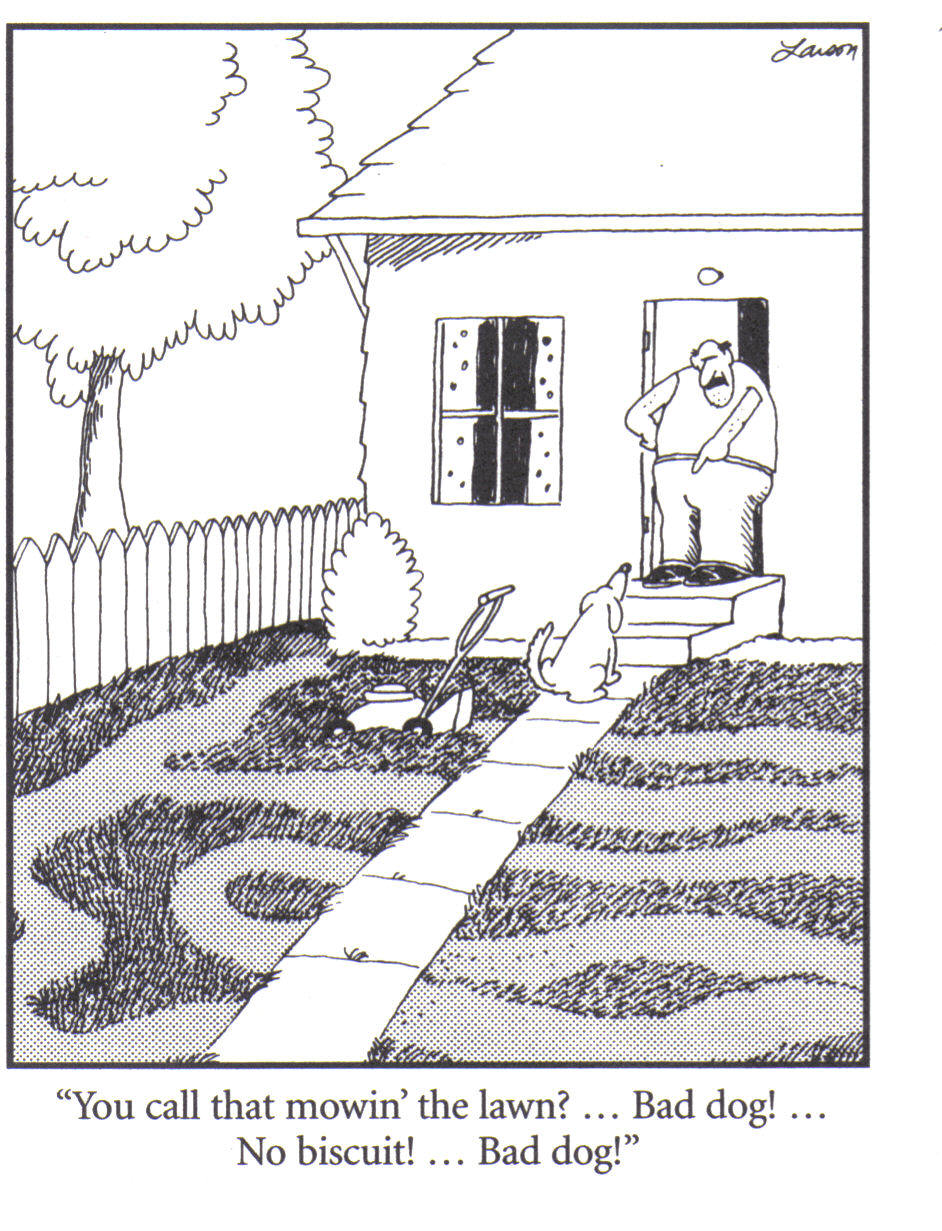
Another thing I realized was how sincere Jacob was in his desire to work and to help. He was doing his best and wanted to contribute. I suppose I could have criticized and scolded him for occasionally adding to my work, but to what end. (A Gary Larson cartoon comes to mind, which I have included below.) At two years of age I just wanted to affirm his desire to help and to make his car washing experience as positive as possible. As he developmentally matures, then my communication will change, too. For instance, I will coach on how to clean the wheels and tires and will offer tips on how to get sap off. Through it all, though, I will want to keep the principles of affirmation and appreciation in mind.

Dog mowing lawn cartoon

Choice theory can really begin at birth. It’s more than just giving kids choices. It has a lot to do with how I show up as the parent or the teacher. My expectations set the tone. To that end, I look forward to many more car washes with Jacob. I always want him to feel the same way.

Why Fulfill Your Own Dreams, When Your Kids Can Do It For You?

As with each of the 7 Worst Mistakes that Good Parents Make, #7–Your kids fulfilling your dreams–is sneaky. A parent can look like he cares about how his child is doing, can come across like he simply yearns for his child to be successful, and that he wants this for the child’s sake, when really he wants it for his own ego needs. Each of the 7 Mistakes has this quality, that being that parents can look like they’re doing what they’re doing for one reason, when in fact they are really doing it for another reason. So, with that brief introduction in mind, let’s consider the last of the Mistakes Good Parents Make through the lens of choice theory.

Why Fulfill Your Own Dreams, When Your Kids Can Do It For You?

Roger Pope is livid as he leaves the school gymnasium and heads to the parking lot. Although his son played in the game that just finished, he wasn’t a starter. And when he was on the court his talents were not really featured as they should have been. Mr. Pope will be confronting the coach tomorrow about that. Peter Bolls is sensing his daughter’s enthusiasm to become a doctor is faltering and he feels his frustration rising. He wants to straighten her thinking out — now! There’s no way she is going to change her major and become a .  .  .  a teacher, of all things. As Marjorie Kent dropped her daughter off at school this morning, and watched her connect with a few of her friends as they all walked up the steps and into the main building, she wondered how popular her daughter was and about how good her grades were compared to others. She seemed to be accepted by the other students and respected by the school staff, but maybe not. Kids could be so fickle. Marjorie decided then and there to have a party at their house this coming weekend and have a lot of the kids over. Couldn’t hurt, she thought. Roger, Peter, and Marjorie all have something in common–their own needs are being met through the achievements and status of their children.

Alfie Kohn wrote about such parents in Only for My Kid, an article published in Kappan in 1998. Kohn cited cases in which schools that were attempting to create a curriculum in which all students could succeed were taken to task by parents whose kids were already successful. These parents actually undermined progressive reform efforts to teach more students effectively. When school officials tried to talk with these parents about specific learning strategies the parents expressed little interest or declined to listen at all. The only thing that mattered to them was that the school program continued to create pedestals on which their own child could stand and that would differentiate him/her from the others. Kohn referred to these parents as BIRG parents, using an acronym I have never forgotten and that seems to capture the essence of #7. BIRG stands for Basking in Reflected Glory. And as much as I want to point a condemning finger at the icky parents in Kohn’s article, the acronym also challenges me to self-evaluate the extent to which I may BIRGing.

BIRG stands for Basking in Reflected Glory.

It is the basic need for power and achievement that fuels a parent’s basking in the glory of his child. If our child is famous–it fulfills our desire for fame; if he or she is talented–others will think their talent came from us; if he or she has their act together–it is a reflection on our superior parenting. Much is at stake in this process. Usually, parent and child can survive this sometimes subtle and sometimes blatant manipulation. Sometimes, though, as depicted in the movie, Dead Poets’ Society, the result can be catastrophic.

BIRGing is really about exploitation. We want to gain an advantage, improve our own reputations, or increase our status through the accomplishments of our son or daughter. Our need for this status drives us to manipulate the behavior of the child whose fame train we are riding. It’s not only parents who BIRG. Teachers and even schools can BIRG, too. We proclaim and advertise our elite students’ skills and successes in the hope that others will want to go to our fantastic school as well. Look how good Megan is as a musician. She goes to our school! Or look at what an athlete Stephan is. He is one of our students! Whether at home or at school, kids pick up on this manipulation and they resent it. They don’t always understand what is going on, especially if they are young children, but they don’t like how it feels.

I don’t want to convey that parents can’t have hopes and dreams for their children, and it doesn’t mean they can’t try to influence their children in the direction of those dreams. The danger lies in parents ignoring or bulldozing the dreams of their children and replacing them with their own. Doing this for our own selfish reasons, so that our personal needs are the priority, only makes it worse. One of the greatest gifts a parent can give a child is to help him or her discover their true identity and enable them to achieve their dreams. It is an unselfish act to do this, a legacy-creating act whose ripples will be felt for generations to come.

One of the greatest gifts a parent can give a child is to help him or her discover their true identity and enable them to achieve their dreams.

Structure is my friend. Signed, Choice Theory

Number 6 on The 7 Worst Things list has to do with failing to give children structure. The idea of structure may seem in opposition to the ideas of choice theory, and indeed, some people get confused on how the two can go together. Let’s check #6 out together.

The 7 Worst Things Good Parents Do

1. Baby your child.

2. Put your marriage last.

3. Push your child into too many activities.

4. Ignore your emotional or spiritual life.

5. Be your child’s best friend.

6. Fail to give your child structure.

A few choice theory things come to mind regarding children’s need for structure (actually, it’s not just children that benefit from structure) –

Lead-management and the middle of the road

When asked what the opposite of boss-management is, people will quickly suggest that it’s lead-management, which, to their surprise, isn’t correct. The opposite of boss-management is actually a management approach called laissez-faire. Boss-management relies on rewards and punishments and tends to over-manage in the process; laissez-faire relies on kids to manage themselves and tends to under-manage. On a spectrum, with laissez-faire on one side and boss-management on the other, lead-management actually falls between them. Lead-management has boundaries and guidelines and rules; the uniqueness of lead-management lies not in the absence of boundaries, but in the way you apply them.

Structure is our friend

Choice theory affirms the need for structure in the form of clear expectations, detailed instructions, reasonable boundaries, and consistent rules. A lead manager develops expectations and boundaries from a spirit that acknowledges the internal motivation of her students. She doesn’t want to set up or perpetuate a power struggle. Expectations and boundaries are created to improve the enjoyment and the success of everyone involved. Whether it’s children at home, students in the classroom, or employees at work, all of them appreciate knowing how to achieve more and have fun in the process.

The difference is in the application

Prior to their understanding choice theory, I have heard a few people say, “Well, if you can’t make kids do what you want them to do, I guess you just let them do whatever they want.” Nothing could be further from the truth! Both boss-managers and lead-managers have expectations and boundaries. The difference lies in how they apply the boundaries. Rather than bribing certain behaviors and punishing others,  lead managers want to guide behavior, first by creating a need-satisfying environment, second by invitation and persuasion, and third by gently requiring that reasonable boundaries be respected.

Getting out of trouble

Even when there is a warm, engaging environment; even when teachers or parents are attempting to create need-satisfying experiences; and even when the expectations and boundaries are clear and reasonable, children will cross the line and get in trouble. True, it will happen much less often in such an environment, but it will occasionally happen. Students in a lead-managed classroom know that they will need to get themselves out of what they got themselves into. If they have behaved in a way that has harmed a relationship, then they need to come up with a way to restore the relationship and keep it from being harmed in the future. They know they are supported in this process. Anger, threats, disgust, or guilt will not be directed at them. Usually, children and students know what to do to fix what they have done and can develop a plan to prevent it from happening again. Sometimes, they aren’t sure where to begin and if this is the case, the lead-manager parent or teacher is happy to help. Instead of arbitrary punishments that appear to quickly deal with the problem, yet really don’t address the issue at all, lead-managers take the time (in many cases this does not take much time at all) to help students understand what they have done and plan for better thinking and acting in the future.

It might seem counterintuitive, but there is actually freedom in structure. When the motive and underpinnings of structure are unselfish and designed to help and support others, rather than control them, structure is really good.

(I feel like I’ve left something out when it comes to structure and choice theory. Any ideas on what it might be?)

On to #7 in the next blog.

7. Expect your child to fulfill your dreams.

Friel, J. and Friel, L. (1999). The 7 worst things good parents do. New York: Barnes & Noble.

Parent and Child – “best” friends?

Choice theory emphasizes the importance of positive, caring relationships. In fact, our mental health is dependent on our having good relationships with others. So with this in mind, some might wonder how a parent being in such a close relationship with his/her child could be a problem. First, let’s agree that there is a difference between being a true best friend, who always has the best good of his friend in mind, and a “best friend,” who likes to hang out and “do stuff.” It feels to me that #5 – Being your child’s best friend – is referring to the latter.

The 7 Worst Things Good Parents Do

1. Baby your child.

2. Put your marriage last.

3. Push your child into too many activities.

4. Ignore your emotional or spiritual life.

5. Be your child’s best friend.

From a choice theory viewpoint, this is a really important topic! So many good things come out of parents being in good relationship with their children, and so many bad things come out of that relationship being broken. The more important the relationship (I’m hard-pressed to think of a relationship more important than the parent/child relationship), the more important it is to stay connected. Connection is everything; because as long as we are connected, we have influence. For a parent, influence is like gold.

The “best friend” from childhood was often rooted in insecurity, and was more about what could be gotten from the friendship, over what could be given. “Best friends” were there for the moment, like flavor-of-the-month ice cream, they tended to come and go. They had our back, for a while. They liked the same things, for a while, too. There isn’t necessarily a problem with having a “best friend.” It seems to be a rite of passage to have a best friend and to learn about being able to count on friends, as well as being disappointed by them. This is part of growing up. Problems occur, though, when parents behave in a way that mirrors childhood friendships. Young teachers, not used to being the adult presence and wanting to be on a buddy-buddy level with students, sometimes  learn about this problem the hard way. Most of them learn about what it means to be a professional and adjust their student relationships accordingly. A few do not make this adjustment and their careers can be cut short.

Parent and child have a special and unique friendship; theirs is a relationship like no other. Part of the uniqueness has to do with the challenge parents have to foster a warm, positive relationship, while also compassionately setting behavioral expectations within a consistent structure. Children want the warmth and acceptance that comes from a good friend, but they also want (yes, want) helpful structure and even limits in their lives. The warmth and acceptance between parent and child should last for a lifetime; the trick is knowing how and when to incrementally let go of the structure we have for our children and the limits we place on them.

6. Fail to give your child structure.

7. Expect your child to fulfill your dreams.

Friel, J. and Friel, L. (1999). The 7 worst things good parents do. New York: Barnes & Noble.