Posts tagged “Glasser biography

A Picture Is Worth a Thousand Discussions

satirical-art-pawel-kuczynski-6-620x


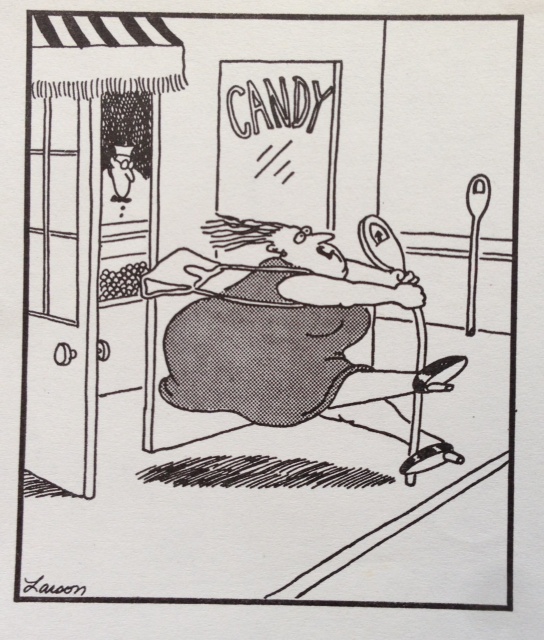
Some pictures just cause us to pause and think about what we are seeing. This picture did that for me. (Thank you, Chris Kinney, for sharing this picture with us.) What a great discussion-starter it would be in a class, especially a choice theory workshop. Or maybe ask participants to come up with a title for the picture. It certainly causes us to think about classroom learning strategies and our own experience as a teacher and as a learner. In the year and a half The Better Plan blog has been going, the posts have shared several “discussion starter” pictures. Today’s blog is a gallery of those pictures. So much can be captured in a photo, a drawing, or a painting.

Candy Vacuum   We Choose   strings-attached   Push or Pull
Still a classic, no matter how many times I see it.

Still a classic, no matter how many times I see it.

self-assessment-1
This is such a dark picture, yet it captures a process in which we might find ourselves.

This is such a dark picture, yet it captures a process in which we might find ourselves.

amnesty_print_chains


It is a good thing when we can help people see how powerful the pictures they place in their quality worlds are, and how these pictures drive us toward their fulfillment. It is good, too, when people come to see how valuable freedom is, not just freedom from political tyranny, but freedom within our own thinking and behavior. Sometimes a picture can say more than a 20 minute lecture, and it invites a personal response in ways that a lecture may not.

==================

Leaving tomorrow morning for the 2nd International Glasser Conference, being held in Toronto, Ontario, from July 9-13. I am looking forward to seeing some of you there. I am presenting at the conference, first thing Thursday morning, about the biography and key aspects of Glasser and his ideas. I think I’m ready. We’ll see how it goes.

I spent a lot of time yesterday trying to be able to sell my books, Champion of Choice and Soul Shapers, right here on the blog. It can be done, however it is fairly expensive to set it up. I may end up just having people send me a check, along with their shipping address and any instructions for how they may want me to sign the book. If the requests for signed editions of the book are great enough, I would definitely want to add an on-line sales option.

================

Have you contributed a review of Champion of Choice on Amazon? Why not take a moment and do that now? It doesn’t have to be lengthy, and it’s easy to do.

The Simon Cowell In Each of Us

$T2eC16h,!)EE9s2uiwPRBR)O6o2dG!~~60_35

At their core the 7 Deadly Habits are built on the foundation of judging others. Think about it.

The 7 Deadly Habits are –

1. Criticizing
2. Blaming
3. Complaining
4. Nagging
5. Threatening
6. Punishing
7. Rewarding to manipulate

Each of these habits involves the spirit of judgment. Criticizing, blaming, complaining, and nagging serve as tools for one person to apply behavioral pressure on a family member or colleague. Threatening and punishing take the spirit of judgment to a more intense level. And even rewarding to manipulate, which feels better than punishment, is still a form of manipulation.

This year's American Idol judges - Harry Connick, Jr., Jennifer Lopez, and Keith Urban.

This year’s American Idol judges – Harry Connick, Jr., Jennifer Lopez, and Keith Urban.

We marinate in a judging society, with TV shows like American Idol, Dancing with the Stars, Survivor, The Bachelor, America’s Next Top Model, The Voice, and Top Chef thriving and calling for our attention. Immersed in a society of judgment it shouldn’t be a surprise that we view others, even our family and friends, in this same way. And in this same way we begin to develop a little “Simon Cowell” in our brains, an overconfident, opinionated, supposedly “all knowing” presence that knows what’s best.

The choice theory axiom that Glasser put at the top of the list is –

The only person you can control is yourself.

This axiom, or principle as I would call it, really does speak to this issue. It’s not about judging and controlling others. It’s about knowing and directing ourselves. When we honor this axiom we become happier and our relationships become stronger and more intimate.

School Application

I think it can be said that –

Without intervention students will judge others.

Schools can make a significant positive social impact by minimizing, or even eliminating, activities that rely on students being ranked and compared to one another. Resist the temptation to turn activities into contests in which students are pitted against each other. We don’t need to determine the “best” essay or who is the “best” speller. Instead, our goal should be to design activities in which all of the students are drawn to participate in and engaged in the learning.

Even our recess games and rainy day indoor games can contribute to this spirit of inclusion. For instance, consider the following version of musical chairs.

In the normal version of musical chairs there are always fewer chairs than participants and the goal is to be quicker, stronger, and more aggressive than your playmates and get one of those remaining chairs. There is often a sneaky piano player or musical device to add to the drama, but the basic premise is you better get one of those chairs, even at the expense of someone else who has the same goal. The result is that very quickly most of the players are standing against the wall watching while the few remaining players push, pull, tackle, and attack their way to victory.

musical-chairs

In a cooperative version of musical chairs you still have the sneaky music (ya gotta have the music) and you still remove chairs as the game goes along. The difference is that you don’t remove players. This means that as the game goes on you have the same number of players having to sit, stand, and be suspended from fewer and fewer chairs. It gets pretty hilarious when 10 players have to somehow get situated on two chairs.

The message we send to children in the normal version is that in life there will always be fewer prizes than participants and that you better be quicker and more aggressive in getting your needs met, even if it keeps someone else from meeting theirs.

In the cooperative version children are introduced to the idea that we are in this thing called life together, and that if we hold on to one another and help each other we can all make it. There may be fewer chairs in life, but that doesn’t mean we can’t share what’s left.

=============

The Glasser biography can be had through the following link –

The Glasser Book Store
http://wglasserbooks.com/books.html

Zeig, Tucker & Thiesen Publishing
http://www.zeigtucker.com/product/william-glasser-champion-of-choice/

Amazon
http://www.amazon.com/William-Glasser-Champion-Jim-Roy/dp/193444247X/ref=sr_1_1?s=books&ie=UTF8&qid=1398205174&sr=1-1&keywords=william+glasser+champion+of+choice


Hot Off the Press! Really.

Bob Wubbolding, who wrote the Foreword for the biography, and Glasser at the Evolution of Psychotherapy Conference in 2005.

Bob Wubbolding, who wrote the Foreword for the biography, and Glasser at the Evolution of Psychotherapy Conference in 2005.

The Glasser biography became available yesterday on the Zeig, Tucker & Theisen Publishers website. The following link takes you to the right page –

http://www.zeigtucker.com/product/william-glasser-champion-of-choice/

I first learned about the biography being available through an email from William Glasser, Inc.   Hot Off the Press it proclaimed; ten years in the making it pointed out; followed by a short testimonial by Carleen Glasser –

Champion of Choice is a wonderful story and a great read because it gives you the feeling that you are present, watching the life and ideas of a true genius evolve.”

The book is listed at $22.95, but is being sold right now for just $22.00 on the publisher’s website. Buyers are given the option of giving a $5 donation, along with their book purchase, to the William Glasser International organization. It is a very simple process and a nice touch, I think.

I received a compliment yesterday when someone said they loved the promo I wrote for the book on the publisher’s website. I had to admit that I didn’t write it, but that I liked it, too. The promo in question went like this –

WILLIAM GLASSER: Champion of Choice
A biography by Jim Roy

William Glasser did not just have a profession, he had a mission—to empower people through choice, free will, and self-determination. He envisioned a better world, and the weighty issues he tackled reflected that—the definition, diagnosis, and treatment of mental illness; the explosion of psychotropic drugs; addiction and self-medication; failing marriages and the high divorce rate; disconnected families; crime and crowded prisons; underachieving students and marginal schools; and worldwide political oppression and violence.

Jim Roy chronicles the life and legacy of William Glasser whose controversial ideas and brilliant insights significantly impacted mental health and education professionals. Champion of Change illustrates Glasser’s lifelong dedication to help others lead productive, meaningful lives.

Although Glasser was already gaining recognition in the early ‘60s with the publication of his first book, Mental Health or Mental Illness, his notoriety changed significantly after his second, Reality Therapy (1965). Working as psychiatrist in the late ‘60s at the Ventura Schools for Girls, a school for troubled teens, Glasser’s professional life really began to take shape as his ideas were implemented, dramatically changing and reforming young women who most had given up on. His long and successful run at the school prompted another book, Schools Without Failure (1969), which is still a bible to many present-day educators.

Over the next four decades Glasser published 23 books and a slew of booklets and articles, and was interviewed and written about in myriad books, magazines, and journals. The principles and concepts he held and generously shared and articulated through his books and public speaking were reality therapy, control theory, choice theory, and mental health as a public issue rather than a medical issue. The latter being the most controversial in that Glasser swam against the tidal wave that swept in the growing belief that drug therapy should supersede talk therapy.

Also captivating is Glasser’s personal life – his own dysfunctional family history, the family losses he endured, and his quest to find love again. And through it all he selflessly continued to work to change the bigger picture. In the introduction of William Glasser – Champion of Change, it’s stated that novelist Thomas Berger once said writers write because “it isn’t there,” and Jim Roy takes that to heart giving us a comprehensive and compelling biography on voice that will surely echo throughout history.

2014 / 420 Pages / 6 x 9 / Paperbound / Illustrated / ISBN 978-1-934442-47-0 / $22.95
Add $5 donation to William Glasser International ($27.95)

You may have noticed that twice in the promo the biography was referred to as Champion of Change. The layout editor of the biography somehow got that phrase in his mind early on in the process and it continues to show up at various times. My wife thinks that Champion of Change might actually be a better title, but Champion of Choice has won out so far.

Kim Daub Olver, current Executive Director of Glasser International, shared on Facebook yesterday that she feels the book will be a huge contribution to the world. To that I say, I hope so. It would be so cool if the biography really made an impact on people’s thinking and acting.

================

Enjoying The Better Plan blog? Why not click on the Follow link and receive updates as they are posted. You also have my permission to tell family and friends about the blog. We all could use an insight now and then on living a non-coercive life.

Linda, Gone Too Soon

Linda Harshman and Jim Roy, both attending the 2005 Glasser International Conference in Dublin, Ireland.

Linda Harshman and Jim Roy, both attending the 2005 Glasser International Conference in Dublin, Ireland.

Linda Harshman, longtime Executive Director of the Glasser Institute, passed away on Friday evening, April 4. She faithfully held that position for over 20 years and did everything she could for William Glasser and his organization to be successful. Bob Wubbolding, who worked with Linda as the longtime Director of Training for the Institute, wrote that –

Many of you have undoubtedly received the sad news that Linda Harshman died at her home about 11:15 pm Pacific Time on April 4, 2014. She was with her sister Judy and her friend Frank. She was under the care of Hospice for a short time before her death.

Sandie and I spoke to Carleen Glasser today and she joins us in expressing our sadness at the loss of a very fine person. Linda was an anchor for the William Glasser Institute for many years and a dear friend to many of us.

Carleen, Sandie and I were very fortunate to visit with her about 2 weeks ago. Throughout her illness Anna Corbett and Jean Suffield frequently visited with her and cared for her. We owe them a great deal of gratitude for their unrelenting care giving and support. Also, her sister Judy from Nova Scotia provided family closeness and support as Linda approached death.

It was Linda’s wish that there be no public service held for her. Nevertheless, our prayers and thoughts have accompanied her and will continue in the future as we hold her memory close to our hearts.

And John Cooper, chairperson of William Glasser International, wrote that –

I have just learned of the passing of Linda Harshman some 24 hours ago. A sad time for everyone who knew Linda and of her support for Dr Glasser and his work.

It was just recently we heard that Linda was fighting a valiant battle with Stage 4 Cancer. The cards and messages that many people sent to Linda, in the intervening weeks were all read to her by Frank, her friend. We are advised the words of love and appreciation were well received and meant a lot to Linda. Then just days ago we learned that chemotherapy had been ceased and that she was under Hospice Care.

For those who had the opportunity to meet and work with Linda or just knew of her work it is hard to accept that one so animated, strong and energetic in administering the work of the William Glasser Institute is no longer with us. I am advised that Linda played a large part in supporting affiliates / countries as they began to establish their own institutes and that many people would like to acknowledge Linda. Such testimonies may form a part of our recognition. WGI will advise everyone what we will be doing to celebrate her life and work and how you can all contribute.

I am sure I voice the thoughts of all in sending a message that we share the sorrow of Linda’s near friends and family at this time.

I appreciate these messages from Bob and John a lot. They bring all of us together in a shared sense of loss, an appropriate grief. In that spirit I would like to add a tribute to Linda. What follows is an excerpt from the Glasser biography. The excerpt is from a very significant talk that Glasser gave in 1996.  He was setting a course for the future of the Institute, even though others disagreed with him. The disagreement had to do with school discipline plans, but that’s not our focus here. Our focus here is on Linda and the esteem in which Glasser held her. With that in mind, from the biography –

At the end of the talk he said something that really put into perspective what he was trying to say. “So that’s the dilemma we have,” he began to conclude. “On Sunday we’ll talk about that dilemma and see if we can come to some resolution that will be satisfying, but the resolution will not be that I can accept any discipline programs, cuz I can’t. If it ends up right back where it was with me and all the rest of the people go, it’ll be me and Linda and we’ll keep hammering away for the rest of our lives. I feel very, very serious about this. Because I finally recognized what my mission in life is.”

Could there be a higher tribute to Linda’s faithfulness and commitment to Glasser’s vision? Organizationally, Glasser had been walking shoulder to shoulder with Linda and knew that he could count on her, through thick and thin, come what may.

Who would have thought, even just a few years ago, that Glasser and Linda would be gone from us, having passed away only seven months apart? Their passing is a stark reminder that if the show is to go on, the baton must be passed on to others – us – who will accept it in the kind of spirit that inspired the two of them.


The Best Version of Themselves

Glasser received an honorary doctorate at the same time I received my Ed.D.

Glasser received an honorary doctorate at the same time I received my Ed.D.

I began the last blog with “The Glasser biography is printed and is now available!” It turns out it would have been more accurate if I had left it at “The Glasser biography is printed.” I have the book. It looks great! But I still can’t tell you how you can get a copy. Nothing yet on the publisher’s website or on the wglasserbooks.com website. The Better Plan followers will be among the first to know about how to get the book. Stay tuned.

=============

photo 1

I have continued to think about some of the things Glasser suggested in one of his unpublished articles that I posted as part of the March 19 blog. For instance, in reference to how parents should guide their children he wrote that –

“What we should be sensitive to from early on is what they want. Then as much as we can, rather than to give them things we should make an effort to take the additional time to teach them how to satisfy their needs themselves.”

The idea of taking the time to teach kids how to satisfy their own needs has made a real impression on me. This process is about honoring your child as a fellow human being with unique dreams and goals of his/her own. It is about respecting their ideas and helping them achieve them. It is a process full of love and compassion.

It was helpful to me that Glasser went on to explain that as parents we can –

“Assure them from the time that they can comprehend it that we believe in the way we live our lives, but that our way is not necessarily the best way, the only way or the way for them. And as our way changes, as it will, show them that we can be tolerant of ourselves as we change. From this they will learn that they too have a way but that it is not the only way and that they should be tolerant of themselves as they change.”

Is such an honest and candid relationship possible between parent and child?

I especially thought about the effect such a relationship would have on a child’s spiritual journey. What would it be like for parents to express how much they believe in the way they live their lives, but somehow to admit that their way may not be the only way for the child? What if parents modeled an authentic and real connection with Jesus, and invited their children to be a part of that connection, yet somehow did so non-coercively? Too many children are growing up to be screwed-up adults, unclear regarding their purpose in life and spiritually unhappy. To a great extent I think this has a lot to do with children experiencing the opposite of what Glasser described. Instead of focusing on creating and maintaining their own spiritual lives and then inviting, inspiring, and persuading their children to join them, parents are leading halfway religious lives and then trying to force their children to do the same. Criticizing, nagging, threatening and punishing are frequently present in this approach.

Glasser believed that if we can foster a relationship with our children that honors and respects them as fellow human beings –

“ .  .  . especially to refrain from criticizing them, we have a chance, even a good chance (there are no sure things in this delicate process) to enjoy the reward which is a child who loves us, respects us, and enjoys spending time with us.”

And I would add that more adults would turn out well-adjusted and mentally healthy.

photo 2

As I considered Glasser’s thoughts on parenting I was reminded about something I read in Ted and Nancy Sizer’s book, The Students Are Watching: Schools and the Moral Contract (1999). Describing the role schools can play in students’ lives, they wrote that “We must insist on a high school design which will help all the high school’s people to reach for the best version of themselves.” p. xiii

I like the idea that we can help children and students to reach for the best version of themselves. I like the phrase “best version of themselves” a lot.

===========

Classroom Application:

In the absence of intervention, students will come to see their teacher as the judge and chief evaluator. Students turn in assignments and hope that their teacher will accept it, or maybe even like it. Somehow the school system has created a divide between what students do and their own connection to that skill or product.

Teachers can begin to restore this connection between pupil and product by changing their own role in the classroom. Whenever appropriate, a teacher can help students evaluate aspects of their assignments by saying or asking things like –

Tell me what you like about what you have created.

What part of this assignment was the most satisfying for you?

What grade would you give yourself on this assignment and why?

What strategies did you use that helped you complete this assignment?

Teachers can still make evaluative statements; we just need to do less of it. We need to share the evaluation process with students. This sharing can be done informally, like the sample questions above, or it can be done formally where student self-evaluation becomes part of the project rubric.

===========

“I think the big mistake in schools is trying to teach children anything, and by using fear as the basic motivation. Fear of getting failing grades, fear of not staying with your class, etc. Interest can produce learning on a scale compared to fear as a nuclear explosion to a firecracker.”    Stanley Kubrick

Glasser Biography Now Available

photo

The Glasser biography has been printed and is now available!

I knew the day would come, and yesterday it did come, as I received from the printer my copies of the finished book! It took longer than I thought it would to go through the editing and publishing process, but that is behind us now.

I am pleased with the look and feel of the book, especially the inside look of the pages. Great font and spacing; it is very readable in that way. Hopefully, you will find it readable in every way.

The first interview I conducted with Glasser took place on September 26, 2003. It’s hard to believe it’s been more than 10 years since that moment we began in his Los Angeles home. I didn’t start out as his biographer. I approached him about my completing a dissertation on the development of his ideas. He agreed and the interviews began.

After our third interview he began referring to our work as his biography project, something I was open to, although I had no clue at the time of the implications of what it would mean to become his biographer. At the 2004 international Glasser conference in Schaumburg, Illinois, he surprised me during the banquet when he officially introduced me as his biographer. I realized then that the project was going to be more than a dissertation.

I presented a copy of my dissertation to Glasser in 2007.

I presented a copy of my dissertation to Glasser in 2007.

We continued interviewing together through 2008, although we talked pretty consistently even after the formal interviews had stopped. He filled in details as I ran into missing pieces of his story. He was always glad to visit about his ideas. The biography project was important to him.

I wish that I could place a copy of his biography in his hands today. I really wanted to do that; I think he wanted that, too. We would have enjoyed holding something so tangible as a representation of all that we had worked on together. And for him, with the book representing his life and work, it would have been even more significant.

The biography is now available, and you would think I would be able to tell you about how to get a copy. But alas, I cannot .  .  . yet. My copies were shipped from a printer in Illinois, although I am pretty sure the printer will have nothing to do with sales and shipping. The publisher is Zeig, Tucker & Theisen Publishing, but as of this morning there is no announcement on their website about the book. I know that Jim Coddington at wglasserbooks.com is going to have information about the biography, but nothing yet there, either.

I will be in touch with the publisher on Monday and will get all of the ordering information, which I will immediately pass on to you.

For now I am enjoying going through the book and re-reading portions of it myself. It has been a while since I have written it so it is like bumping into a good friend who you haven’t seen in a long time. It has been good for me “catching up” with the Glasser story.

=============

8 Books on William Glasser’s Bookshelf (that are now on mine)

Used bookstore in San Luis Obispo, CA.

Used bookstore in San Luis Obispo, CA.

For almost a year there has been an old book on top of one of the stacks on my bedside table, and even though I haven’t read it, my love and belonging and power needs are met every time I see it.

Glasser and I talked about a lot of things as I wrote his biography. During our interviews he would frequently bring up what he happened to be reading at the moment. He read a lot. Sometimes he would talk about an article he read in the New Yorker; or about an editorial in the Los Angeles Times; or about a book he was reading. When we visited about his childhood he described how much he read even then.

As a child he especially liked a group of books known as The Young Trailers Series. He spoke fondly and respectfully of the Young Trailers author, Joseph Altsheler, and about how he could really write adventure stories, tales that required resourcefulness and bravery. He read these books so many times that he could not remember the exact number. I had never heard of them or the author, but became curious about them due entirely to Glasser’s enthusiasm. I did some checking, figuring that I would just go to half.com or Amazon and pick up one or two of these books, and discovered instead that getting my hands on an Altsheler book was not as easy as I thought it was going to be. If I was willing to part with $200 I could have one mailed to my house. Otherwise I would need to begin searching the occasional used bookstores I was able to frequent.

Looking on my bookshelves now, I am reminded of the different books that Glasser alerted me to, and that I was able to find at used bookstores here and there. Books like Jesse Stuart’s, The Thread That Runs So True (1949), and Ernest Kurtz’s, Not God: A History of Alcoholics Anonymous (1979). He loved anything that Anthony Trollope wrote, who he felt could really get inside a character and what he or she was thinking. I don’t have any of Trollope’s books yet, but I probably will someday add a few of his books to the Glasser section in my library. I go to a used bookstore in San Luis Obispo, California, at least twice a year and while browsing there a few years back I discovered an old copy of Glasser’s all-time favorite book, Raintree County (1947), by Ross Lockridge, Jr. “I’ve read that book at least seven times,” he shared with me, which is no small feat considering it runs 1,060 pages long. When I took it to the counter to buy I thought it might be kind of expensive, but it wasn’t. Didn’t they know it was William Glasser’s favorite book?

IMG_0942

Not all of Glasser’s recommendations were of old books. For instance, he convinced me that I needed to go out and buy a book by Mark Haddon called The Curious Incident of the Dog in the Night-Time (2003), an incredible book with an autistic savant as the hero of the story. He also convinced me on books like Mad in America (2002), by Robert Whitaker; America Fooled (2006), by Timothy Scott; and especially Beyond Prozac (2005), by Terry Lynch. For those years that Glasser and I worked together he seemed to be with me whenever I went book shopping, be it in a Barnes & Noble, a used bookstore, or online. My experience was that he had a good eye for reading material.

IMG_0947

I had kind of given up on finding any of Altsheler’s books, although last year when I was in a used bookstore in Nevada City, California, and discovered they had a kid’s section, I decided to look more carefully. There could be a chance. And then, as I looked from book spine to book spine, there it was. There was The Forest Runners (1908), by Joseph Altsheler. I opened and closed my eyes to make sure I was seeing correctly. I looked inside and saw that it was the second book of eight in The Young Trailers Series. I wondered about its price as I approached the cash register. I was told it was $18 and that it would come to almost $20 with tax. I got the $20 out of my wallet so fast the bookstore owner must have been tempted to say, “Wait a minute, now I can see the price more clearly. It’s not an 18, that’s an 80. I meant to say $80.” But he didn’t and I left with a special treasure.

IMG_0939

The Forest Runners has sat on my bedside table ever since. I haven’t read it and I don’t intend to soon, yet I feel good every time I see it. I feel a connection to Bill and remember his joy and excitement as he described things the book’s characters overcame. My oldest grandson is three and a half, so he’s not ready for swashbuckling adventure yet, but when he is I know of a book we can share together. (Oh, bother. How am I going to find the other seven books in the series?)

=================

Interested in stories about Bill Glasser? Glad for choice theory tips on how to live a happier life? Appreciate ideas on how to bring choice theory into the classroom? Then why not pass it on and tell a friend or colleague about The Better Plan blog.

http://thebetterplan.org

==================

Follow on Twitter – @thebetterplan

==================

Remember the new 2103 – At A Glance link at the upper left hand corner of the page when looking to catch up on topics from last year. Quick links to all the articles are chronologically listed.

Why DRIVE Drives Me

drive2_custom-9249e86ca8c89adc06c6484e8498e3e5e8672279-s6-c85

Drive (2009), Daniel Pink’s New York Times Bestseller, represents one of the reasons I was “driven” to write the Glasser biography. Drive is a well-written, captivating explanation of human motivation. Pink describes what he sees as a progression from Motivation 1.0 – motivation based purely on a biological drive for survival – to Motivation 2.0 – motivation based on extrinsic reward and punishment – to Motivation 3.0 – motivation based on intrinsic needs for autonomy, creativity, and achievement. Reading Pink’s insights and examples are like reviewing a What’s What list of research and a Who’s Who list of thought leaders and gurus in the fields of psychology, philosophy, and business over the last 50 years. Only problem is, even though the book covers the dawning of intrinsic motivation and the human need for freedom and self-determination, the influence and contributions of William Glasser are never mentioned.

I read and re-read Drive with such intense mixed emotions. On the one hand I really appreciate the way Pink makes a case for choice theory, while on the other hand I am really frustrated, and even a bit angry, that choice theory or Glasser is totally left out of the book. Abraham Maslow is included; Deci and Ryan are included; and others like Csikszentmihalyi, Seligman, Herzberg, and Deming are mentioned, and a host of others, but not Glasser. How you can write a book about human motivation that summarizes the theories on the topic from the last 50 years and not include William Glasser is beyond me.

Drive is not the only example of Glasser being left out or overlooked. In the course of my research for the Glasser biography I noticed a troubling trend of his work and ideas being less and less at the forefront and more and more slipping into the shadows. Even as the wave of internal control psychology grew bigger, affirming the personal power of choice, people seemed to forget the identity of one of the original wave creators. This felt unfair to me, and even unwise. Unfair because Glasser was one of the pillars on whom others built, and unwise because his message, and the behavior model he developed, is so helpful.

Part of what has motivated me to write Glasser’s story is the hope that the biography will contribute toward establishing his legacy and his prominence as a progressive leader in the fields of mental health and education. I don’t want his ideas to ride off into the sunset. I want his ideas to be recognized as laying the foundation for today’s effective practices.

In spite of Drive not referring to choice theory or Glasser, I still recommend you read it. Drive really is an excellent book and if you are into choice theory you will find that it adds to your understanding and expertise. Just be prepared to have mixed emotions as you go through it.

———————————–

Do you know friends who are into choice theory and who would benefit from these posts? Remember to let them know about thebetterplan.org.

If you appreciate today’s blog, remember to click on the LIKE button at the end of the post.

If you are on Facebook, you can share the post with your friends, too.

———————————

“Everything that frees our spirit without giving us control of ourselves is ruinous.”  Goethe

Glasser Biography Is Published! (kind of)

Jim Roy and Carleen Glasser with the first edition of Bill's biography. Taken at the Evolution of Psychotherapy Conference.

Jim Roy and Carleen Glasser with the first edition of Bill’s biography. Taken at the Evolution of Psychotherapy Conference.

I stopped by the Evolution of Psychotherapy Conference in Anaheim, California, this past Thursday (Dec. 12, 2013) and headed to the conference bookstore to see the Glasser biography for the first time myself. I wasn’t totally clear whether the bio would be ready, and if so, what it would look like. So it was good to see that it had been printed and to hold it in my hand. It was a very special moment for me to walk to the bookstore with Carleen Glasser, who Bill had been married to since 1995 until he passed away in August, and for both of us to hold the book together.

I said that the biography is “kind of” published because apparently the conference edition of the book is a pre-publication version, with the actual big printing taking place next month. For instance, one thing I noticed after buying a copy of the book, was that the Foreword was missing. The publisher had asked Bob Wubbolding to write a Foreword, which I very much supported, and which Bob did, yet for some reason it hasn’t made it into the book yet. Hopefully, that will be fixed soon, along with a few other less notable fixes.

———————–

Choice Theory Study Group is Growing

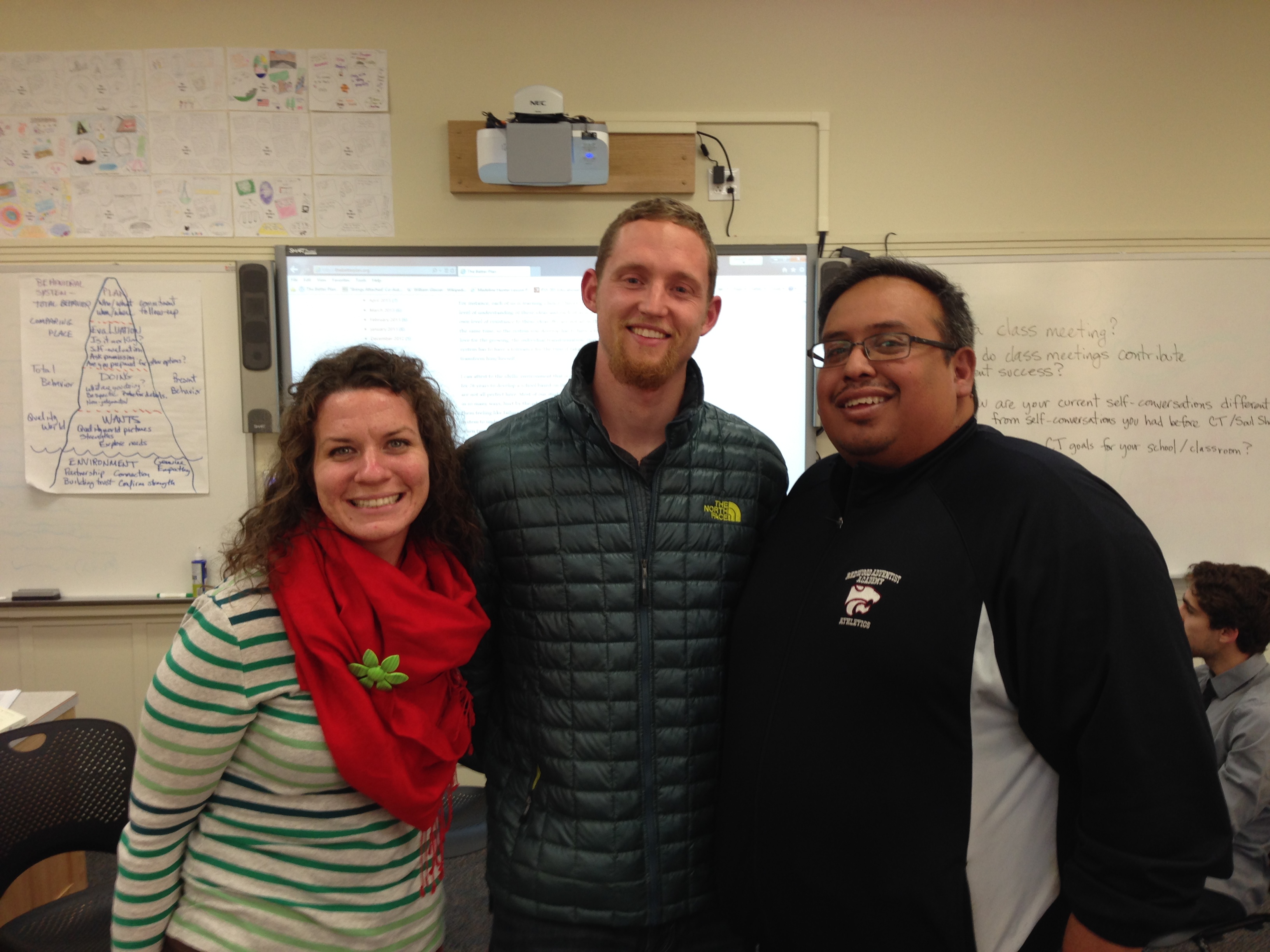
Three of those who attended the recent Choice Theory Study Group: Sonya Reaves, teaching principal at Oakhurst SDA Elementary near Yosemite; Joel Steffan, Gr. 5/6 at Foothills Adventist Elementary School in St. Helena, CA; and George Barcenas, Physical Education and Spanish teacher at Redwood Adventist Academy in Santa Rosa, CA.

Three of those who attended the recent Choice Theory Study Group: Sonya Reaves, teaching principal at Oakhurst SDA Elementary near Yosemite; Joel Steffan, Gr. 5/6 at Foothills Adventist Elementary School in St. Helena, CA; and George Barcenas, Physical Education and Spanish teacher at Redwood Adventist Academy in Santa Rosa, CA.

Our recent Choice Theory Study Group on December 7 broke a record for attendance and we are already looking forward to our next study group on January 25. Put the January date in your calendar now and plan to join us for choice theory discussion and activities. One of the topics we covered on the 7th had to do with classroom meetings. I have included the handout here. Check it out.

Class Meeting guidelines

———————–

Classroom Management Philosophy Paper

I taught Classroom Management during Fall quarter and one of the culminating assignments for my students was to think about and write their philosophy of classroom management. We use Harry Wong’s The First Days of School and Marvin Marshall’s Discipline Without Stress, Punishment or Reward as course textbooks. Part of class time is devoted to introducing choice theory to these future teachers. We really only have time for an orientation to the choice theory principles, yet this year’s students really seemed to take to the ideas. One of my undergraduate students, Laura Helm, put together a concise, yet effective description of the teacher she wants to be. I thought I would share (with her permission) what she wrote.

Classroom Management is an integral part of a teacher’s career. Without effective management, it is very challenging for successful learning to take place. Classroom management seems like a daunting task, and it can be very challenging. After taking this class, I am more prepared to tackle this aspect of being a teacher. Taking Classroom Management has taught me an incredible amount about effective management and the different ways to achieve it. My classroom management philosophy involves self-governance, Choice Theory, procedures, internal motivation, moving away from rewards and punishments, and having relationships with your students.

Possibly the most important concept we learned about is Choice Theory. Choice Theory focuses on self-responsibility along with natural consequences. It is about having the power to choose how you act and how you respond. A significant point of this theory is that you are the only person you can control, and you cannot control others. We govern ourselves and have the power to choose our behavior. Everything we do is working to fulfill our basic needs, as outlined by Glasser in his Choice Theory model. Implementing Choice Theory and its principles in the classroom is essential. Teaching students the significance of self-responsibility and about our basic needs is very important to me. Not only will this be of great importance in the classroom, but also in the future lives of my students. Choice Theory is a way of understanding ourselves and our students on a deeper level, and getting to know how each of us is motivated.

My key beliefs about classroom management surround Choice Theory and management without coercion. I believe that we are motivated intrinsically; therefore external coercion is not effective or beneficial. We do what we do because of something internal, and to fulfill our basic needs. External control, such as rewards and punishments, is not an effective motivator. I think we, as teachers, need to understand that everyone is motivated internally and use that to help the learning process.

In my opinion the use of rewards and punishments in the classroom should be lessened, if not eradicated, as they are a form of coercion. By using rewards, students only focus on getting the reward, not the importance of the learning or doing the work. Punishments often do not address the specific behavior, and can be altogether unrelated. How is it going to help a student learn not to hit other people if he is forced to sweep the parking lot instead of working on changing his behavior? Instead of punishments, natural consequences should be emphasized. There are consequences for behavior and choices that are made, some positive and some negative. Since the student chose their behavior, they will deal with the natural consequences that come about as a result. Unrelated punishments may help for a short time, but they will not help the student to learn why their behavior was wrong and will prevent them from growing or learning to change their behavior.

Another crucial aspect of classroom management in my opinion is procedures. Procedures are of the utmost importance in having a well-managed classroom. Procedures are the way in which the classroom is run and how things are done. Procedures are not rules and they do not have punishments, but students face the consequences of not following procedures correctly. Having specific procedures in place leads to a classroom that runs smoothly. This was made clear to me from watching the video of Mrs. Seroyer’s classroom management techniques. This video impacted me and gave me a new perspective on how to manage a classroom. She emphasized the importance of procedures and how they are one of the most significant parts of effective classroom management. By setting up procedures, teaching them, then rehearsing them until they are learned, students know what the expectations are and how they are supposed to do tasks in the classroom.

To me one of the most important aspects of classroom management is having a strong, positive relationship with your students. Genuinely caring about your students and showing them that you want them to succeed and are there to help is crucial. Once the students believe this, they will be more willing to put effort and care into their work and their behavior. Heather Denton highlighted the importance of this when we visited her classroom. She told us that students will be less willing to care about what we are saying if we do not show them we care for them. I agree with her that relationships are extremely important and are essentially the basis for successful classroom management.

Before taking this course, I had no knowledge about Choice Theory. I thought the only way to manage classrooms was what I had seen and experienced from being a student in many different classrooms. Most of my teachers managed their classrooms with the use of rewards and punishments, and I figured that was the most effective way to manage a classroom. I was usually one of the “good” students, and I rarely got in trouble. When I did, I was punished by time out, having my name written on the board, or something similar that did not help me learn from my mistakes.

My view on classroom management changed substantially after taking this course. It was intriguing to learn about Choice Theory, and that there is more than one way to manage a classroom. Just because classrooms are traditionally managed with rewards, punishments, and other forms of external control, it does not mean that I have to manage my classroom in those ways. I have realized that managing students begins with having a relationship with them. I also understand that everyone is motivated internally, so coercion is not effective with most students. Using rewards, punishments, and coercion never sat well with me, but now I have the knowledge to teach without using coercive techniques.

It is so encouraging to know that candidates such as Laura will be joining our teaching ranks shortly.

————————-

It’s been almost a year exactly since I started The Better plan blog. Thanks for being a part of the journey.

It’s Been Awhile

IMG_0673

I knew it had been a while since my last bike ride, but I didn’t know it was that long. When I got home after riding today I downloaded the last several rides from my Garmin and discovered my last ride was three weeks ago. My goodness, or should it be my badness. It has been a while since my last blog, too. It’s been almost two weeks since the last Better Plan posting and that is a record. Not a record I am proud of mind you, but a record none the less.

The beginning of this school year has been so full and so busy for me, more than usual, I think. Besides getting classes set up and going this Fall quarter, several additional things also have my attention. To find out if you are interested in any of these things keep reading.

Beirut Trip

I am leaving for Beirut, Lebanon, this coming Wednesday, where I will be giving several choice theory presentations to teachers and school administrators. Jimmy Choufani, one of the school principals (and a follower of this blog), has been talking with me for over a year about getting this to happen, so it is awesome that the plan has come together. Jimmy read Soul Shapers over a year ago and wants his colleagues to have an opportunity to at least hear about the principles of choice theory. He has shared with me that on one of the days during the conference the audience will be made up of Christians and Muslims. What a testimony to their unity in the midst of so much unrest all around them. I am humbled to be a part of this venture.

1308277

Also going to Beirut as a co-presenter with me is Dr. Ed Boyatt, recently retired Dean of the School of Education at La Sierra University. Ed, along with Dick and Anita Molstead, (all followers of the blog) was Superintendent of Education in the Oregon Conference while I was principal at Livingstone Academy in Salem from 1993-1996. (Livingstone was the school where most of the Soul Shapers book took place.) Their support meant a great deal to me and I dedicated Soul Shapers to them because of that. I am so thankful that Ed is going on this trip! Together we want to share how the principles of choice theory actually reflect the character of God, as well as share choice theory details that will be especially helpful to educators. After the weekend conference Ed and I will be observing in schools in Beirut and then talking with principals and teachers there about how choice theory can begin to have a presence in classrooms.

We solicit your prayers as we prepare for the trip. Any words of advice would be welcomed as well.

Glasser Biography

The Glasser biography – William Glasser: Champion of Choice – is supposed to come out in late November. The inside of the book looks wonderful. I am really pleased with the look and visual tone of the book. It will be a pleasant read in that way. I am in the midst of a slight disagreement regarding the cover of the book, but it is not a major thing. Hopefully, my input will sway them, but then again, what do I know about cover design. It will just be so good to have the book done!

The Evolution of Psychotherapy conference in Anaheim is at the beginning of December and I think they want to have the book available for that.

Masaki Kakatani, long time Glasser Institute member, has contacted the publisher to begin translating the biography into Japanese. Very cool.

Choice Theory Study Group

Our next Choice Theory Study Group will be on Sabbath afternoon, November 2, at 2:00 pm in the Education building at Pacific Union College. Mark it in your calendar.

Agenda items include:
+ Brief updates on any choice theory lessons or experiences in your classroom or school.
+ I will give a brief update on the Beirut trip.
+ Role play review on how to conference with a student with an attainable want.

Let me know if you have a topic or question for us to consider on November 2.

Choice Theory Study Group
November 2, 2013
PUC Education building