An Unpublished Glasser Letter to the Editor

It’s good to hear Glasser’s voice again in this unpublished letter to the editor of the Los Angeles Times.

Bhs_2014-01-18_20-33

First, an introduction. Birmingham High School, located in the San Fernando Valley of Southern California, came under attack as a bad high school at the close of 2005 and the beginning of 2006. Three years later, in 2009, the school was allowed to become a charter school, with part of the school breaking away to become a smaller magnet school. In 2006, though, because of multiple articles appearing in the LA Times, Glasser became aware of Birmingham’s challenges and wrote a letter to the editor that he hoped would be published. He shared it with me at the beginning of February, 2006. I don’t think the letter ever was published, but I pass it on to you as a reminder of the ideas that Glasser held dear. (The letter is a little long, but you can take that up with Bill.)

THE SCHOOLS ARE NOT OUR ONLY FAILING INSTITUTION
By William Glasser, M.D.

After reading the high school articles in the Los Angeles Times, I feel it is important that the reader not get the impression that school failure is the most serious failure of our society. Many of your readers might be interested in hearing how school failure compares with other failures that are more difficult to solve and much more costly than improving the schools. Our schools are hardly the least effective institution in our society.

Let’s take a look at some of our other failures and I think you’ll see what I mean. Right now, around half the marriages end in divorce and a majority of the half who stays together are very unhappy. There are huge costs in both money and misery associated with so many broken homes.

It is also very interesting to note that while school failure occurs predominantly among low economic classes, marital failure strikes mostly the rich and the middle class. Many couples get sexually involved and have children without getting married. Divorce rates would be much higher if more of them married.

Right now our three domestic car manufactures are failing because the workers and the managers have not been able to figure out how to make a car Americans will buy. Schools often fail because they are both under funded and challenged by student poverty but that is not the problem in the auto industry. They are trying to sell millions of cars below cost, losing billions in the process and laying off thousands of well-paid employees they no longer need. American workers making American cars were the mainstay of our middle class for almost a century. As that class shrinks, many people will suffer.

But our schools, marriages and auto industry are bastions of success compared with our health care delivery system. We spend more money on health care than any other first world country and deliver less care in the process. This system is run by highly educated people who have billions of dollars at their disposal but they are so ineffective that over 40% of our population, many of them well educated and hard working, have no coverage at all. Health care costs adversely affect education, marriage and the work place. But even agreeing on what’s wrong with the system much less fixing it, is no more than a distant dream.

With due respect to the authors of these four articles, they could have written about these other failures as well because the basic questions that need to be answered are (1) Why is there so much failure? And 2) What can we do to reduce it? But if we could answer those questions for Birmingham, the answers would not only be relevant to schools; they would be relevant to marriage, work and health care, literally to many other failures we struggle with not mentioned here.

If we ask teachers, parents and students, what’s wrong with Birmingham, their answers would be clear and simple: each group would blame either one or both the other groups. If we ask husbands and wives, what’s wrong with their marriage, the same thing occurs: they blame each other. If we ask the car manufacturers why their cars which used to sell, no longer move off the showrooms, they’ll blame the workers for asking for too much pay and too many benefits. In turn, the workers will blame the management for poor product design, out of date engineering and exorbitant salaries.

Even in delivering health everyone will tend to agree that it costs too much. But if you ask all the people actually involved in health care such as doctors, nurses, technicians and drug manufacturers why the costs are so high, no one will stand up and say I charge too much. What they will say is that the other group or groups are to blame for the failure even though none of them would be clear on specifics. But to be fair, we can’t expect them to have this knowledge. If they had it, these problems would have already been solved.

The general answer the people involved in these failures use is to go beyond blame and use coercion to try to force the other to change. But even coercion has problems. When low grades, failure and detention were used in Birmingham the students stopped attending. When coercion is used in marriage, divorce or not, the marriage is destroyed. When it is used in industry the workers do low quality work.

In delivering health care, there is no one to coerce. You can’t force people to pay for something with money they don’t have. In desperation, sick people are now clogging our emergency rooms that must treat them or break the law.

Peaceful persuasion, through negotiation, has been the hallmark of what we call democracy for centuries. When we negotiate no one gets all he or she wants but each gets enough to be satisfied, at least for a while. Our whole legal system is based on using a court, judge and jury when the parties can’t negotiate successfully by themselves.

But there is another ancient way to solve our failure problems that could be used in school, marriage, work or health care. That way is education. This gets me back to what initially led me to write this paper. I believe that we can teach people to get along with each other much better than they do now. But it is also true that we, as a society, don’t even attempt to teach in any school from kindergarten through graduate school, what we all need to learn: how to get along with the important people in our lives much better than we do now.

I believe many people don’t even think about the previous statement. They don’t for two reasons. First, they see so many people failing in the schools and in marriage that they don’t think getting along better is even possible. Second, as long as our society seems to function well enough to satisfy the low standards of the majority, we accept large, amounts of school failure, marital failure, product failure, and even medical failure. Most people will read about Birmingham and our other failures and think, that’s the way it is, what can I do about it?

But what if we can easily find a large school in which the students, staff and parents have been taught to care for and support each other and learned how satisfying this experience is. This is now taking place in the Grand Traverse Academy, K-12, one of a group of highly effective public schools, charter and non charter, in which, essentially, every student enjoys school and is successful.

While it may seem that this would be a very expensive, these schools accomplish this for no more, often less, than is spent in neighboring public schools. What they do in these schools will work in any school including Birmingham High. But, please, don’t believe me. Send two of the reporters writing the articles to visit Grand Traverse, talk with the students, staff and parents all of whom know exactly what is going on and see with their own eyes what has been accomplished. I advise two, one might not be convincing.

The problems in marriage could be substantially reduced if we could offer both premarital and marital partners a course in how to get along well together, essentially, using the same ideas that are used in Grand Traverse. Marriages fail not because the partners have never loved each other but because they have not learned how add lasting friendship to early infatuation.

Our car manufacturers fail because they have made low quality cars for so long that they don’t believe that they and their workers can make a quality car. They managed their workers for years in ways that did not build long lasting supportive relationships among the lower managers and with the workers. Right now they are giving steep price cuts to try to sell cars their former customers have lost faith in. Cutting prices is not the way to persuade customers to regain faith in their cars. The customers see the price cuts as a way to sell a shoddy product.

There is a way that has a good chance to persuade their customers to come back without steep price cuts. Advertise and sell the cars with a five year or hundred thousand mile warranty that covers every repair by giving the owner, no questions asked, a loan car until his or her car is fixed.

Americans want to buy American cars and support American workers. American workers can certainly do quality work. They are doing it now for our foreign competitors. If this warranty were provided, both the workers and the management would have an incentive to learn to work together for quality that they don’t have now.

Health care costs could immediately be lowered substantially if we would only provide health care for people who were sick. Right now half of the people who seek medical care have no diagnosable disease which means they have no pathology to explain their symptoms. Without pathology there are no specific treatments. They suffer from symptoms, including a lot of severe pain and fatigue, because they are unhappy. And they are unhappy because they do not know how to get along with each other and still maintain their self-respect.

Basically, all four of these institutions are filled with adversaries. Adversaries cannot design or build quality cars any more than they can build quality schools, quality marriages, or quality health care systems.

So in the end because we are genetically social creatures, it’s all about learning how to pursue happiness together. Everyone who wants to could do this by learning some version of what is now being taught at the Grand Traverse Academy. For a few pennies on each dollar we spend now, we could teach unhappy teachers, students, parents, husbands, wives, workers, managers, doctors and nurses how to get along better with each other and the people they work with.

Add to that group, millions of unhappy people who are symptomatic but not sick, most of them now wrongly labeled with an illness they do not have, we could teach groups of these unhappy people to become much happier by learning how to improve their relationships. All these people are now miserable, not all the time, perhaps, but in substantial parts of their lives.

Teaching what is done at Grand Traverse to the students, staff and parents of Birmingham High would result in many more students, not only graduating but also convinced of the value of education. An education in which, starting in kindergarten, they would learn to get along well with each other. This would not to hard to do at Birmingham because even the group who called themselves the “outsiders” realized what they had thrown away and were still trying. I don’t believe you could convince many of the 500 students who graduated last June that they graduated from a failing school.

=============

Now priced at $17.34 on Amazon; 19 reviews have been submitted. (We're closing in on 20. Yes!)

Now priced at $17.34 on Amazon; 19 reviews have been submitted. (We’re closing in on 20. Yes!)

Somebody needs to enter a review of the biography so that we can get to 20 reviews. It could be you!

Let me know if you want to order a signed copy of the book from me at jimroyglasserbio@gmail.com.

If you prefer an electronic copy of the book, go to  https://www.zeigtucker.com/product/william-glasser-champion-of-choice-ebook/

============

The greatest weapon against stress is our ability to choose one thought over another.  William James

William James (1842-1910); some saw him as the "father of American psychology."

William James (1842-1910); some saw him as the “father of American psychology.”


The Greatest Scam of All Time?

photo

The current edition of The Atlantic (Oct. 2014) has a small headline on the cover that caught my eye. “The Greatest Scams of All Time” it read. Given something I remembered about Glasser, I was interested in learning more about these scams.

photo

The scam article turned out not to be an article at all. (Irony?) Instead, it appeared on one page, the last page of the magazine, and listed the answers that various famous people gave in response to the question, “What is the greatest scam of all time?”

Mark Seal, editor of Vanity Fair, said it was the purchase of the island of Manhattan for roughly $25 from a tribe of Indians. (Although some point out that the Indians didn’t own the land in the first place so it was really them that pulled the scam.)

Robert Whitaker, author of Anatomy of an Epidemic and one of my favorites, Mad In America, and a participant in the recent Mental Health and Happiness on-line conference, explained how a process in the 1920s, where a goat’s gonads were placed in a man’s testicular sac, was advertised to increase virility.

Criss Angel, famous magician, in the spirit of Harry Houdini’s promise of a cash prize to anyone who could demonstrate supernatural abilities, offered $1 million to a Long Island psychic to prove her “powers.” The psychic has so far declined.

And Frank Abagnale, the author of Catch Me If You Can (on which the movie of the same name is based), feels that Bitcoin is the scam of scams.

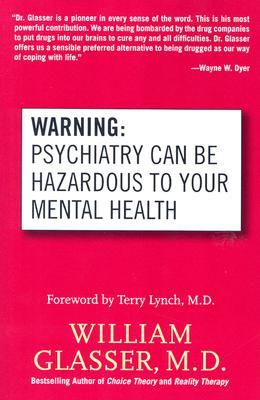
The question, What is the greatest scam of all time?, brought me back to an interview I had with Glasser in 2004, not long after his book, Warning: Psychiatry Can Be Hazardous to Your Mental Health (2003), hit bookstores. When I pushed him a bit to explain why he felt compelled to write the Warning book, and to give it such an accusing title, he responded clearly and firmly.

“I wrote the Warning book because society is looking for a chemical cure to an unhappy problem. This is the most gigantic medical fraud that’s ever been perpetrated in the United Staes—the fraud of mental illness. I mean it’s gigantic!”

678610

One of the chapters in the Glasser biography is entitled Warning and is the place in the book where I describe the physicalizing of mental distress into brain disease, which gave the drug companies a platform from which to make huge profits and affirmed the psychiatry profession as a medical specialty.

Is this how Glasser would have answered the greatest scam of all time question? I don’t know. I wish he was still here so that we could hear it from him directly. In some ways the Warning book was a bit uncharacteristic for him. He had strong feelings throughout his life about talk therapy being the best way to help a person in distress, and he was proud that he never prescribed a brain drug during his career, yet he was not on a warpath. I characterized him as being involved in the good fight of choice theory, rather than in a bad fight against the pharmaceuticals.

It wasn’t lost on me that Glasser had written a book called Warning, which called out the drug companies and psychiatry, yet within a short time after the book’s publication he had moved on to another focus, that being the need to view mental health as a public health issue, rather than a medical issue. When I pointed out how “the Warning title seemed to sound the battle cry for a full-on, prolonged assault on the psychopharmacology system, he responded, almost in a tone that confirmed his desire to move on, “I’m damning psychiatry as much as I’m gonna damn it. I’m saying they diagnose diseases that don’t exist, they give drugs that can harm you, and they tell you that you can’t help yourself. That’s about as good as I can do.”

===============

2014 – At A Glance link now available!

Some of you have noticed that an additional navigation link has been added to The Better Plan website. Now you can easily access all of the blog posts, along with reader comments, in quick, chronological order. Categorized by month the posts are just a click away!

photo

===============

Some things to keep in mind –

+ Take a moment and enter your email address to FOLLOW the blog. You will receive an email when new posts are posted. It makes it easy for you and helps the blog to grow, which will call attention to the ideas of Glasser and choice theory.

+ I think that to submit comments, I think you need to sign up with WordPress, although it is an extremely simple registration process. This also allows to LIKE a post, which is one more way to call attention to choice theory ideas within the blogging community. This is a good thing.

+ When you submit a comment, make sure you check the alert box so that you know when I or someone else responds to your comment.

+ Invite a loved one or friend or colleague to Follow the blog, too.

God as Coercer

Belief-in-an-Angry-God-Now-Linked-to-Mental-Illness-2

When it comes to God being coercive, we can respond in one of several ways.

Way #1 – If the Bible says it then that is how it is. Sure, He was coercive during those Old Testament times. He had to be coercive to do what needed to be done. I would have been coercive, too, if I were Him.

Way #2 – The Bible says stuff that I am not totally comfortable with, but I am going to give God a break until all the facts come out.

Way #3 – If God is like how the Bible portrays Him, then I want to head another direction entirely. Agnosticism or atheism suits me fine.

The topic of God as Coercer has been an important one for me personally. Choice theory explains human motivation and behavior better than any other theories of which I am aware. And I have come to appreciate God even more as I think about Him actually creating humankind with the freedom and power that choice theory proclaims. It is so significant to me that God did not create us to be his puppets, but instead gave us this incredible ability to decide what or who we will follow. “Come let us reason together,” He invites (Isaiah 1:18). He seems to be saying, weigh the evidence and choose. There is much in Scripture to support this view. And yet, there are passages in Scripture that also portray God in a different light. This different light portrays God as controlling and even violent. Some see a difference between the God of the Old Testament and the God of the New Testament. God is unchanging, though. Jesus himself said, “If you have seen me, you have seen the Father.” (John 14:9) So how are we to view these God as Coercer passages?

puppet-strings-image

For years I have been collecting Scriptural texts that relate to choice theory. I have categories like Survival & Safety, Love & Belonging, Power & Achievement, Freedom & Autonomy, Joy & Fun, Perceived World, and God the Coercer. As I read different stories and passages, some of them seem to step forward and urge me to store them in one of these folders. Of the three “Ways” described earlier, I am most closely aligned with Way #2, although rather than passively waiting for details to emerge, I am on a mission to find out what’s going on with God and the use of force or manipulation.

Here, for example, are some stories of God as manipulative coercer –

And the Lord told Moses, “When you arrive back in Egypt, go to Pharaoh and perform all the miracles I have empowered you to do. But I will harden his heart so he will refuse to let the people go.” Exodus 4:21

The way this is worded it leads us to think that God needed Pharaoh to be a power-hungry jerk, so He touched Pharaoh’s heart and made him jerky. Or how about this passage describing a scene from the life of King Saul, which led Saul to look for an anti-depressant in the form of the musician, David –

Now the Spirit of the Lord had left Saul, and the Lord sent a tormenting spirit that filled him with depression and fear. 1 Samuel 16:14

angry-god-13106479

Again, the writer attributes Saul’s mental distress directly to God. Apparently, Saul was minding his own business when God sent a tormenting spirit to attack him. These texts fly in the face of God creating humankind with free will and the intelligence to make reasoned choices. It flies in the face of the hundreds of times in Scripture where God or angels reassure humans with the words “Don’t be afraid,” or “Fear not.” And it contradicts the apostle Paul’s clear statement that “God has not given us a spirit of fear, but of love, power, and a sound mind.” (1 Tim. 1:7)

The book of 1 Kings in the Old Testament is full of language that makes God responsible for every terrible and destructive action that takes place. When kings and their entire families were assassinated during a coup, it was because God wanted it to happen. If God’s people didn’t obey Him then He would “uproot” them from the land; He would “reject” them; and He would make them “an object of mockery and ridicule.” People will gasp in horror and ask, “Why did the Lord do such terrible things?” You get the gist.

The story of Elijah begins in 1 Kings 17 and even here we see the same language and view of God. Because of a severe drought, Elijah finds shelter and food with a poor family, a widow and her son, in the village of Zarephath. God is miraculously sustaining this little unit, yet when the boy gets sick and dies the mother cries out to Elijah, “O man of God, what have you done to me? Have you come here to point out my sins and kill my son?” (1 Kings 17:17, 18) Her comment reminds us of the way people then viewed the behavior of their gods and the fact that there were uncontrollable forces about that could only be attributed to the supernatural.

elijah_the_prophet__image_1_sjpg2104

I would have expected better from Elijah. I mean, he was one of the greatest prophets in the Old Testament. And he was one of the few people in the history of the earth to be translated without seeing death. The dude has some rather impressive credentials. Yet when he took the boy’s lifeless body upstairs he then did his own crying out. “O Lord my God,” he began, “why have you brought tragedy to this widow who has opened her home to me, causing her son to die?” (v20) Even Elijah had been saturated with this way of looking at God.

AngryGod1

I think it is hard for us living in a 21st century secular world to relate to the 9th century BC religious world. If we define religion as a vehicle for humans to access, relate to, and appease their gods, then the world during Old Testament times would have been a deeply religious place. Unfortunately, similar to the Greek gods of mythology, the “gods” of the Old Testament were capricious, arbitrary, moody, and self-serving, even to the point of demanding human sacrifices. “Gods” of that day were thought to control nature and cause catastrophes as a way to manipulate humans. This was the context of the day; not an accurate context, but it was their view of reality. And it was the context in which God had to communicate. I think this issue, the context issue, is the cause for a lot of our misunderstanding regarding God’s Old Testament behavior. I don’t have it all figured out yet, but I think this is a part of the answer.

My quest to know God better and to be in relationship with Him is very important to me, and my belief in choice theory is very important to me, too. The two really need to be able to go together. I want to remain open as I continue to search for clues that speak to the extent to which God is a choice theorist. My belief is that God is the ultimate choice theorist, that He invented the concept of freedom and wants us to experience freedom every day. Stay tuned.

“Now, the Lord is the Spirit, and wherever the Spirit of the Lord is, He gives freedom.”   2 Cor. 3:17

===============

Now priced at $17.40 on Amazon; 19 reviews have been submitted. (We're closing in on 20. Yes!)

Now priced at $17.40 on Amazon; 19 reviews have been submitted. (We’re closing in on 20. Yes!)

The eBook version can be accessed at –

https://www.zeigtucker.com/product/william-glasser-champion-of-choice-ebook/

The paperback version can be accessed at –

http://wglasserbooks.com

or from Amazon at –

http://www.amazon.com/William-Glasser-Champion-Jim-Roy/dp/193444247X/ref=sr_1_1?s=books&ie=UTF8&qid=1410617000&sr=1-1&keywords=champion+of+choice

Signed copies of Champion of Choice can be accessed through me at –

jimroyglasserbio@gmail.com


So You Wanna Be a Pioneer

Dr. Leonard Bailey and his wife, Nancy, giving the opening colloquy talk at PUC, 2014.

Dr. Leonard Bailey and his wife, Nancy, giving the opening colloquy talk at PUC, 2014.

School started this past week at Pacific Union College and on Thursday morning our first colloquy speaker was Dr. Leonard Bailey, of Baby Fae heart transplant fame. I recalled the controversy in 1984 that surrounded Loma Linda University and a doctor there who had transplanted a baboon’s heart into a newborn baby girl. Before the term viral became common, this story went viral.

v53302zxaqx

I wasn’t sure what to expect this past week, in the days leading up to his talk. The first colloquy is always one of pomp and circumstance, with all the faculty marching in wearing their regalia, a loud organ laboring to increase the drama. It turned out that I enjoyed the talk, with two important elements standing out.

Element 1 – The Pioneer Angle

The pioneer moniker is heard somewhat frequently at PUC, since our athletic teams are known as the Pioneers, and this is the theme that was used to introduce Dr. Bailey. During his presentation he shared many video clips that brought you back to when the story was actually unfolding. Ted Koppel, Diane Sawyer, and other major media outlets covered the story from every perspective. Interviews and articles referred to Bailey as Dr. Frankenstein. Animal activists had a field day. If you were old enough in 1984, then you can remember what a big deal the procedure was.

11bd51fae96102f8dd6b756aa487f670

I had forgotten that, without drastic intervention, 100% of newborns with a condition known as hypoplastic left heart syndrome will die. Bailey explained how if ever a disease merited transplant attention this condition certainly qualified. And so he outfitted a lab at Loma Linda and for eight years he worked with transplant techniques on baby goats and monkeys. The Baby Fae procedure ultimately led to human-to-human baby heart transplants, with infants growing up to lead normal lives as adults. Over 500 of these heart transplants have since taken place at Loma Linda, with receivers of new hearts, now in their 30s, living productive lives. Pretty amazing!

Bailey seemed to be a pretty humble guy to me (either that or he knows what humble is supposed to look like) as he described what it was like to be a pioneer. I was reminded of the price a person pays to be out in front. He talked about heading in a direction before others do, or even heading in a direction in spite of the blockades that others put up. He really was swimming against a strong current, yet look at all the lives that are now being saved because of his efforts.

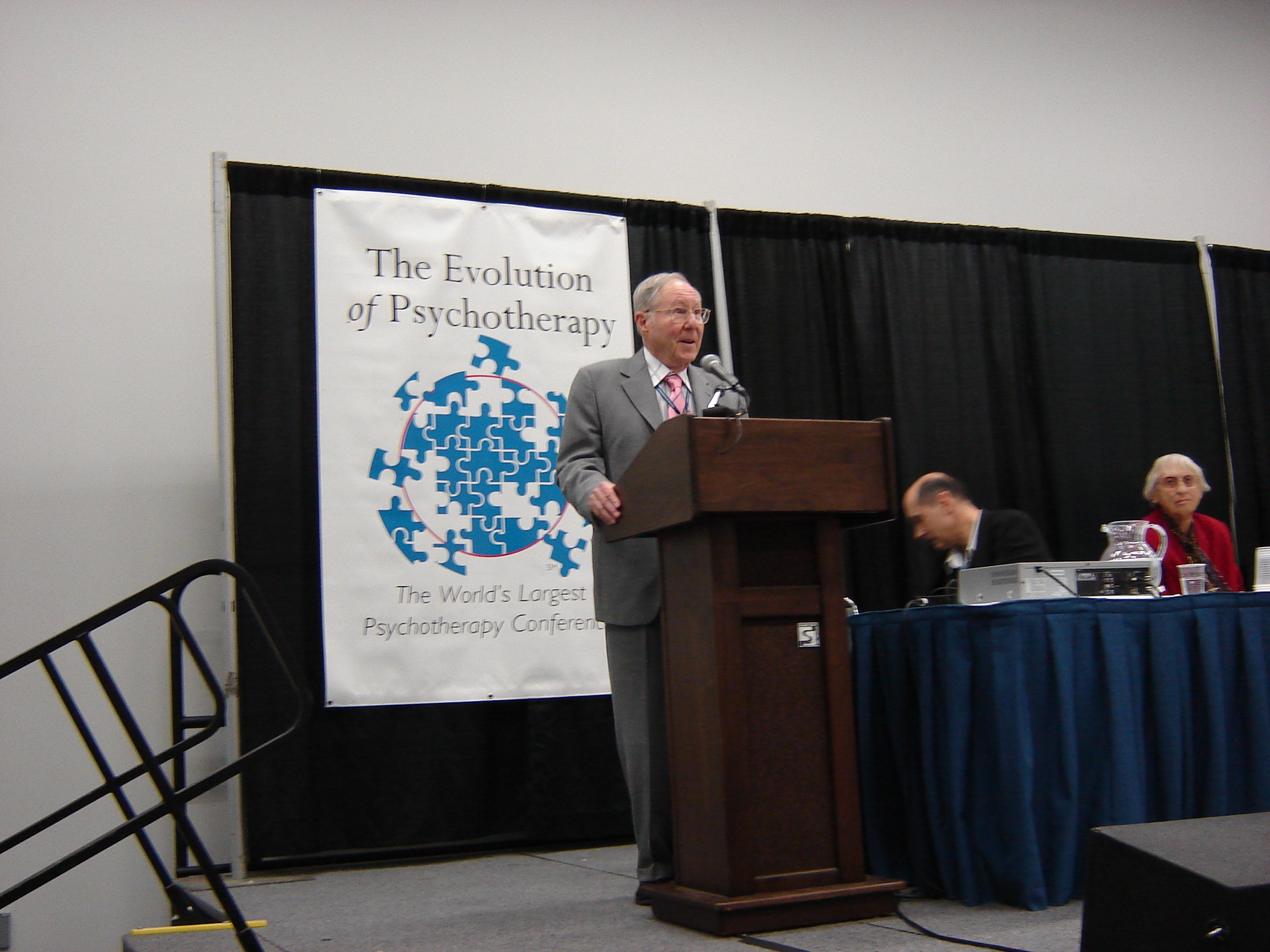
William Glasser presenting at the Evolution of Psychotherapy Conference, 2005 (Photo by Jim Roy)

William Glasser presenting at the Evolution of Psychotherapy Conference, 2005 (Photo by Jim Roy)

As I listened I was reminded of Glasser’s efforts and the currents he swam against. Glasser was a pioneer in the truest sense of the word. (If I had it to do again, I think the title of the biography could include the word pioneer.) His rejection of the concept of mental illness and the labels used to transform symptoms into disease, his disavowing the therapeutic value of focusing on the unconscious mind or on past experiences, his recognition of the damaging effects of external control psychology, and the way he embraced the science of the power of choice, these and other key ideas all are testimony to his pioneering spirit. He was not necessarily unique in each of these pieces (nor was Bailey unique in his field – Does the name Christiaan Barnard ring a bell?), but the package of the ideas that Glasser assembled was incredibly unique.

Element 2 – The Donor Angle

For every newborn that receives a new heart and the life that goes with it, there is a newborn that donates that heart and the life that goes with it. For every family shedding tears of joy, there is a family shedding tears of indescribable grief.

Can you see the two small stitches holding things in place?

Can you see the two small stitches holding things in place?

At one point during Dr. Bailey’s talk I was overcome with emotion as this equation (a life received = a life given) hit me between the eyes. Literally. You see, I live with two donor corneas. I can see because someone (a woman from Kentucky and a man from Chicago) shared a part of their body with me. I see because they cannot. Even as I write this I am choked up. What can I say? My mother passed on a degenerative disease to me (as I now have probably passed on to my children) that was causing my eyesight to get cloudier and murkier every month. Without intervention, as the Bible says, I was “seeing through a glass darkly.”

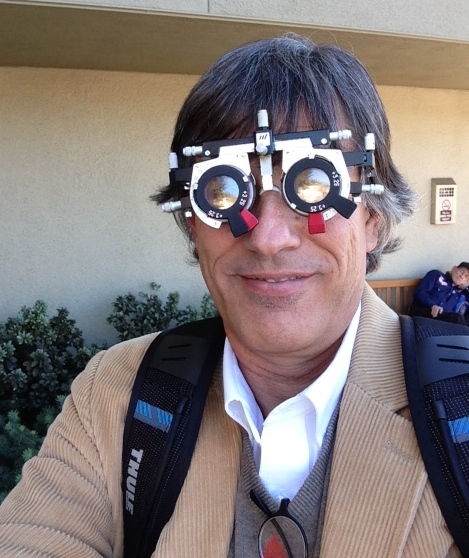
Me getting outfitted with new glasses.

Me getting outfitted with new glasses.

Yet my joy at seeing clearer, seeing colors in all their gorgeous beauty, came at the expense of another. My heart goes out to the loved ones of those from whom I have benefitted. I have listed myself as a donor, although I am not sure how valuable anything is from a 60 year old. Still, if after I leave this earth I can be of help to another, I would really like to do that.

I am not gone yet, though, and if you are reading this you are not gone yet either. I encourage you to list yourself as a donor, but more importantly, I want to encourage all of us, myself included, to be a help to others while we are alive on this earth. One incredible way to help others is to live choice theory. It can be so powerful when a person lives a life of choice, rising above the slights and discomforts, acknowledging their feelings rather than being controlled by them, using the caring habits, and meeting their needs without keeping someone else from meeting theirs.

Love to all!

================

Now priced at $17.63 on Amazon; 18 reviews have been submitted. (We're closing in on 20. Yes!)

Now priced at $17.63 on Amazon; 18 reviews have been submitted. (We’re closing in on 20. Yes!)

The eBook version can be accessed at –

https://www.zeigtucker.com/product/william-glasser-champion-of-choice-ebook/

The paperback version can be accessed at –

http://wglasserbooks.com

or from Amazon at –

http://www.amazon.com/William-Glasser-Champion-Jim-Roy/dp/193444247X/ref=sr_1_1?s=books&ie=UTF8&qid=1410617000&sr=1-1&keywords=champion+of+choice

Signed copies of Champion of Choice can be accessed through me at –

jimroyglasserbio@gmail.com

Misdirected Zeal and Why We Keep Trying or Quit

photo

It’s amazing to me just how important our view of reality is! And it is fascinating to me how involved we are in shaping our personal view of reality!

In choice theory-speak, the perceived world represents what we think we HAVE, or what we believe reality to be. (The quality world, on the other hand, represents what we WANT.)

I have read a couple of things recently that reminded me of the significance of our individual perceived worlds. One of the things I read is from Scripture; the other is from a study* out of Rutgers University on perseverance.

The apostle Paul, describing people who want to make themselves good by keeping religious rules, uses a phrase that got my attention. He writes –

I know the enthusiasm they have for God, but it is misdirected zeal.              Romans 10:2 NLT

The phrase misdirected zeal conveys our ability as human beings to become convinced about an idea or belief that isn’t true. Our self-created convictions can lead to zealous behavior, but this behavior doesn’t make the conviction any truer. We see extreme examples of misdirected zeal when terrorists blow themselves up or when members of the Westboro Baptist Church put on hateful demonstrations. Their extremism, though, shouldn’t divert our attention to the numerous more common examples of how we create our own reality. That Fox News is now a major media outlet is testimony to the millions of viewers who view reality from a certain perspective.

Fox 708

For choice theorists the Rutgers study will not be earthshaking, yet it is worthy of our attention. The researchers’ goal was to find out what caused some people to quit, while others work harder and push on. The answer they discovered has to do with how much control people perceive they have over the situation.

The student who fails an exam because he feels he didn’t study hard enough will probably study harder, or differently, the next time. On the other hand, the student who fails an exam because he believes the teacher used trick questions on the test that didn’t really cover the content will probably give up studying or even drop the course.

Landscape

Classroom Application

Teachers may need to give students “bad news,” but it should be done in a way that conveys belief in the student’s ability to complete the task. Some possible approaches include –

+ “Let’s think of some ideas that will help you understand this better.”

+ “Would changing the way you study for this kind of test be helpful? Would you like to talk about different study strategies?”

+ Would you like another chance on this assignment? Do you understand it well enough to give it another try?”

+ “I think you’re very capable of doing well on this material. I wonder what is preventing it so far.”

Helping students to perceive that their doing well is within their control is really a key. The Rutgers research recognizes the value of providing constructive feedback that encourages students to persevere and keep on keeping on. We all like that kind of feedback actually. We all persevere with things we feel are in our control.

* An article regarding the Rutgers study can be found here –  http://www.medicaldaily.com/whether-you-quit-or-persevere-depends-your-perception-control-what-make-us-try-again-301706


An Interview with Jim Roy

This interview took place on September 11, 2014, at Lower Lake High School in Lower Lake, California. Chris Kinney, who led the interview, teaches Social Studies and Technology classes at the high school and has more recently been given the school’s broadcasting program. Besides being posted to YouTube the interview will also be shown on a local Clearlake television channel.

Chris Kinney and Jim Roy

Chris Kinney and Jim Roy

Chris, a former student of mine who completed his teaching credential through Pacific Union College, is an incredible example of what can be accomplished when belief, energy, and commitment come together. He wants to empower his students to achieve success and he sees the principles of choice theory as essential in that process.

After a recent class discussion one of Chris’s students shared the following on her/his Facebook page –

“Ok, I meant to post this last night, but I was really tired. Ok, so yesterday one of my teachers, whom I highly respect and look up to, gave a mind blowing speech on choice theory. He went on and on about how our education system is very messed up and is only a grade, not actually showing off the experience you learned in the class. It’s what your grade says, not what your brain says. He then went on about how everyone in life is only trying to fill their basic needs, which is literally in every case scenario. He then talked about how school is literally the only place that you will be told you fail in your life, and as soon as he said that my mind was amazed. I couldn’t believe how much all this theory made sense and actually should be in all schools. Sadly the state doesn’t want you to have experience and know what you’re doing; they want you to have a good grade on a test or a quiz.”

The principles of choice theory are empowering, and because of that it appeals to high school students, middle school students, and even elementary students. Like Glasser used to say, “There is nothing in choice theory that a six year old can’t understand.”

====================

Now priced at $17.44 on Amazon; 17 reviews have been submitted. (We’re not stuck on 16 anymore!)

The eBook version can be accessed at –

https://www.zeigtucker.com/product/william-glasser-champion-of-choice-ebook/

The paperback version can be accessed at –

http://wglasserbooks.com

or from Amazon at –

http://www.amazon.com/William-Glasser-Champion-Jim-Roy/dp/193444247X/ref=sr_1_1?s=books&ie=UTF8&qid=1410617000&sr=1-1&keywords=champion+of+choice

Signed copies of Champion of Choice can be accessed through me at –

jimroyglasserbio@gmail.com


Exciting, meticulous, enlightening, must-read . . .

Dr. Sam Gladding

Dr. Sam Gladding

Dr. Sam Gladding, chair of the Department of Counseling at Wake Forest University and former president of the American Counseling Association, has written the following review of Glasser’s biography for psycCRITIQUES, a publication of the APA. His assessment may be especially interesting to those of you who have read the book.

=====================

Theories evolve, but by the time they become chapters in books, they appear to have been developed and are mostly, if not fully, presented as complete. Furthermore, little attention is traditionally given to the theorists behind the ideas. In fact, most theory chapters, and even some excellent books (e.g., Corey, 2013; Sharf, 2012), only briefly describe the theorists behind the theories. Such brevity most likely has to do with word-count limitations and space considerations. Thus, most theory books will mention general facts and turning points in theorists’ lives but not a lot more. For example, a turning point in William Glasser’s life was his initial deep friendship with his mentor psychiatrist friend, George L. Harrington. However, what happened after the friendship grew cold? How did the break with Harrington affect Glasser and the development of reality therapy theory?

What is usually left out of most books and book chapters on the lives of prominent theorists is what motivated them to conceptualize human behavior and psychological interventions in the way they did. Timing and the matter of luck in the generation of ideas are seldom mentioned, such as Glasser’s fortunate naming of his theory reality therapy, which quickly became popular. Likewise, who influenced theorists inside their families and in their family life is usually not considered even though it is often quite relevant. As the late radio news commentator Paul Harvey would have asked, “What about the rest of the story?”

For those who want more complete information about psychological theorists, Jim Roy’s biography William Glasser: Champion of Choice is an enlightening, exciting must-read. Roy gives the most complete and up-to-date examination yet of Glasser and his personal and theoretical evolution.

William Glasser (1981)

William Glasser (1981)

Glasser’s Development

For many older mental health professionals, Glasser is associated closely with the titles of his second and third books, Reality Therapy (1965) and Schools Without Failure (1969).

After all, it was these books that launched him from a state and regional maverick psychiatrist to a nationally known, famous, and at times feisty theorist. For those who have more recently entered the mental health professions, Glasser’s works Counseling With Choice Theory (2000) and Warning: Psychiatry Can Be Hazardous to Your Mental Health (2003) may seem more relevant.

The story of William Glasser starts in Cleveland, Ohio, where he transformed himself from a chemical engineer to a medical school graduate and evolved as he moved west to become a University of California, Los Angeles-educated psychiatrist. Roy explains how Glasser and his theory grew in detail, especially after Glasser settled in Los Angeles and began working at the Ventura School for Girls, the only job he could get after his fellow psychiatrists shunned him for not following the mores of psychiatry.

The exciting aspect of Roy’s work is that he includes the setbacks in Glasser’s life as well as his triumphs. For instance, Roy relates how Glasser was ignored by the psychiatric community because of his opinions about mental health and mental illness and how his isolation affected him. He also gives readers insight into Glasser’s family life and his relationship with his first wife, Naomi, and their children. Glasser wrote most of his initial books by hand on planes because his commitment to his family kept him from doing so at home. Roy also describes how Glasser overcame shyness and an avoidance of public speaking. He paints a picture of the kindness and toughness of Glasser as a therapist, a humanitarian, and as a champion for what he believed in: mental health.

Glasser and one year old son, Joe. (1952)

Glasser and one year old son, Joe. (1952)

Roy does not gloss over what made Glasser who he was and why his theory changed over time, for example, his embrace of choice theory as the underpinning of reality therapy. The fascinating aspect of the book is Roy’s direct reporting of events in Glasser’s life and his insights into how Glasser developed. Roy’s prose is crisp and interesting, especially surprising because he initially wrote this work as his doctoral dissertation. Roy did his homework by reading all of Glasser’s books, as well as his numerous articles. In addition, Roy interviewed Glasser 46 times over five years. He was as meticulous in his own way as Ernest Jones, the biographer of Sigmund Freud, was in his. However, Roy did not know Glasser for as long or as intimately as Jones knew Freud.

The Appeal and Limits of the Book

This book will have an appeal to numerous audiences. First, psychological theorists will find the text fascinating because they will be able to read about a modern theorist struggling to organize his ideas in a coherent and unique way. Adversity and affirmation are parts of Glasser’s life that Roy opens up to readers. Second, schoolteachers, personality theorists, and disciples of choice theory will find a treasure trove of information that will enliven their respect for Glasser and make them appreciate what he did even more. A lesser man would have done lesser things. Glasser stands as a role model because of his commitment to his ideas and achieving results. Finally, readers in the general public who enjoy biographies will find Roy’s text fascinating because it tells an engaging story about a famous man and how he became who he was. The book traces the steps taken by Glasser to rise from obscurity at a school for delinquent girls to notoriety as a defender of mental health.

Overall, the strengths of William Glasser: Champion of Choice are its readability and its attention to detail. This book is a developmental history of an unlikely psychiatrist becoming eminent internationally against formidable odds; Glasser influenced psychology and psychiatry, but he also made major contributions to humanity. The weakness of the book is that Roy’s story of Glasser is retrospective and subjective because much of it was related by Glasser himself, who was 78 when the interviews started. Although it appears that most of what Glasser says is brutally honest, few dialogues of Glasser’s discussions with his contemporaries are provided except in summary form. Therefore, it may be that some events in Glasser’s life, like his break with his mentor, Harrington, were more painful and troubling than what Glasser conveyed to Roy.

Nevertheless, this book is enlightening and exciting. It gives inside information that helps explain a complex man and his thinking more thoroughly. It helps the reader appreciate the battles Glasser fought and often won on his way to becoming prominent. Finally, the book brings Glasser to life as an advocate for the betterment of humanity, especially for those in less-than-the-best positions to speak for themselves, such as children, prisoners, people who are lonely, and individuals experiencing mental distress.

==========================

Now priced at $17.32 on Amazon; 16 reviews have been submitted. (We've been stuck on 16 for a while.)

Now priced at $17.32 on Amazon; 16 reviews have been submitted. (We’ve been stuck on 16 for a while.)

The eBook version can be accessed at –

https://www.zeigtucker.com/product/william-glasser-champion-of-choice-ebook/

The paperback version can be accessed at –

http://wglasserbooks.com

or from Amazon at –

http://www.amazon.com/William-Glasser-Champion-Jim-Roy/dp/193444247X/ref=sr_1_1?s=books&ie=UTF8&qid=1410617000&sr=1-1&keywords=champion+of+choice

Signed copies of Champion of Choice can be accessed through me at –

jimroyglasserbio@gmail.com


Two Lawnmowers

IMG_1407

There is so much choice theory in this picture.

Two lawnmowers parked in a backyard shed, their work done for now, resting as the grass grows once again, but ready to get back at it when the lawn once again needs a trim.

Two lawnmowers. One real, heavy, dusty, its grasscatcher hanging out the back; the other small, plastic, unimposing, a toy.

Of course, the picture captures more than these two objects. It captures something about a relationship, something about the caring habits, and something about lead management. You can see the lawnmowers; do you see choice theory sitting there, too?

When I get the mower out to mow the lawn, my grandson invariably grabs his mower and wants to join me. He will ask, “Grandpa, can I help you mow the lawn?” And I will answer with something like, “Yes, I could use the help. Thank you very much.” I can imagine an adult answering that question with “No, I need you to stay out of the way. Lawnmowers are dangerous and you need to keep your distance.” Or maybe “No, I don’t need your help. You can play on the lawn after I am done.” I don’t like those answers, though, since I really like my grandson’s help with the different projects in which I am involved.

As I mow he is pushing his mower across the grass, too. Sometimes out in front of me, sometimes behind me, sometimes off to the side. He has a system, a plan that he follows, much the same as me having a plan as I work to efficiently get all the grass cut. He laughs a lot as he darts around, and I do, too, for that matter. When I stop to empty the grasscatcher, he stops, too, and walks with me to the green trash can, where we empty the clippings.

This last time, after we were all done with mowing, I pushed the mower to the back of the property, where there is a shed that keeps stuff like lawnmowers. I pushed it up the little ramp and was about to shut the shed door, but noticed that my grandson was now pushing his little mower up the ramp, too. I asked if he was sure he wanted to leave his mower there, as he wouldn’t be able to play with it if it was locked in the shed. He said he understood that, but that he wanted his mower to be in the shed, too, ready for the next time the lawn needed to be mowed.

IMG_1415

I suppose I could have said, “No, let’s not put your mower in the shed. That’s not where it goes.” But that didn’t occur to me. I was so touched by our two mowers sitting there together.

So where’s the choice theory? A lot of you, as you read this, have already come up with multiple examples. Here are a few that come to my mind –

The Relationship
My grandson and I have a really good relationship. I enjoy being with him and I like it a lot when he wants to help me. He talks a blue streak as we work, some of the talk related to the job, but a lot of it not. And while sometimes he actually can hand me something I need or carry a board to where it is needed, not all of his “help” is actually helpful. But I want him close, I want his “help”, all of it.

The Caring Habits
Words like accepting, encouraging, and listening come to mind as I think about our mowing the lawn together. Yes, he is just pushing a toy around, and yes, I could respond in kind, but I don’t think our two mowers would be sitting in the shed together right now if I used one of the deadly habits like criticizing or complaining.

IMG_1414

Lead Management
My grandson loves helping with projects. A few weeks back I constructed 75’ of new fence. It was a grueling job that involved the removal of the old fence, disposal of the old boards, removal of the old fence posts, and the digging of the new holes. It was hot, too. And yet he was with me a lot of the time. Out there in his Crocks and his underwear, talking, listening, handing me stuff, and doing stuff on his own. He is growing up to be an involved, helpful young man, not because we are making him be that way, but because we are open to his being involved. We are supportive of his interest and his efforts. At times we invite his participation or try to persuade him to join in the work. Usually, it is more about accepting his offer to help.

The picture of the two mowers captures what is possible when we place a high value on relationships and keep the caring habits in mind. Whether young or old, people thrive when the elements of lead-management are present.

===============

Me and Chris Kinney.

Me and Chris Kinney.

The talk at Lower Lake High School this past Thursday evening (9-11-14) went well. Chris Kinney, a teacher at the school and one of my former students, organized the event and recorded it, too. There are administrators and teachers at the school that want to head in a choice theory direction and Chris is fueling and supporting that vision. I will be sharing more about this in an upcoming blog. Well done, Chris! It was a great evening all the way around!

===============

We have been stuck on the number 16 when it comes to Amazon book reviews for Champion of Choice. It would be great for the book, and by extension the ideas of choice theory, if that number could go significantly higher. Reviews don’t have to be long and they are simple to do.

Now priced at $17.23 on Amazon; 16 reviews have been submitted. (We've been stuck on 16 for a while.)

Now priced at $17.23 on Amazon; 16 reviews have been submitted. (We’ve been stuck on 16 for a while.)

The eBook version can be accessed at –

https://www.zeigtucker.com/product/william-glasser-champion-of-choice-ebook/

The paperback version can be accessed at –

http://wglasserbooks.com

or from Amazon at –

http://www.amazon.com/William-Glasser-Champion-Jim-Roy/dp/193444247X/ref=sr_1_1?s=books&ie=UTF8&qid=1410617000&sr=1-1&keywords=champion+of+choice

Signed copies of Champion of Choice can be accessed through me at –

jimroyglasserbio@gmail.com


Mistakes, Mischief, and Mayhem

There are some things we just never forget!

The phrase “mistakes, mischief, and mayhem” turned out to be one of those things for me. I first saw it in Jane Nelsen’s book, Positive Discipline (1981, 2006), twelve years ago, and it made such an impression on me that it has become a part of my management paradigm, a kind of beacon that, combined with choice theory, helps to point me in the right direction.

b101_small

Nelsen felt that classroom behaviors can be categorized as either mistakes, mischief, or mayhem, and that our management strategies need to keep these levels of behaviors in mind. For the sake of clarity, the following definitions will help –

Mistakes – misbehaviors that are just that, mistakes. It is easy for us to forget how complex a classroom can be. There are so many expectations regarding how students relate to one another, how they relate to things, how they relate to places, and how they relate to time. Additionally, each of them comes from unique backgrounds that differ greatly. Most of the “misbehavior” in classrooms fit into the mistakes category.

Mischief – misbehavior that has an element of intentionality. It may not have a meanness element to it, however it is distracting, probably draining to the teacher if not corrected, and takes away from the learning environment.

Mayhem – misbehavior that breaks a rule and crosses the line of civility and respect, whether the behavior is directed at fellow students, teacher, or things within the classroom. Mayhem behaviors involve disrespect, disobedience, and/or destruction. These are serious misbehaviors that require a student response, maybe in the form of an action plan to prevent the misbehavior in the future, which also may involve steps to restore what their misbehavior harmed (e.g. – relationship, trust, broken object).

It becomes plain that misbehaviors are not all equal and that a mistake is vastly different than mayhem. Treating each of these misbehaviors on the level they deserve can greatly affect the learning atmosphere of the classroom, and will allow teachers to head home each day without a pit of worry and tension in their stomach.

discipline

One common mistake for teachers is to treat any and all misbehavior as mayhem. Teachers may not know about the concept of Procedures or have forgotten about their value and treat all behavior, or lack thereof, on the level of Rules. A student forgets to walk into the classroom after recess – Bam! – he broke a rule; a student leaves her desk and gets a drink during a teacher presentation – Bam! – she broke a Rule. Treating everything like mayhem creates a controlling, tension-filled space that foments rebellion in all kinds of forms.

It is freeing to teachers when they acknowledge that most misbehaviors are simply mistakes that can be prevented or corrected through the use of Procedures. Mistakes don’t have to be about getting in trouble or being punished. Procedures are taught, reviewed, and rehearsed, and when students forget a Procedure they are reminded of it and probably asked to rehearse it correctly.

Harry Wong emphasizes that the first two weeks of school should focus on learning Procedures. Once students “get” the idea of Procedures and know the Procedures needed to get the school year started the classroom environment is then ready for students to “soar!”

Using Procedures to provide helpful classroom structure will prevent most of the usual behavioral issues, although there may still be students who are mischievious in class in a way that distracts from the learning. It is common for mischief to include clowning and various forms of pranks. Mischief can be reduced and eliminated by 1) consistently implementing the Procedures, and 2) creating a need-satisfying classroom. By need-satisfying I mean a classroom where the teacher is intentional about helping students meet their need for purpose, love and belonging, power, freedom, and fun. In other words, planning activities, events, and opportunities for students with a high need for power to meet that need, and students with a high need for fun to meet that need, and so forth. As teachers we don’t just hope this happens or merely allow it to happen, we plan for it to happen.

shutterstock_14193661_crop380w

Lastly, we hope that mayhem behaviors never occur in our classroom, but inevitably they do. Kids sometimes behave poorly, sometimes very poorly, and when they do we must confront the behavior and assist them toward forming better behaviors. It is important that teachers convey compassion to the student being confronted, but this compassionate spirit should not prevent dealing with such behaviors decisively. Mayhem behaviors (e.g.- defiance of the teacher, attacking another student verbally or physically, willful destruction of school property) may involve a time out or in-school suspension and may involve the student developing a plan to restore what was broken and prevent further incidences in the future. As the teacher I need to have a sense that the student understands the importance of kind and safe behavior and that s/he can make a commitment to kindness, respect, and cooperation. We can’t expect perfection, however we can expect a willingness and a desire to grow in these areas.

And so the 3Ms of classroom behavior are Mistakes, Mischief, and Mayhem. Treating each of them for what they are will go a long way toward student success this year!

=====================

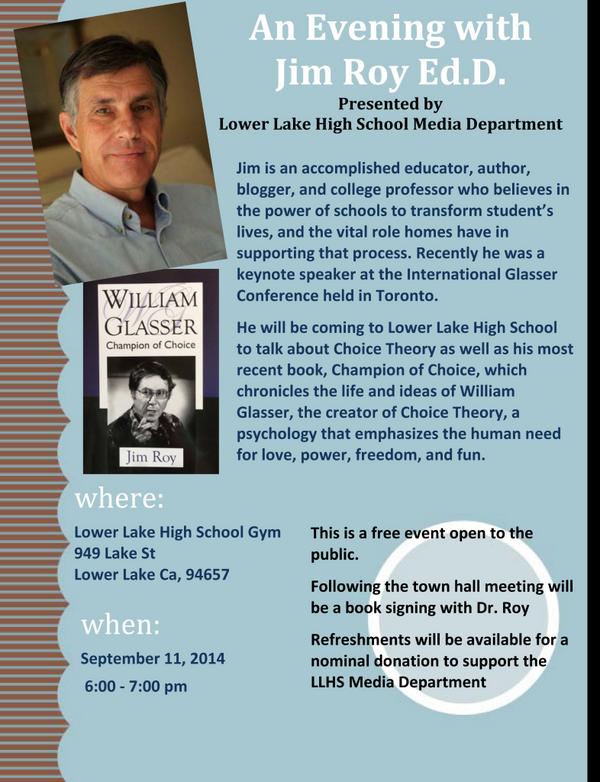
Chris Kinney, who teaches at Lower Lake High School, and who was featured in the August 20, 2013, blog (Good Morning, Mr. Kinney) right here in The Better Plan, invited me to come and talk to people at his school about the new Glasser biography and about choice theory in general. So, I will be doing just that tomorrow evening, September 11, from 6:00-7:00 pm. He put together the following flyer, which is really well done. I would love it if local choice theorists could attend this event!

BuiYAd1CcAAskUI

=====================

The quickest and cheapest way to access William Glasser: Champion of Choice is to purchase the eBook version at the following link –

http://www.zeigtucker.com/product/william-glasser-champion-of-choice-ebook/

Now priced at $17.73 on Amazon; 16 reviews have been submitted. (We've been stuck on 16 for a while.)

Now priced at $17.73 on Amazon; 16 reviews have been submitted. (We’ve been stuck on 16 for a while.)