A Ghost, a Lizard, and “May I Kill It?”

the_great_divorce_c_s_lewis

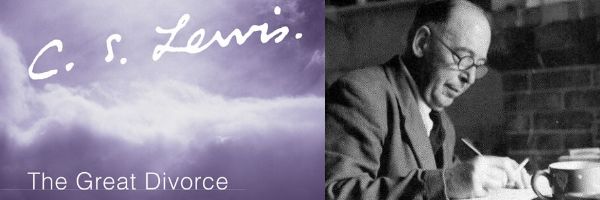
Life is choices, and a book that captures the essence of these choices is a little volume by C.S. Lewis called The Great Divorce (1946). Lewis describes a bus stop on the outskirts of heaven where people (ghosts, really) from Hell can be brought (in a bus, of course), so that they can (if they choose) begin the journey into deeper heaven and eternity. The ghosts are, in fact, met by people (spirits, really) who will escort them to heaven. Often, the spirits and ghosts knew one another during their earthly lives, much to the ghosts chagrin. “How could you have made it to heaven and not me?” they wonder aloud.
great divorce 2

The book is mostly comprised of conversations between the spirits and the ghosts—the spirits humbly imploring the ghosts to let go of the past and begin a new life of realness and freedom, while the ghosts come up with every argument in the book to reject these pleas and invitations. Pride, hurt, resentment, and vanity come to the fore as ghost after ghost heads back to the bus, rather than beginning the journey toward heaven.

The Great Divorce is my favorite book. It is so cleverly done and so insightful. Two of the vignettes have especially stuck with me over the years. The first, which I will share with you below, is slightly different in that it captures the interaction between one of the ghosts and an Angel. The ghost has brought a pet with him (more like a companion) and is feeling that the two of them probably need to head back to the bus.

The Ghost and the Lizard

I saw coming towards us a Ghost who carried something on his shoulder. Like all the Ghosts, he was unsubstantial, but they differed from one another as smokes differ. Some had been whitish; this one was dark and oily. What sat on his shoulder was a little red lizard, and it was twitching its tail like a whip and whispering things in his ear. As we caught sight of him he turned his head to the reptile with a snarl of impatience. “Shut up, I tell you!” he said. It wagged its tail and continued to whisper to him. He ceased snarling, and presently began to smile. Then he turned and started to limp westward, away from the mountains.

“Off so soon?” said a voice.

The speaker was more or less human in shape but larger than a man, and so bright that I could hardly look at him. His presence smote on my eyes and on my body too (for there was heat coming from him as well as light) like the morning sun at the beginning of a tyrannous summer day.

“Yes, I’m off,” said the Ghost. “Thanks for all your hospitality. But it’s no good, you see. I told this little chap,” (here he indicated the lizard), “that he’d have to be quiet if he came—which he insisted on doing. Of course his stuff won’t do here: I realize that. But he won’t stop. I shall just have to go home.”

“Would you like me to make him quiet?” said the flaming Spirit—an angel, as I now understood.

“Of course I would,” said the Ghost.

“Then I will kill him,” said the Angel, taking a step forward.

555bc1b9fe306ca89a69d98b009f2774

“Oh—ah—look out! You’re burning me. Keep away,” said the Ghost, retreating.

“Don’t you want him killed?”

“You didn’t say anything about killing him at first. I hardly meant to bother you with anything so drastic as that.”

“It’s the only way,” said the Angel, whose burning hands were now very close to the lizard. “Shall I kill it?”

“Well, that’s a further question. I’m quite open to consider it, but it’s a new point, isn’t it? I mean, for the moment I was only thinking about silencing it because up here—well, it’s so damned embarrassing.”

“May I kill it?”

“Well, there’s time to discuss that later.”

“There is no time. May I kill it?”

“Please, I never meant to be such a nuisance. Please—really—don’t bother. Look! It’s gone to sleep of its own accord. I’m sure it’ll be all right now. Thanks ever so much.”

“May I kill it?”

“Honestly, I don’t think there’s the slightest necessity for that. I’m sure I shall be able to keep it in order now. I think the gradual process would be far better than killing it.”

“The gradual process is of no use at all.”

“Don’t you think so? Well, I’ll think over what you’ve said very carefully. I honestly will. In fact I’d let you kill it now, but as a matter of fact I’m not feeling frightfully well today. It would be silly to do it now. I’d need to be in good health for the operation. Some other day, perhaps.”

“There is no other day. All days are present now.”

“Get back!” You’re burning me. How can I tell you to kill it? You’d kill me if you did.”

“It is not so.”

“Why, you’re hurting me now.”

“I never said it wouldn’t hurt you. I said it wouldn’t kill you.”

“Oh, I know. You think I’m a coward. But it isn’t that. Really it isn’t. I say! Let me run back by tonight’s bus and get an opinion from my own doctor. I’ll come again the first moment I can.”

“This moment contains all moments.”

“Why are you torturing me? You are jeering at me. How can I let you tear me to pieces? If you wanted to help me, why didn’t you kill the damned thing without asking me—before I knew? It would be all over by now if you had.”

“I cannot kill it against your will. It is impossible. Have I your permission?”

The Angel’s hands were almost closed on the Lizard, but not quite. Then the Lizard began chattering to the Ghost so loud that even I could hear what it was saying.

“Be careful,” it said. “He can do what he says. He can kill me. One fatal word from you and he will! Then you’ll be without me for ever and ever. It’s not natural. How could you live? You’d be only a sort of ghost, not a real man as you are now. He doesn’t understand. He’s only a cold, bloodless abstract thing. It may be natural for him, but it isn’t for us. Yes, yes. I know there are no real pleasures now, only dreams. But aren’t they better than nothing? And I’ll be so good. I admit I’ve sometimes gone too far in the past, but I promise I won’t do it again. I’ll give you nothing but really nice dreams—all sweet and fresh and almost innocent. You might say, quite innocent . . .”

“Have I your permission? said the Angel to the Ghost.

“I know it will kill me.”

“It won’t. But supposing it did?”

“You’re right. It would be better to be dead than to live with this creature.”

“Then I may?”

“Damn and blast you! Go on can’t you? Get it over. Do what you like,” bellowed the Ghost: but ended, whimpering, “God help me. God help me.”

Next moment the Ghost gave a scream of agony such as I never heard on Earth. The Burning One closed his crimson grip on the reptile: twisted it, while it bit and writhed, and then flung it, broken backed, on the turf.

“Ow! That’s done for me,” gasped the Ghost, reeling backwards.

For a moment I could make out nothing distinctly. Then I saw, between me and the nearest bush, unmistakably solid but growing every moment solider, the upper arm and the shoulder of a man. Then, brighter still and stronger, the legs and hands. The neck and golden head materialized while I watched, and if my attention had not wavered I should have seen the actual completing of a man – an immense man, naked, not much smaller than the Angel. What distracted me was the fact that at the same moment something seemed to be happening to the Lizard. At first I thought the operation had failed. So far from dying, the creature was still struggling and even growing bigger as it struggled. And as it grew it changed. Its hinder parts grew rounder. The tail, still flickering, became a tail of hair that flickered between huge and glossy buttocks. Suddenly I started back, rubbing my eyes. What stood before me was the greatest stallion I have ever seen, silvery white but with mane and tail of gold. It was smooth and shining, rippled with swells of flesh and muscle, whinnying and stamping with its hoofs. At each stamp the land shook and the trees dindled.

The new-made man turned and clapped the new horse’s neck. It nosed his bright body. Horse and master breathed each into the other’s nostrils. The man turned from it, flung himself at the feet of the Burning One, and embraced them. When he rose I thought his face shone with tears, but it may have been only the liquid love and brightness (one cannot distinguish them in that country) which flowed from him. I had not long to think about it. In joyous haste the young man leaped upon the horse’s back. Turning in his seat he waved a farewell, then nudged the stallion with his heels. They were off before I well knew what was happening. There was riding if you like! I came out as quickly as I could from among the bushes to follow them with my eyes; but already they were only like a shooting star far off on the green plain, and soon among the foothills of the mountains. Then, still like a star, I saw them winding up, scaling what seemed impossible steeps, and quicker every moment, till near the dim brow of the landscape, so high that I must strain my neck to see them, they vanished, bright themselves, into the rose-brightness of that everlasting morning.

————-

 

sunrise-morning-mist-wearandcheer.com_-1024x576

There are wonderful choice theory springboards in this vignette (whether you resonate with spiritual allegory or not) that we don’t want to miss.

For instance, we are reminded that it is quite possible for us to have conflicting pictures in our quality world. This characterizes the relationship we can have with our various self-medicating habits – whether  the habit involves food, drugs, sex, or a host of other options. Most of us have a go-to “comforter.” We yearn for the solace or pleasure of the habit, yet loathe ourselves at the same time.

The vignette also reminds us of the importance of the Reality Therapy question, “What do you really want?” If we are battling a habit, then we are pretty much asking ourselves that question constantly. In the end the question will be answered. A gentleman, whose relatives frequently reminded him about what he should be eating, once shared with me, after eating a meal his relatives would not have approved of, that he would rather die eating the way he wanted, than live a bit longer eating the way they wanted. His behavior answered the question, “What do you really want?”

The part of the vignette I really like comes at the end when the ghost and the lizard are re-created into the best version of themselves. (This part would be for those of you who are into spiritual allegory.) I have come to believe that when we give ourselves to God, that He gives us back to ourselves, healed, restored, and free. I actually think that choice theory wants to do this, too. Give people back to themselves in power and freedom.

====================

Signed copies of Soul Shapers or Champion of Choice can be ordered from me. You can also quickly order them through Amazon using the links below. There is also a digital version link for those of you with iPads and Kindles.

 Soul Shapers: A Better Plan for Parents and Educators

Available new on Amazon from $14.75; used from $5.19.

Available new on Amazon from $14.75; used from $5.19.

William Glasser: Champion of Choice
Now priced at $18.57 on Amazon.

Now priced at $18.44 on Amazon.

Click here for electronic version of Champion of Choice.

Being the Best Me

choice.png

I really like the February 15 post on the Mental Health & Happiness website. (http://mentalhealthandhappiness.com) Readers were asked to think about how they wanted the world around them to be different – maybe a loved one behaving differently or a circumstance changing. Then readers were asked to think about a world in which everything was indeed as they wanted it – all the changes they preferred had come to be. Sounds good. We’d all sign up for that.

have-an-expectant-attitude-600x300

After being asked to reflect on how they would think and feel in this perfect world, readers were then challenged to act as if they actually lived in this world. How would you behave in a world that was just how you wanted it? Do you have a sense of what it would look like to not be burdened with anxiety? How would you enter the house after work if you were happy? Can you imagine how you would be with your friends if you didn’t worry about what they thought of you? How would you act with your spouse if the two of you were best friends and really trusted one another? You get the idea.

So (you probably know where this is going), readers were then challenged to live as if they were actually living in their “perfect” world, challenged to behave as if these pictures were reality. If I have a picture of what it would look like for me to walk in the front door of my house in a happy state of mind, what prevents me from going ahead and doing it?

il_340x270.186178566

This collection of thoughts really got my attention for some reason, and I am still thinking about the implications of accepting this view of things. It is empowering to think that I can choose my behavior and that I can literally choose how I show up. In other ways, though, it feels disempowering when I think about not being able to use angering and depressing and sadnessing and headaching as a way to convey my difficult circumstances to others. Could it be that I can enter my house happily, even when I’m in the midst of a difficult circumstance? Could it be that I could talk to my spouse about how I felt about the difficult circumstance without needing to anger or withdraw?

happiness

This is such a great Quality World activity. The theory behind the Quality World describes how we place need-satisfying pictures in our heads because this picture in some way helps us to feel better or to feel in control. Once a picture has been placed in our Quality World we go about behaving in a way that will help that picture become a reality. Why not choose to behave in a way that mirrors the world in which you want to live? Pretty cool!

====================

Welcome to those of you from the recent ASDASA conference who are now following The Better Plan blog. The Leading the Quality School breakout sessions went well, I think, and I am excited about the number of Adventist principals and superintendents who are drawn to a choice theory approach to education.

Principals and superintendents – I encourage you to share The Better Plan blog with your teachers and staff. Just have them enter thebetterplan.org in the URL address bar. It’s that simple. Once at The Better Plan, take a moment to enter your email address on the left hand side of the page and then click on the FOLLOW link. You will get an email asking you to confirm this request.

===================

Signed copies of Soul Shapers or Champion of Choice can be ordered from me. You can also quickly order them through Amazon using the links below. There is also a digital version link for those of you with iPads and Kindles.

 Soul Shapers: A Better Plan for Parents and Educators

Available new on Amazon from $14.75; used from $5.19.

Available new on Amazon from $14.75; used from $5.19.

William Glasser: Champion of Choice

Now priced at $18.57 on Amazon.

Now priced at $18.44 on Amazon.

Click here for electronic version of Champion of Choice.

ASDASA and Leading the Quality School

homepage-banner-ASDASA-ad2a9e499531690678f59f3ac976a033

I will be in Dallas, Texas, for much of this week attending the ASDASA Conference, a large event for Adventist school administrators from around North America. I was asked to present a breakout session on Leading the Quality School, which I will be doing on Monday and Tuesday.

Leading a quality school is a complex task, all the more so when you throw religion into the mix, yet I will attempt to share The What, The Why, and The How of it during the brief time scheduled for the breakout.

4279721_orig

It’s impossible to talk about a school or district incorporating choice theory without talking about lead management. If choice theory provides the foundation, lead management is about actually building the structure on that foundation. If choice theory is the target; lead management is the arrow. Lead management is choice theory in action.

Glasser talked about two leadership styles – lead management based on choice theory and the idea of internal control, while boss management is based on behaviorism and the idea of external control. Boss management is very different from lead management, although there is overlap between the two. Some assume that boss management is the exact opposite of lead management, but this is not true. The opposite of boss management is laissez faire, which is basically a hands-off leadership style approximating no management.

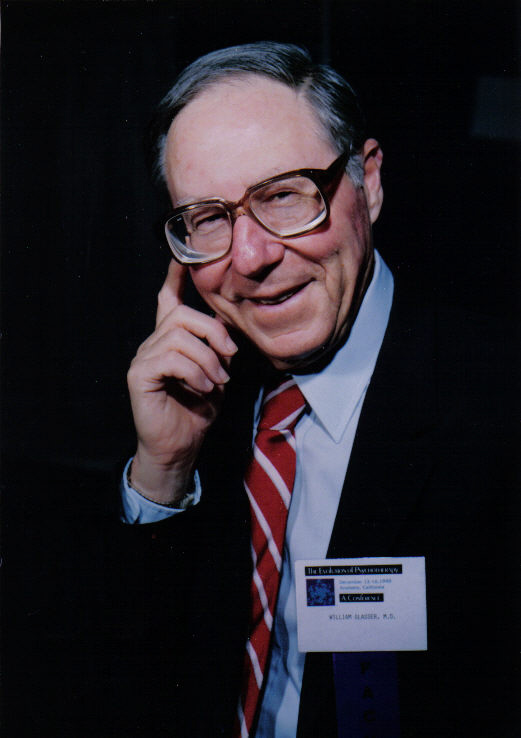
Dr. William Glasser (1990)

Dr. William Glasser (1990)

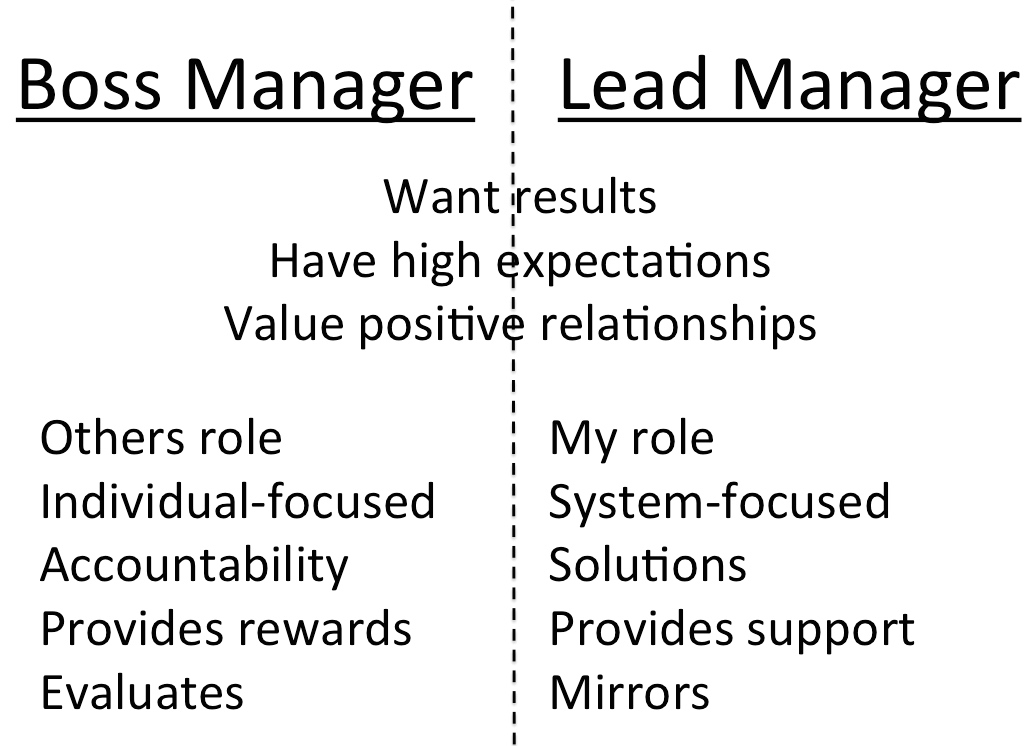
As a slide from the presentation conveys, both boss managers and lead managers want results based on high expectations. They differ on how they manage toward good results, but they both have high goals in mind. They also both want good relationships with the people with whom they work. It’s too easy to assume that boss managers are mean and don’t care about people, but I don’t believe that. I have known some boss managers with good hearts who do care about the people or students with whom they work. It’s very hard for a boss manager to maintain positive relationships, due to the nature of external control, but in their heart of hearts they want to get along with people.

Lead managers and boss managers differ in key areas, though, as the graphic below suggests.

Screenshot 2015-02-13 17.19.30

Others role vs My role
Boss managers tend to be focused on the performance of others, what others are doing correctly or wrongly, and the external forces that need to be applied to improve their performance; while the lead manager recognizes that the only person he can control is himself; the lead manager sees that so much about management is about what is inside of him – the knowledge, the attitude, the extent to which his ego is involved.

Then he added, Son of man, let all my words sink into your own heart first. Listen to them carefully for yourself.   Ezekiel 3:10

Individual-focused vs. System-focused
Boss managers believe that poor performance is an individual’s problem, probably caused by lack of skill, lack of effort, lack of commitment, or poor judgment. In their minds, the situation would be better if the individual took it more seriously or tried harder. A lead manager believes that poor performance, by an individual or otherwise, often reflects systemic flaws. In a lead manager’s mind, individuals perform better when needed support is built into the system.

Accountability vs. Solutions
When mistakes are made, boss managers hone in on who made the mistake and establish the level of blame that is appropriate. They might not be comfortable with the word blame here, but basically it’s about blame. Lead managers are more concerned with problem-solving and solutions than assigning blame. What can be done to fix this or make it better? is the focus.

Provides rewards vs. Provides support
The boss manager sees it as her/his responsibility to make subordinates achieve success through the strategic application of incentives and sanctions. Rewards feel better than punishments, but they both are on the manipulative side of the coin. Lead managers seek to learn from their colleagues what they need to do their job well and try to supply that need. Lead managers offer affirmations and celebrations, but not as a carrot to manipulate performance.

Evaluates vs. Mirrors
The boss manager conducts evaluations and shares her/his findings with subordinates. These evaluations reflect the boss manager’s view of the employee’s performance, often with four commendations for every recommendation. Rather than judging an employee’s performance, the lead manager’s goal is to facilitate the employee self-evaluating his own performance. The lead manager becomes a mirror to the employee, and through well-worded questions assists the employee as he reviews his own performance and sets goals for the future.

School leadership is about creating the conditions for students and teachers to be successful, and in the process to become the best version of themselves!

==================

If you haven’t already, take a moment and enter your email address to FOLLOW The Better Plan blog. It’s as easy as entering your email and then clicking on Follow; you will then receive an email asking you to confirm your request. Welcome to The Better Plan!

==================

There is a lot of choice theory material you can easily access on The Better Plan site. At the top of the page, on the left hand side, you will see links that are titled Year At A Glance. Clicking on one of those links, either for 2013 or 2014, will give you the article titles from that entire year. Click on one of the titles and you instantly are able to check it out. Do some exploring and find posts that are of special interest to you.

==================

Signed copies of Soul Shapers or Champion of Choice can be ordered from me. You can also quickly order them through Amazon using the links below. There is also a digital version link for those of you with iPads and Kindles.

 Soul Shapers: A Better Plan for Parents and Educators

Available new on Amazon from $14.76; used from $5.47.

Available new on Amazon from $14.76; used from $5.47.

William Glasser: Champion of Choice

Now priced at $18.57 on Amazon.

Now priced at $18.57 on Amazon.

Click here for electronic version of Champion of Choice.

Credit for Actual Learning, Instead of Time in Class

Fast-Company-logo

A recent headline in Fast Company got my attention. It read –

Credit for Actually Learning – Not Time in Class – Is Shaking Up Higher Education

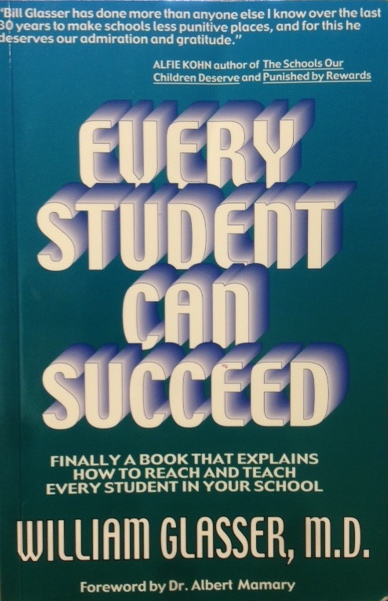
I like it when books or articles affirm Glasser’s view. The idea of “credit for actually learning” was an important part of his vision for school improvement. In his book, Every Student Can Succeed (2000), Glasser introduced the Competency-Based Classroom and described in detail how students can be supported to success. He believed that students need to demonstrate competence to receive credit. Simply sitting in the classroom and doing little to learn the material was not good enough.

The Fast Company article can be accessed by clicking on HERE, however the article’s second headline and first two paragraphs that follow will give you a feel for its focus.

Competency-based learning is the new hot trend, but no one is quite sure how to replace the credit hour.

The credit hour is the standard way of measuring achievement in U.S. higher education. It’s the unit students have to accumulate before they can graduate. It’s used in assessments of how much to pay faculty. It’s an organizing force on campus and in relations between institutions. It’s a currency that everyone understands—but also something that an increasing number of people criticize. Are students really learning or time-serving? Does making everyone learn at the same pace hold back students who could learn more quickly, and does the credit hour-system raise costs unnecessarily?

In its place, a growing number of institutions are developing courses based on “competency”—or what students actually learn—rather than the number of hours they put in. Competency-based education (CBE) is a hot topic among policy-makers, foundations, and colleges because it has the potential to lower costs, broaden access to education, and perhaps raise standards. But, as two new reports point out, CBE isn’t a perfect solution. In some cases, it may be more expensive than the traditional model, and, importantly, it’s still unclear what could replace the credit hour as a universal unit.

ocean

It felt to me that one of the first waves to shake higher education, at least in terms of the credit hour policy, was the wave of high school and academy students wanting transfer credit for various classes and life experiences they were claiming. This was especially true of non-traditional or home school students. The second wave, more like a tsunami really, has to do with the effect of the Internet and online learning. More and more students are taking advantage of cyberspace learning, rather than face-to-face, in the classroom interactions with an instructor.

The Internet reality has most higher education institutions jumping on the digital learning bandwagon, and as a result they are focusing more on what students need to know or be able to do to receive credit. The implications of this kind of focus are spilling over into traditional, Carnegie unit classrooms, too. While a comparatively few universities and colleges do seem glad to pursue this new model of learning, most higher ed institutions are reluctant to consider it at all. If they do begin to get involved they are more likely to enter the “actual learning vs. the credit hour” discussion kicking and screaming, rather than having any real excitement over the potential of a new approach. Still, though, it is good they are getting involved. Their involvement may look about as positive and comfortable as a cat getting a bath, but the end result will be better learning and a clean cat.

cat-bath-1jpg-70b1320cbd4f40d3_medium

Glasser’s reasons for emphasizing competency-based learning were different than higher ed’s reasons today. His reasons went deeper, as he recognized the importance to an individual’s mental health to be involved in quality pursuits and to ultimately create quality products, be it at home, at work, or at school. It is need-satisfying to learn relevant material and then to produce quality assignments. Students need to learn that their efforts matter and that they can accomplish what they put their minds to. The Internet existed in 2000 when Glasser wrote Every Student Can Succeed, although online learning had not yet started to explode. The Internet didn’t exist in 1990 when he wrote The Quality School and explained that only when students achieved competence would a grade be recorded in the transcript.

IMG_1778

The wave of online learning is only going to grow, which means that traditional formats, including the credit hour policy, will continue to be tweaked and changed. For those of us who are teachers it would be good to give Every Student Can Succeed another read, as regardless of the level at which we teach – elementary, secondary, or higher ed – the implications of the “actual learning vs. credit hour policies” will have an impact on our instruction and assessment.

=====================

images

Follow The Better Plan on Twitter

@thebetterplan

=====================

 Soul Shapers: A Better Plan for Parents and Educators

Available new on Amazon from $14.76; used from $5.47.

Available new on Amazon from $14.76; used from $5.47.

William Glasser: Champion of Choice

Now priced at $18.57 on Amazon.

Now priced at $18.57 on Amazon.

Click here for electronic version of Champion of Choice.

Trading Life for Looks

I saw some data from recent research that, unfortunately, brought to mind The Better Plan blog from January 22, 2013, which was titled Give Me Victory or Give Me Death. You can click on the title to take a  look at the post, but basically it described the results of a survey given to elite athletes where half of them admitted that they would trade their lives for success in their particular sport. The article commented on how powerful the basic needs are in our lives, as well as how central the quality world is in choosing the behaviors we see as need-satisfying. Toward the end of the post I wrote that –

SI cover

Until athletes, and the rest of us for that matter, understand the concept of the basic needs and the scrap book (quality world) process of meeting those needs, our rules and punishments will have very marginal success at best, and actually be counterproductive at worst. We need to understand that people are always acting in what they think is their best interest at the moment. Whether a recreational cyclist who drinks water before heading out on a ride to get in better shape or a professional cyclist who dopes before heading out on the next leg of the competition, both are doing what they think is best. Based on the pictures they pre-determined in their mental scrap books, their behavior is rational. Maybe not right or ethical, but rational.

woman-surprized-mad-at-scale-ngo-okafor-300x225

In similar ominous fashion, recent research out of the UK has found that 30 percent of women would trade at least one year of their life to achieve their ideal body weight and shape. Once again we have evidence of people, in this case women, who are willing to trade their lives for a picture in their quality world. The data revealed that in order to achieve their ideal body weight and shape –

  • 16% would trade 1 year of their life
  • 10% would trade 2-5 years of their life
  • 2% would trade 6-10 years of their life
  • 1% would trade 21 years or more of their life
21e86992c0e8e42f3fe7a5c26b6b2890

Further data revealed that –

  • 46% of the women surveyed have been ridiculed or bullied because of their appearance.
  • 39% of the women surveyed reported that if money wasn’t a concern they would have cosmetic surgery to alter their appearance. Of the 39% who said they would have cosmetic surgery, 76% desired multiple surgical procedures. 5% of the women surveyed have already had cosmetic surgery to alter their appearance.
  • 79% of the women surveyed reported that they would like to lose weight, despite the fact that the majority of the women sampled (78.37%) were actually within the underweight or ‘normal’ weight ranges. Only 3% said that they would like to gain weight.
  • 93% of the women surveyed reported that they had had negative thoughts about their appearance during the past week. 31% had negative thoughts several times a day.
self-acceptance-300x300

There is so much to say here, yet you probably could respond to this data as well as me. I think of the quality world as the My Needs Met world (MNM). It is hard to overstate the importance of the pictures we create and store in our personal My Needs Met storage system. So important are these pictures, so valuable are they to us, that in some cases we are willing to trade our lives for them.

There are influences around us that invite us and pressure us to create these pictures. Applause and adulation invites us to trade our lives for a trophy; media pressure invites us, especially women, to trade self-acceptance for self-loathing and constant efforts to be different, even if it means going under the knife. Such pressure and invitations are external to us, though. They can beckon, but they cannot enter our quality world without our consent. We put pictures into our quality world and we can take them out. There are quality world pictures that are worth dying for. Let’s really make sure they are the right pictures.

* An article on the study out of the UK can be found here.

==================

Follow The Better Plan on Twitter

@thebetterplan

===================

Click on Champion of Choice to quickly order a copy.

Now priced at $18.51 on Amazon.

Now priced at $18.51 on Amazon.


Teenagers, Cigarettes and Choice Theory

793px-Cigarette_smoke

The California legislature is about to consider a bill that raises the legal cigarette smoking age from 18 to 21.

What a great opportunity to teach students about choice theory!

Don’t get me wrong. It’s not so much that I want to feature the habit of smoking, but current events like this legislation can be a great springboard for learning.

State senator Ed Hernandez, D-Azusa, wants to keep cigarettes out of the hands of teenagers and believes that “We can no longer afford to sit on the sidelines while big tobacco markets to our kids and gets another generation of young people hooked on a product that will ultimately kill them.” Most people will agree that smoking is harmful. We agree less, though, on how to go about keeping people from smoking or getting them to quit after they have already started to smoke. As one person reacted to the impending vote, “What’s really going to work, legislation or education?”

hqdefault-400x300

When I first read the legislation or education comment a light bulb went on in my head and I recalled Glasser’s belief that the real future of choice theory depended on its becoming part of a public health approach to happiness and mental health. In other words, it’s about education. Toward the end of his career Glasser was excited about a booklet he wrote called Defining Mental Health as a Public Health Issue. He felt that people could be helped by having accurate information, and then supported as they put that information to use in their lives.

define_mh_as_ph_BG

Is correct information enough when it comes to keeping teenagers from smoking, though, or is legislation the answer? Maybe the situation requires both education and legislation. This is the question that can begin to form an outline for a learning unit on Teenagers and Smoking.

There are so many good ways to plan and organize such a unit. One way would be to organize essential questions around the four parts that Glasser always covered when he lectured – the basic needs, the quality world, creativity, and total behavior. The following are examples of questions that could be considered by middle school or high school students as they study the topic.

Basic Needs
What basic need is a teenager satisfying by smoking? Or is it a combination of more than one basic need?
What do you think is the average age when people smoke their first cigarette?
Do you think young people are ignorant of the health risk of smoking? Or do kids who smoke simply have a low need for survival?
To what extent would teaching students about their basic needs prevent them from smoking?
Is the need to belong (love & belonging) strong enough to lure a teenager into starting the smoking habit?

Quality World
Why do you think a teenager places the smoking habit in his/her quality world?
Is a boy or a girl more likely to start smoking before he/she is 20 years old? Why do you think so?
Do you think cigarette advertising works? Are teenagers drawn to cigarette advertising or are they drawn to smoking by friends?
Is smoking an act of rebellion? If so, what are teenagers rebelling against when they start smoking?
Is it possible to have conflicting pictures in our quality world? How do we deal with QW conflicts?
Would raising the legal smoking age to 21 keep more teenagers from smoking?
To what extent do teenagers keep laws in mind?
Why do you think leaders and managers put so much effort into forcing people to behave in the way that they want them to behave?

Creativity
What is addiction?
Is smoking a form of self-medication?
Why would a person voluntarily choose to be addicted to cigarettes?
A guy by the name of William Glasser helped us understand the difference between pleasure and happiness. Can you explain the difference?
Is it possible for a teenager to choose to become unaddicted to cigarettes?
What would a teenager have to do to break the smoking habit?
What makes it hard to break a habit?

Total Behavior
What is the physiological impact of smoking on the body?
To what extent does the smoking habit have to do with a person’s thinking and to what extent does it have to do with a person’s feelings?
If we have direct control over our actions, as the concept of total behavior states, why is it so hard to quit smoking?
Describe each of the four parts of a total behavior – thinking, acting, feeling, and physiology – for a teenager contemplating their first cigarette? For their 50th cigarette?
To what extent do laws keep people from making hurting themselves? To what extent should laws keep people from hurting themselves?

no-smoking-224x300

These are examples of questions and topics that could be included in a Smoking and Teenagers learning unit. Some of the questions require research. All of them invite discussion. The important thing is that the class would be looking at a relevant current issue through the lens of choice theory. In the process they would more fully understand the way that they themselves are internally guided, rather than externally controlled – be it by money-driven tobacco companies or the pressure of a friend next door. (Any help you can give me toward refining any or all of these questions would be appreciated.)

Keep on the lookout for other topics that will invite interest, lure into learning, and invite discussion.

=================

woman-surprized-mad-at-scale-ngo-okafor-300x225

Coming next on The Better Plan – A recent study reveals that women are willing to trade years off of their lives for an ideal body. Trading Life for Looks will explore this all too common destructive mindset. Choice theory can help turn this mindset around. (And men, so can we.)

Choosing One Thought Over Another

New-William-James-quote

One of choice theory’s strongest and most important concepts is that we have direct control of our thinking and our actions. This is one of the keys of the internal control model.

Megan Milholland-Brooks, English teacher at PUC Prep (the Seventh-day Adventist 9-12 school here in Angwin) recently saw the following slide in a PowerPoint presentation and said that she thought of The Better Plan blog. I have seen this somewhere in my past, however I am glad that she shared it with me, and glad, too, that I can pass it on to you.

Untitled

This could be made into a great classroom poster, which would remind students about the importance of their thinking.

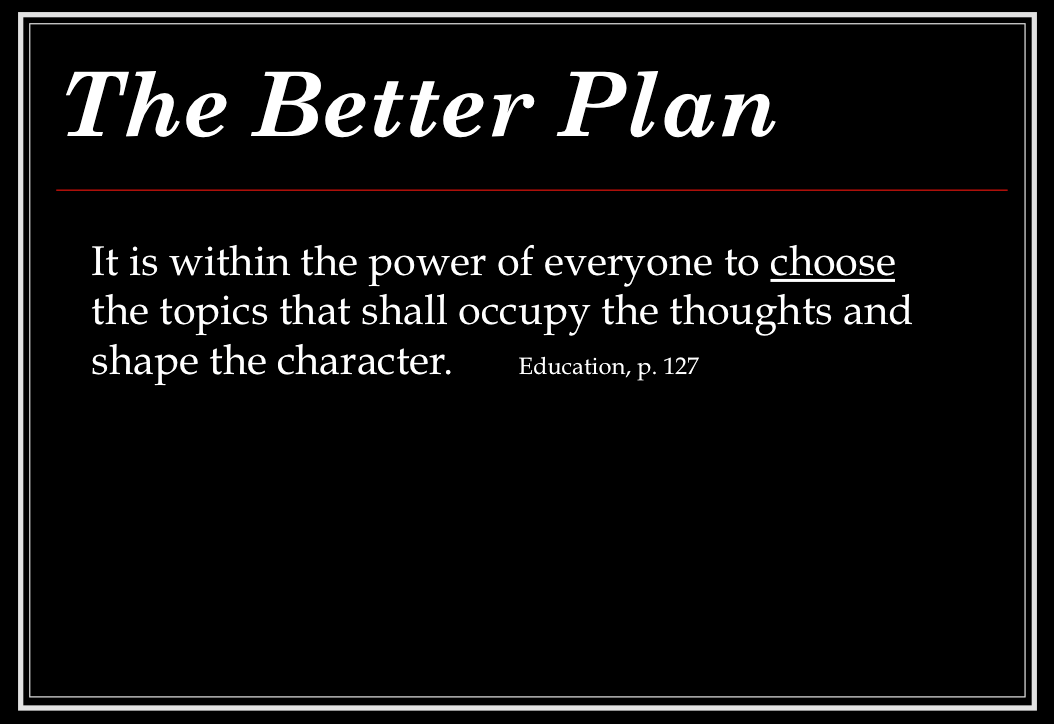
Since we are on the topic I will share an insight from the book Education that seems to fit here.

Screenshot 2015-02-04 12.59.57

The implications of this element of our human design are huge! For the most part, what we wrestle with or fret over or seek to overcome has everything to do with our thoughts. We really do create the weather in our lives.

I recently saw a powerful description in the little book, Jesus Calling, a meditational book that I have been opening in the morning for several years now. (My iPad version allows me to make notes in the margins and I have started dating my comments from year to year, which helps me see the steps I am taking along the way.) The thought for January 29 begins (remember, this is written as if God is talking to you personally) “I have gifted you with amazing freedom, including the ability to choose the focal point of your mind. Only the crown of My creation has such remarkable capability; this is a sign of being made in My image.”

“I have gifted you with amazing freedom,
including the ability to choose the focal point of your mind.”

As teachers and parents, let’s pass this gift on to our children. In a world filled with so much external control, let’s model and teach our students about internal control. It may require a significant shift in our own lives, but it will be worth it, for us personally and for our students.

=================

793px-Cigarette_smoke

Coming soon on The Better Plan — The California legislature will soon be considering a measure to raise the legal cigarette smoking age to 21, up from 18 years of age. How might this be an excellent current issue from which to consider the concepts of choice theory?

=================

Get the eBook version of William Glasser: Champion of Choice, by clicking HERE.

Now priced at $18.51 on Amazon.

Now priced at $18.51 on Amazon.

We Live the Feeling of Our Thinking


IMG_0517

This picture just captivates me.

On one level I am drawn to its wonderful creativity. I bought the door stop pictured below for my office door out of sheer respect for whoever the person was who thought of it. This kind of creativity needs to be rewarded.

22356_1237931432935_1251781_n

I have to tip my cap to this artist of the chain link fence picture as well. On another level, though, this picture goes so much deeper than just creativity. What is it saying to you? The chain link fence, ubiquitous, a comparatively cheap and efficient way to keep something in or keep something out, strong, you can see what is on the other side, yet you cannot reach it. The design of the fence itself is a model of conformity and permanence. Its tightly wound wire states very emphatically that “you can’t get out.”

Yet in this picture, not only can someone get past this fence now, the fence itself is breaking free. The very instrument of control, force, and restriction is itself becoming instruments of freedom. Dead weight has become helium. Anchors have become wings.

It is easy to see ourselves in the picture, both in the lock-step control of the lower part of the fence and in the links breaking free in the upper part of the fence. Optimism spills out from the picture, even if only to feel good for the links flying into the distance. “Good for you,” we whisper. “Good for you.” So powerful are the images of the links as wings that even the total grayness of the picture cannot keep us feeling gray. Somehow we see the gray as a color of the rainbow.

Of course, we need not only whisper, good for you. The links taking off to who knows where can be us. Those freedom loving links can represent our new way of being, our new view of the world, our recognition that we can choose to leave a tightly wound focus on control.

IMG_0517 - Version 2

It would be interesting to use this picture as part of an assignment in school. I can see it easily being used in creative writing for Language Arts, or for activities in Health class, or Social Studies, or Bible. What are some thought questions that could open the discussion in a class setting? Such questions might include –

What is this picture saying?
What did the artist want to convey?
The caption under this picture said that We Live the Feeling of Our Thinking. What does that mean?
Did someone need to cut the links to free them or did they free themselves?
Does this picture suggest that fences are bad and that being free of them is the goal?
Is there such a thing as a good fence?
What would make a fence less good, or even bad?

What do you think? How could this picture be used in a classroom or in a choice theory workshop? How could the picture’s creativity and insight really be plugged into?

================

Quickly order books by Jim Roy at the links below –

Now priced at $13.47 on Amazon.

Now priced at $13.47 on Amazon.

Click for Soul Shapers

Now priced at $18.51 on Amazon.

Now priced at $18.51 on Amazon.

Click here for Champion of Choice


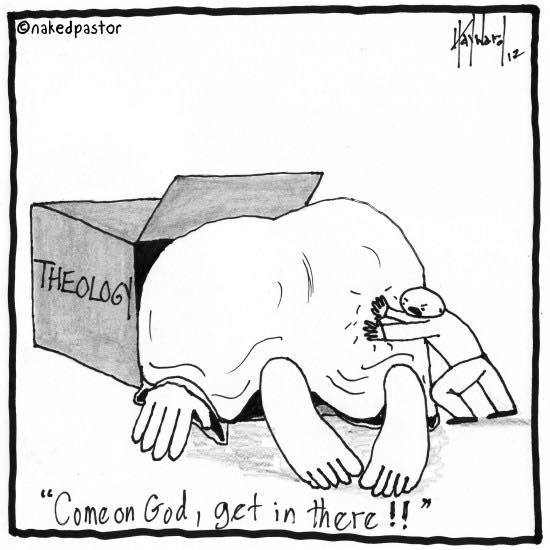
Stuffing God Into a Box

10801770_10202676523788825_3839559751082623107_n

Cartoons can say so much with so few words. This cartoon does that for me. As soon as I saw it I thought of a particular element on the choice theory chart. In case you don’t have the chart close by at the moment (I know that some of you have the chart memorized) here it is.

998222_515918598476499_846043754_n

What part of the chart does this cartoon relate to for you? If you were teaching a choice theory class or workshop, could the cartoon be used to help class members understand the chart? I would love to hear from you on this. I suspect that the cartoon could be applied to more than one area of the chart and I would like to hear your take on it.

For me, the cartoon of a person trying to shove God into a box of their preconceived beliefs really relates to the concept of the Perceived World. The Perceived World represents our personal view of reality. We are constantly comparing the pictures we have in our Quality World (what we want) with the reality of our Perceived World (what we think we have). When what we want differs greatly enough from what we think we have, we choose a behavior that we think will fix the discrepancy.

The two filters to the left of the Perceived World are significant. We perceive reality through our senses, a sleek process that a) evaluates the level of knowledge we have about the input, and also b) evaluates the value we place on the input. The Knowledge filter is pretty straight-forward. Those things we have partial knowledge of or better slip through to our Values filter, which is a very important moment in the process of perceiving our reality. You’ll notice that the Values filter is the same color – yellow – as the Quality World. The Quality World is the album in our heads where we store pictures of everything that we come across in our lives that is need-satisfying. As children we learn things from our parents, our teachers, our pastors, and any number of other adults that we place in our Quality World. As a result the Quality World becomes a very powerful compass in our lives, not always an accurate compass, but a powerful one none the less. Powerful because what we place in our Quality World becomes the filter or lens through which we see our reality.

800px-Hand_showing_lens_demonstration

When I see a person trying to stuff God into a box of their own religious beliefs, it reminds me of the ability we have as human beings to create our own picture of reality, and further to believe that picture is in fact the only accurate picture of reality period. Voltaire, the French philosopher, may have understood this human ability when he wrote that “If God has created us in His own image, we have more than reciprocated.” So powerful is our Quality World filter and the picture of reality that we create that rather than letting God make is into His image, we go about making Him into our image.

We do not see things the way they are. We see things the way we are.

What did I miss? How would you use the cartoon to teach about a piece of the chart?

This same topic has been addressed in earlier posts. Check them out here –

Misdirected Zeal

Why Christians Are So Un-Christian

===============

Click here to easily access a digital copy of the Glasser biography, Champion of Choice.

Now priced at $18.77 on Amazon.

Only $10 for digital version.


And I Quote . . .

IMG_1648

A fellow blogger* posted “75 of the Best, Most Inspiring, and Kickass Quotes on (Positive Mental) Attitude!” and it caught my attention. I am passing on to you several of the quotes that especially relate to the elements in choice theory. For instance –

It isn’t what you have or who you are or where you are or what you are doing that makes you happy or unhappy. It is what you think about it.   Dale Carnegie

When something bad happens, you have three choices: you can either let it define you, destroy you, or let it strengthen you.   Anonymous

A man sees the world what he carries in his heart.   Goethe

Yesterday I was clever, so I wanted to change the world. Today I am wise, so I am changing myself.   Rumi

Happiness is an attitude. We either make ourselves miserable, or happy and strong. The amount of work is the same.   Francesca Reigler

It is our attitude toward events, not events themselves, which we can control. Nothing is by its own nature calamitous – even death is terrible only if we fear it.   Epictetus

There is little difference in people, but that little difference makes a big difference. The little difference is attitude. The big difference is whether it is positive or negative.   W. Clement Stone
Part of the reason I include this quote is that it was the Clement Stone Foundation that donated $300,000 to a young William Glasser in 1967, which allowed Glasser to set up the Institute for Reality Therapy.

If you don’t like something, change it. If you can’t change it, change your attitude. Don’t complain.   Maya Angelou

I don’t think of all the misery, but of the beauty that still remains.   Anne Frank

A positive mental attitude may not solve all your problems, but it will annoy enough people to make it worth the effort.   Herm Albright

The greatest discovery of my generation is that a human being can alter his life by altering his attitudes.   William James

If you want to change attitudes, start with a change in behavior.   William Glasser

Life-1

May each of us continue to shift toward personal responsibility; may we recognize the power we have to adjust and focus our thinking; and may we do this in a spirit of love.

Have Choose a great day!

===================

Read about the Clement Stone Foundation reaching out to Glasser and, even as his wife and others urged him not to take the money, his decision to accept it in the Glasser biography – Champion of Choice. Click here to order the book quickly.

Now priced at $18.42 on Amazon.

Now priced at $18.42 on Amazon.

* Click here for the blog I get these quotes from – 75 of the Best, Most Inspiring, Kickass Quotes.