Posts by Jim Roy

The Quiet Crisis

I am teaching a summer school class this week on secondary reading. Some of you just zoned out at the very thought of taking such a boring class. I’d rather have a needle stuck in my eye than take that class you might be thinking. Memories of thick textbooks, “overpacked” with information and with questions at the end of each chapter, drift across your glazed eyes. A class in high school reading may as well be a class in *static omnibetoline. (Who cares? Right?)
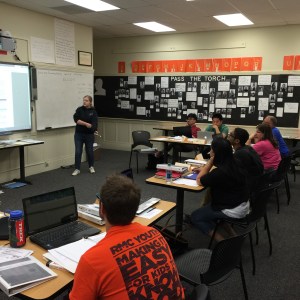
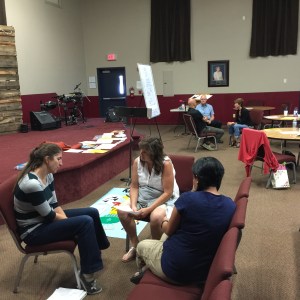
The secondary reading class at work.

The secondary reading class at work.

But that is just the thing. Literacy skills, which include reading, are the life blood of learning. Reading connects us to classroom success, but by learning to read well – to read with a purpose, to be able to identify the key points, and to comprehend what is read – it also connects us to an incredible world and a lifetime of discovery and learning. Rather than contributing to boredom and irrelevance, a skillful teacher can select WHAT is read and then coach students on HOW it is read in a way that ignites an interest and lures students into engagement.

The teachers in the class represent schools in Arizona, California, and Oregon.

The teachers in the class represent schools in Arizona, California, and Oregon.

I haven’t mentioned Choice Theory in the class yet this week, yet Choice Theory has been an important part of what we are learning. Known as the “quiet crisis,” data indicates that 25% – 40% of high school students are unable to access information in a textbook. There are multiple reasons for this, many that we have discussed in class, but the key is how can we as teachers enable students to be more successful? The Basic Needs framework provides a great viewpoint from which to consider possible solutions. For instance –

We honor a student’s need for Power and Success when we explicitly teach reading strategies.
Even if a student can read, we don’t assume that she/he knows HOW to read for comprehension. Being able to do things like 1) identifying the key idea, 2) comparing and contrasting different viewpoints, and 3) summarizing what an author really wanted to say can be taught. In fact, skills like these have to be taught, and probably re-taught. Human beings have a basic need to be successful in what they attempt. When we expect kids to know how to do complex tasks without teaching them how to complete the task their response is predictable. While a few students will ask for help or clarification, many students will act like the book is stupid or the assignment is dumb and doesn’t matter. “Who would want to do this ridiculous task?” they mutter with some disgust. Let’s not be faked out by their feigned coping mechanism. Instead let’s give them the tools to be successful.

We honor a student’s need for Purpose and Meaning when we make available or assign articles and books and other resources that are relevant to teenagers.
This is the challenge of teaching – connecting the learning to the learner. The casual observer doesn’t get this. You tell someone something, maybe you show them how to do something, and that should be it the casual observer thinks. But that isn’t it. It is nowhere near it! High school students, like everyone else in the world, latch on to ideas that matter to them. They engage in ideas that for them are important. Believe me, high school students care, they have intense opinions, and they want to make a difference. They yearn for school experiences that are not boring and irrelevant. Keep the following graphic in mind –

IMG_1332


We honor a student’s need for Freedom and Autonomy when we design choice into assignments and projects, including choices in what materials are read and researched.
This is not as hard as it may sound, and even if it initially adds to your “to do” list the rewards will be worth it. Not only can teachers come up with more than one book or article to complete the same assignment, it is also possible to create a rubric for an assignment or project, which includes the students themselves coming up with the appropriate reading or documents.

We honor a student’s need for Love and Belonging when we provide opportunities for talking about what is read with other students.
This can’t be overstated! Classrooms need to be places of safe, supportive connections. The connection between teacher and student is very important, however I believe the connections between the students are even more important. Students achieve success to the extent they feel supported and encouraged, by the teacher as well as by each other. Creativity flourishes in a safe environment. Real engaged learning often involves getting out of our comfort zones and risking a bit. We are much more open to risking when we feel safe and connected with others. (The importance of this need being met is even more important for English Language Learners.)
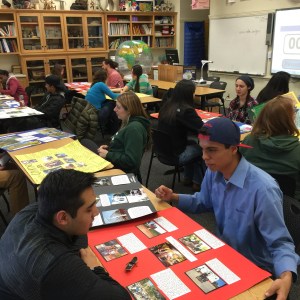
The classroom abuzz with students talking presenting their cultural heritage projects to each other.

A classroom abuzz with students talking presenting their cultural heritage projects to each other.

We honor a student’s need for Joy and Fun when we select reading materials that are enjoyable to read and when we provide an environment for reading that is welcoming and relaxing.
Some learning tasks require hard work and extended effort, but hard work doesn’t make a task less satisfying. Usually it is just the opposite. Our satisfaction increases when we are engaged in a challenging task in which we see value. Glasser viewed fun as the payoff for learning. The human brain is a natural information seeker, always on the lookout for the interesting, the novel, the important, or the sacred.

Baiting the Reading Hook (Educational Leadership, October, 2010) is an article that describes the possibilities of how a school can create this environment for students. With a little effort we can help to change the way adolescents view reading.

It is a privilege to work with the dedicated educators who are a part of this secondary reading class. It was need-satisfying for me to see the material ignite ideas and inspire changes for next school year. In the process I learned, too, and will be making changes in my own classes. The goal for each of us to help students – regardless of their academic skill set – to become better at the literacy skills of reading, writing, listening, and speaking.

======================

The Better Plan 1 (formerly Soul Shapers 1) begins on Monday, June 20, here at PUC. If it’s possible, I would love to have you join us and become part of the class.

======================

I was recently sent the following question: Is there a test to take to find out your basic need strengths / weaknesses?

How would you respond to this query? I may take a stab at it this weekend.


* static omnibetoline – a totally made-up, fabricated, fake topic or condition

Takeaways from Oregon

Livingstone Adventist Academy in Salem, Oregon, asked me to return this past week and lead out in a follow-up Choice Theory in-service, this time with a desire to focus on application of the ideas. The staff from McMinnville Adventist School joined us as well for the two-day in-service. As I reflect on the topics we covered, the activities we experienced, and the interactions I had with these talented and committed educators, these are the takeaways I have identified so far –

Choice Theory Principles Are Powerful
This may seem to obvious to mention, but I am going to say it anyway. The ideas and principles of Choice Theory really are life-changing. I can see it in the way participants are affected at certain moments during the in-service; I can hear it in their comments as they process how their own relationships are going or how their classrooms are functioning. There is truth in the ideas of Choice Theory and people relate to the ideas at a very deep personal level.

Chris Sequeira, David Davies, and Sharon Cutz, role play a parent who overhears her teenager talk with friends about cheating.

Chris Sequeira, David Davies, and Sharon Cutz, role play a parent who overhears her teenager talk with friends about cheating.

Role Play Reveals the Challenge of Applying Choice Theory
Glasser used to say that Choice Theory is easy to understand, but hard to do. Most of the difficulty, I think, in applying Choice Theory has to do with the length of time we have been marinating in external control, either with external control being used on us or with us using external control on others. Being involved in role play, where participants work through common personal or classroom challenges, shows how challenging it can be to come up with the right question at the right moment. Learning about problem-solving conferencing is about learning to help another person effectively self-evaluate; it’s about helping another person identify insights and make a success plan. Rather than telling and giving advice, it’s about listening and asking the “artful question.” Oh, and by the way, as nice as this may sound, it is hard to do. For some reason we tend to be “better” at telling and giving advice. Fortunately, role play is fun, which keeps us wading back in for more insight and experience.

IMG_0707

Groups spread out for a role play about a student who disrupts the classroom as the class clown. (Pictured: Katrina Koch, Bev Laabs, and Elizabeth Fish)

Students Need To Be Taught Choice Theory, Not Just To Have Choice Theory Used On Them
As teachers (and parents) we can’t delay on this. Few of us feel like Choice Theory experts, but remember that “He who does the teaching does the learning.” We give our students and children a great gift when we teach them about the Basic Needs or about their Quality World. Sonya Reaves recent post about how she taught her students about Total Behavior really underscores this point. Remember to review past Better Plan posts for more ideas. Here are some quick links to get you going.

Desks as Cars. I DID IT!

27 Intrinsic Motivation Ideas

Glasser’s Big 3 Quality School Pieces

Teaching the Quality World

Stamina

Parent Night Was a Success
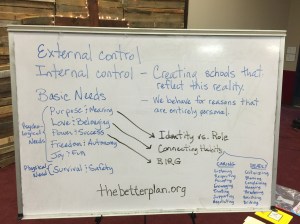
The in-service took place on Wednesday and Thursday, with a Choice Theory for Parents scheduled on Wednesday evening. The goal going in was to introduce Choice Theory to parents who may be interested in the direction the school was headed. School board members were also invited. The outline for the evening was simple. I talked about the idea of external control and the way it shows up in our lives, personally, professionally, and politically. I talked about how external control is very much a part of traditional schooling strategies, where teachers are very much focused on control and compliance. We then shifted to the idea that people were created for internal control and free will, not to be controlled by someone else. As the outline reminds us, we each behave for reasons that are entirely personal. The goal of schools, then, is to come into alignment with this internal control design and tap into the power that comes out of internal motivation. The Basic Needs provide an excellent springboard from which to consider student needs and the ways in which schools can intentionally become need-satisfying places. (If you have forgotten what BIRG stands for check out this link – Why Fulfill Your Own Dreams, When Your Kids Can Do It For You? )

The simple outline followed during the Parent Night orientation.

The simple outline followed during the Parent Night orientation.

Follow-Up Is Needed
This is true whenever systemic change is the goal. This follow-up is really about on-going support. Choice Theory ideas are strong, but we live in an external control world and without some kind of on-going support we tend to revert to what we know, what we have experienced the most. The follow-up doesn’t necessarily have to include me. The key is that there needs to be a local “keeper of the flame,” a local person who keeps the Choice Theory dialogue going and who provides moments for practice and reflection. Positive change is enhanced when there is a plan. I believe these factors are coming into place at Livingstone. I am excited for their future!

41lgMx-kqiL._SX295_BO1,204,203,200_

Parallel Truth
I was touched when, at the close of the in-service, the group presented me with the book, The Anatomy of Peace: Resolving the Heart of Conflict, by The Arbinger Instutute. Several of them explained how the message of the book is so complimentary to the message of Choice Theory, and that they thought I might like it. I am almost halfway through the book and I can already say how obvious the connection is between the two. I can very much recommend it to my Choice Theory colleagues spread around the world. It is striking how effective practices can be arrived at by different people or groups working independently of one another. As you may recall, I felt that way after reading Drive, by Daniel Pink. I am thankful whenever I see others proclaiming the message of internal control. (And for the personal messages that were written on the inside cover of the book from each of the in-service participants – Thank You! I treasure what you shared.)

I become an agent of change only to the degree that I begin to live
to help things go right
 rather than simply to
correct things that are going wrong.

from the The Anatomy of Peace

In the quiet of Thursday morning before participants begin arriving.

In the quiet of Thursday morning before participants begin arriving.

Assume that People Do Their Best? Is that Possible?

Some thoughts from Mark Landry’s (not so) completely. miserable. blog. His latest post, titled Some (painful-for-me) Thoughts on Letting People Off the Hook, began like this –

I’ve learned something recently, something that I know will change my life if I can get my head around it, something I wish I would have realized 20 years ago, but nobody was talking about things like this when I was 30.  If I could fax my younger self I’d say without hesitation – master this.

Brene Brown, in one of her recent books “Rising Strong,” relates some powerful advise from a friend:

Steve said, “I don’t know. I really don’t. All I know is that my life is better when I assume that people are doing their best. It keeps me out of judgment and lets me focus on what is, and not what should or could be.” His answer felt like truth to me. Not an easy truth, but truth.

This sounded great, so I tried it.  Massive fail.  I don’t have it in me.  I’ve built an entire world around judging others, comparing myself to others, using the “laziness” of others to make myself feel good, labeling people based on what they have or haven’t accomplished in their lives.

It feels good to tear someone down.  It makes us feel valuable, ironically, when we take someone’s value away.   But ultimately I have to put myself under the same microscope, which is especially hard these days.  I”m a washed up, has-been pastor, now a stay at home dad.  Not much in my life to tout.  All the judgments, all the “can you believe that guy” thoughts that I’ve used to create my little accomplishment-based caste system have come back to haunt me.  In spades.  Over and again I come up just as short as everyone else.

“It makes us feel valuable, ironically, when we take someone’s value away.”

Along with Mark Landry, I have been thinking a lot recently about the damage of criticism. Glasser rated criticism as the most damaging of the Deadly Habits, the most disconnecting of the “disconnectors.” Passages I am reading in a little book called Thoughts from the Mount of Blessing has reinforced Glasser’s concern regarding the effects of criticism. The people of Jesus’ day, the little book points out, “reflected the spirit of their religious leaders as they intruded on the conscience of others and judged each other in matters that are between the soul and God.”

A cover of the little book, Thoughts from the Mount of Blessing, which is based on what has come to be known as The Sermon on the Mount, found in Matthew 5-7.

A cover of the little book, Thoughts from the Mount of Blessing, which is based on what has come to be known as The Sermon on the Mount, found in Matthew 5-7.

It was in reference to this spirit and practice that Jesus said, “Do not judge others, and you will not be judged.” (Matt. 7:1), and which the little book further explains –

That is, do not make your opinions, your views of duty, your interpretations of Scripture, a criterion for others and in your heart condemn them if they do not come up to your ideal. Do not criticize others, conjecturing as to their motives and passing judgment upon them.” Thoughts from the Mount of Blessing, p. 178

Once again, I am reminded of the similar emphasis of these two disparate authors – Ellen White and William Glasser – the first a spiritual author at the turn of the 20th century and the second a secular author at the turn of the 21st century. Glasser would have resonated with Ellen’s statement, for instance, that –

“The sin that leads to the most unhappy results is a cold, critical, unforgiving spirit.”  Thoughts from the Mount of Blessing, p. 181

PP-JesusTeacing_JS_0057

It is especially interesting to me just how far the damage of a critical spirit can reach, and how powerful that damage can be. Our personal relationships are hurt when criticism is present, often deeply, but we also need to remember how the spirit of criticism can affect an organization’s atmosphere, and in particular a leader’s strategy within that organization. Religious leaders and churches do not draw a pass here. In fact, it is just the opposite. In the passage that follows, Ellen White describes how criticism morphs into control, and how laws and persecution are the sure result. She writes –

When men indulge this accusing spirit, they are not satisfied with pointing out what they suppose to be a defect in their brother. If milder means fail of making him do what they think ought to be done, they will resort to compulsion. Just as far as lies in their power they will force men to comply with their ideas of what is right. This is what the Jews did in the days of Christ and what the church has done ever since whenever she has lost the grace of Christ. Finding herself destitute of the power of love, she has reached out for the strong arm of the state to enforce her dogmas and execute her decrees. Here is the secret of all religious laws that have ever been enacted, and the secret of all persecution from the days of Abel to our own time.

Christ does not drive but draws men unto Him. The only compulsion which He employs is the constraint of love. When the church begins to seek for the support of secular power, it is evident that she is devoid of the power of Christ–the constraint of divine love.  Thoughts from the Mount of Blessing, p. 182

Christ does not drive but draws men unto Him.
The only compulsion which He employs is the constraint of love.

Love is the answer, and always has been. Yet how strong the pull is to coerce loved ones into complying with our ideas of what is right. Whether organizationally or individually, though, whenever the spirit of criticism rules the results are disastrous. May we keep from criticizing, judging, blaming, and forcing others to accept our ideas, especially if we are in any way associated with religion.

===============

I have been receiving a lot of positive feedback on the last post, Desks as Cars. Check it for a great idea about teaching Choice Theory to children.

===============

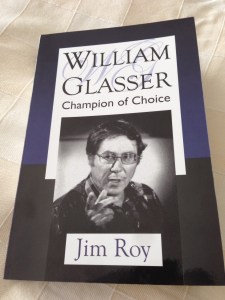
If you have read Glasser’s biography, Champion of Choice, would you take a moment and write a review that I can share as part of The Better Plan blog? Sales of the book have been slow in the U.S. Let’s do what we can to let others know of Glasser’s life and ideas.

Desks as Cars. I DID IT!!

A recent email described a great way to share choice theory with children!

IMG_1933

I DID IT!!!!

I finally got enough courage and taught my students the Total Behavior Car!! I thought I’d share with you the how and why 🙂

Since I am leaving my position of K-2 teacher/principal this year I had been thinking a lot about making sure my students were equipped and prepared for change in their life. At our Spring Education Council meeting one of the principal breakouts had been about children and crisis. The main thing we can do to help prepare our children for crisis, they said, is to teach them how to handle, understand and express their emotions. I agreed with all of this since I have been a big fan of choice theory and seen how it has helped me personally over the last 3 years. So now it was time to help prepare my students to express themselves.

I tried on Monday to teach the concept of the Total Behavior Car. It went terribly. It was all on the board and they weren’t engaged. I think I left more frustrated than they were. So back to the drawing board. I didn’t want to make toilet paper cars like I did way back during The Better Plan workshop (too much tiny work and I didn’t have the supplies on hand) and suddenly about an hour before class it came to me! Turn the desks into cars!

IMG_1929

We moved all the desks into their own parking spaces. What kid doesn’t like a mid-day desk move! Then I got out the wheels (big paper plates) and the steering wheel (small paper plates) and we reviewed the car model. On the board I drew the desk and labeled it according to the chart. We talked about how to choose to be happy, smile, think about happy things and then how our body will feel happy and our feelings will follow. They were understanding it! Hurrah! So while they were labeling their wheels I was taping the parking spaces. Then I became a mechanic and taped all their wheels to their desks. I kept them high so they will be constant reminders to them. As they were finishing the wheels I gave them their steering wheels to decorate (making sure they wrote Wants on it, had I more time or resources I might have them cut out pictures of things that are in their quality world?). Then they even got to make their own license plates. They LOVED it. We reviewed at the end how to make our car go where we want it to and how sometimes people can drive it backwards.

IMG_1936

Tomorrow I’ll be going over more emotions and why they come based on wants, actions and thoughts. I plan on ending this unit with the movie Inside Out where we will talk about the emotions and who has control and what she could have done during different parts to change her emotions.

What do you think? Anything I should add? I was just so excited to finally figure out a way to teach it and to no longer be intimidated by it. Yes, I wish I would have taught this in August, but better late than never, right? I’m sticking some pictures in this so you can see what it all looked like.

Blessings!

Sonya

I am really glad that Sonya decided to go for it and venture into the land of Choice Theory implementation. The implementation step is difficult for some reason, yet her story reminds us that implementation is not as hard as we make it out to be and the rewards are worth our becoming vulnerable. We don’t have to be perfect choice theorists to share the ideas with our students. In some ways, our imperfection makes our sharing even more compelling. Students often latch onto to a topic or idea in which they become co-learners with their teacher.

Students often latch onto to a topic or idea in which they become co-learners with their teacher.

When I contacted Sonya to ask if I could share her story on The Better Plan blog, she wrote back –

The students still have their cars and we refer back to the wheels all the time! I can’t believe it took me so long to use. It’s also helping me to reevaluate how I drive my car. Man I love Choice Theory 🙂 Share away!

There is something very powerful about the concept of Total Behavior. It is transformative, for instance, to learn about the relationship between our thinking and our feelings, and to further learn that we can choose what we will think about. Such realities are life-changing.

The tires on a car are used to represent the four parts of total behavior.

The tires on a car are used to represent the four parts of total behavior.

Much is currently being written in educational journals about the importance of social-emotional learning and the value of positive relationships in classrooms. From the very beginning of his career William Glasser was motivated to unlock the mysteries of psychology for everyone on the planet! The concepts of Choice Theory, with Total Behavior being one of its most important concepts, are such an effective way to introduce and nurture the psychological and emotional health of students. Don’t hold this information back. Don’t worry about not being wise enough to teach the concepts. Go for it!

==============

Tell a friend about The Better Plan blog. It’s easy to Follow the blog at thebetterplan.org. Let’s continue to grow the conversation about choice in classrooms and homes.

You can also access the blog on Twitter

@thebetterplan

images


Changing the System, Not Students

William Glasser was known for his commitment to answering correspondence. He frequently included his contact information on the last pages of books he wrote and invited readers to get in touch with him if they had questions. Given that several of his books were major sellers, including his contact information was no small thing.

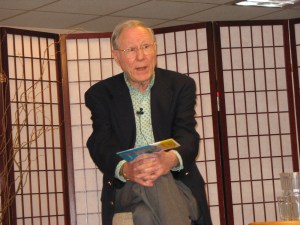
Glasser during a talk in Ventura, CA, ten years ago.

Glasser during a talk in Ventura, CA, ten years ago.

William Glasser, Inc. recently shared one of Glasser’s replies to a reader inquiry and I thought many of you would be interested. The person Glasser wrote to was an elementary school principal who attended a workshop Glasser taught in 1995 at the NAESP convention. (National Association of Elementary School Principals)

William Glasser, 1977

William Glasser, 1977

Apparently the principal wanted Glasser to respond to two comments he submitted regarding school discipline. Unfortunately, the two comments were not included with what Glasser, Inc. shared, but you can almost imagine the comments as you read Glasser’s response, which follows –

September 14, 1995

What you are doing is something I no longer have any interest in whatsoever – that is, concerning yourself with discipline problems in school. Certainly, discipline problems could be handled better than they are now which is what your material is leading toward. In that instance, it is reasonably good. I however, don’t believe that we have any solution whatsoever to discipline problems; handling them better or worse. We need to change the school system that is producing the discipline problems because the system doesn’t satisfy the students’ needs. Therefore, I won’t endorse anything that says the word “discipline” on it. I won’t talk about discipline, but will only talk about changing the system. For more information on this idea, you would need to read my books The Quality School and The Control Theory Manager. Those two books explain it best of all.

It is not that people don’t want what you are doing. They do very much. They recognize that there are a lot of discipline problems and would like somebody to come along and tell them how to deal with it a little bit better. But in the end, your ideas won’t work. They won’t work because they are still trying to support the old system, which is really what is making the problem. It is as if people are falling into a ditch in front of the hospital and finally, the surgeon says, “how come all these broken legs are coming in” and the nurse says, “well, they’re falling into a ditch in front of the hospital” and the surgeon says “well, let’s stop operating for a little bit and go down and fill up the ditch.” That is what we have to do. We can’t figure out better surgical procedures, we have to fill up the ditch.

I hope you understand that you should move toward changing the system and not help a bad system to survive by blaming the student. The students who have discipline problems have every right to be upset. The school doesn’t work for them. We can’t change them if we want to succeed – we have to change the schools.

I’m sure you are disappointed in this letter because you are a good person with good ideas. But your ideas in my opinion are obsolete. Maybe one hundred years ago we had a few discipline problems and we could focus on them, but now we have schools where all the children are out of order. I just worked in one this last year in Cincinnati. No discipline program, yours or anyone else’s would have worked. We changed the system and the problems disappeared. It was hard work, but it shows that what I’m saying makes good sense.

Cordially,

William Glasser, M.D.

=======================

This 1995 letter provided a clue as to how adamant Glasser was about focusing on changing the school program, rather than focusing on disciplining kids into compliance. He came to feel so strongly about this focus that at the 1996 Glasser convention he officially rejected all school discipline plans and explained that those who wanted to work in his organization would have to reject them, too. My purpose in sharing this information here is not to rehash the details of this decision, but instead to consider the real value in Glasser’s points. (If you are interested the details of the 1996 declaration, which led to a significant schism in the organization, the topic is covered in depth in his biography – Champion of Choice (2014))

photo

I agree with Glasser completely that schools need to focus on becoming need-satisfying places for students. Anything less than creating a classroom and a curriculum based on student needs ultimately leads to underperformance, boredom, resentment, and misbehavior. Such schools are possible and the results are inspiring. Whether nearby, like New Tech High School in Napa, California, or far away, like schools in Finland, examples of effective student-centered schools are there for the observing and the copying. (See the video clip that follows.)


I think it is worth clarifying that even schools that focus on becoming need-satisfying in their curriculum and instruction will benefit from having in place appropriate procedures and rules. When Glasser decried discipline plans he was concerned about schools forcing students into complying with expectations that didn’t take their needs into account. He didn’t mean that schools should become “structureless” in the process. Appropriate procedures remind students of the way things are done, and in the process help to prevent problems from even occurring in the first place. Procedures help us in a lot of ways throughout the day – driving procedures, standing in line at the store procedures, and supervising your dog at the park procedures, to name a few – and they can help us at school, too. Rules, on the other hand, are meant to identify behaviors that are not allowed because they are hurtful to others (bullying), destructive to property (vandalism) or that seek unfair advantage (cheating). Broken rules are rare in a choice theory classroom, but the rules still need to be stated.

The real issue lies in how procedures and rules are applied. Broken rules in a traditional classroom lead to blame and punishment; while broken rules in a choice theory classroom lead to problem-solving and restoration of trust. The book Education, written in 1900, describes this process well –

“The true object of reproof is gained only when the wrongdoer himself is led to see his fault and his will is enlisted for its correction. When this is accomplished point him to the source of pardon and power. Seek to preserve his self-respect and to inspire him with courage and hope.”   Education, p. 292

Educators will have to decide for themselves regarding their expectations and plans for classroom management. Glasser stated strongly that any management plans based on the idea that students are the problem and that they need to be fixed will not be successful, and in fact will be destructive to student success. His battle cry was to change the whole system of how we teach and work with students. It seems to me that the effective use of procedures in the classroom is a part of changing the system. (For more on classroom procedures, check out Classroom Management (2015), by Harry Wong.)

9780976423331_p0_v3_s260x420


Learning to Choose

It’s important to provide students with choices, right? Students like school more and their learning improves when they experience elements of freedom and choice in how they are managed and in how they attack their assignments, yet teachers often struggle to provide such choices. They decry its inefficiency or share examples of how students can’t handle choices. Teachers simply want their students to choose to learn, but the thing is, have teachers helped students learn to choose?

IMG_0546

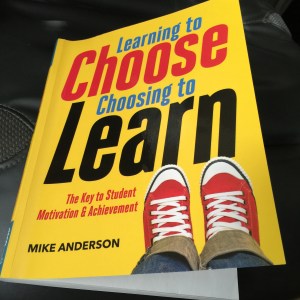
The new ASCD book selection, Learning to Choose, Choosing to Learn (2016), by Mike Anderson, explains not only why learning to choose is important, but also introduces strategies for teachers to begin sharing learning choices with students.

Key points from the book include –

+ Students Self-Differentiate
All human beings are motivated to learn – when the learning is relevant and when it isn’t too easy or too hard. Because of this, when given appropriate options for reading, researching, or completing assignments, students can be helped to self-differentiate. Students can learn to know the level at which they function best and strive for the same learning objectives as the rest of the class.

+ Student-Centered Choice Can Exist with Academic Standards
Standards provide a content learning target, which is very helpful, but this doesn’t mean that students cannot have choice when it comes to how they will reach for or hit the target.

+ Students Will, at Times, Choose Poorly, but Poor Choices Are as Much about Learning to Choose as Are Good Choices
It may be hard to give students the option of making a poor choice, but they can learn a lot as they correct its effects. Rather than standing by and hoping for the best when students stumble, teachers can coach and mentor students at a time when the student is especially open to a better way of doing things.

+ Purposeful, Positive Relationships Contribute to a “Learning to Choose” Environment
Real choices often present an element of risk – do I stay in my comfort zone and focus on what I already know or do I become willing to grapple with new learning, maybe even to the detriment of my grade? Such choices within a classroom are public choices. Students know when classmates are “going for it” on a project or assignment. Such risk is possible when teacher-student relationships, and student-student relationships are warm and supportive.

+ Guide Student Thinking, Not Their Choices
The goal is to help students make decisions for themselves. This is another way of affirming the choice theory belief that teachers need to help students effectively self-evaluate, whether that self-evaluation has to do with a completed assignment or with a decision about whether or not to go to college. The language an adult uses to guide student thinking is subtle, yet important. For instance –

Instead of . . . “This choice is easier and this one is harder.”
Try . . . Choice A involves two-digit numbers and Choice B involves three and four-digit numbers.

Instead of . . . “If you really want a challenge, this one is for you.”
Try . . . “Think about the level of challenge that is the best fit for you.”

Instead of . . . “I think this is the best choice if you are interested in animals.”
Try . . . “This choice involves animals.”

Instead of . . . “If you like to move while you work, this is the choice you should pick.”
Try . . . “If you like to move while you work, you might consider a choice that involves movement.”

Instead of . . . “Meagan, you should pick X.”
Try . . . “Meagan, which one seems like a good fit for you?”

This “Instead of / Try” list is one of many such boxes and tables found in the Learning to Choose book. The author wants the book to provide practical help for any teacher wanting to more frequently speak the language of choice. The book certainly reminded me about the importance of choice in the classroom, and it taught me ideas and strategies that I can put to use right away.

While important in its implications for the classroom, the book also reminded me that learning to choose is not a skill we automatically attain upon reaching adulthood. There are too many examples of adults “stuck in a rut,’ too many examples of dreams not reached, goals not completed or even started, too many damaged relationships and dysfunctional families, and too many occurrences involving hate and violence to be able to claim that the masses have learned to choose well. Learning to choose is a classroom skill, but more importantly it is a life skill. Every child that comes into a better understanding of how to choose becomes a better adult in the future – a better spouse and parent, a better employee or boss, a better neighbor and citizen. This importance cannot be overstated!

================

A short video about Student Voice and Choice

================

Get the Glasser biography – Champion of Choice – from Amazon quickly and at a good price. Let me know if you would like a signed copy.


Tools for Auditing Ourselves

IMG_0535

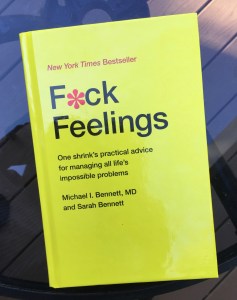
Book titles can get my attention, so, ok, this one got my attention. In fact, I bought a copy. Although irreverent and even funny, it turns out the book has substance. As the book’s subtitle announces, it provides practical advice for managing all of life’s impossible problems. A tall order, although advice can be cheap. The first two chapters of the book – F*ck Self-Improvement and F*ck Self-Esteem – have been interesting and even choice-theoryesque, but my jury is still out on the book’s overall value. While I am still weighing the book’s advice, I can certainly agree that life has impossible problems and that help is needed in learning to manage them.

6357405020812055051488693726_anxiety-charlie-brown

It seems like more than ever people are suffering from the effects of anxiety, fear, and anger. Glasser used to say that a person couldn’t be seriously unhappy for more than six weeks without beginning to experience psychological, and even physical, symptoms. To combat these symptoms, which often involve various forms of chronic pain, Americans have turned to drugs, both legal and illegal, to numb the discomfort. The numbers bear this out. Although making up less than 5% of the world’s population, Americans use 80% of its opioids. One hundred and twenty nine Americans (over 47,000 annually) die every day from drug overdoses, about 60% of them linked to opioids. For the first time since 1986, suicides are on the rise as well. Sally Curtin, a statistician with the National Center for Health Statistics, notes that “While other causes of death are on the decline, suicide just keeps climbing – and it’s doing so for every age group under 75. (A heartbreaking statistic from her data reveals that the age group with the sharpest increase is for girls between the ages of 10-14.) So, yes, there are a lot of people searching for advice and direction on how to manage life’s problems.

113829-400x266-Oxycontinaddiction

As I read the chapter entitled F*ck Self-Improvement, I came upon a statement, really just a phrase, that jumped out at me. The author was talking about how to help another person change an addictive behavior. “If you’re trying to get help for someone who doesn’t yet want it,” the authors begin, “keep in mind that such help seldom is effective, because it doesn’t work when someone is attending treatment for you rather than for themselves. Instead of taking responsibility for another person’s recovery, give them tools for auditing themselves, and challenge them to use those tools to decide for themselves whether they need sobriety and help.”

”  .   .   .   give them tools for auditing themselves.”

That phrase, “give them tools for auditing themselves,” zapped the creative center in my brain and I instantly thought about what our students, from Kindergarten through 12th grade, need from us – tools for auditing themselves. Children need coaching and mentoring on how to be aware of their thinking and their feeling, and even their physiology, and then on how to behave more effectively. This is one of choice theory’s core elements. People, whether in elementary school at the beginning of their life or in a retirement center much later in life, can learn to insightfully self-evaluate and make a new choice, a better choice. This is why Dr. Glasser saw mental health being a public health issue. People can learn to monitor and take care of their own psychological health.

define_mh_as_ph_BG

At the heart of public health is the element of education, the element of teaching people a healthier way. This is why the presence of choice theory concepts in schools can be so powerful. The cycle of externally controlling students, with its emphasis on rewards and punishments, must be broken. Rewards and punishments may produce a semblance of compliance, but it is also producing an adult population incapable of managing themselves and dealing with life’s problems. Rather than being controlled through threats, sanctions, and punishments, students need to be given the tools to audit themselves. There is no greater gift than the gift of self-control and self-management.

Jim Roy and Dave Hanscom

Jim Roy and Dave Hanscom

Self-improvement has become an industry taking in more than 11 billion dollars a year. People may say they don’t want to be addicted to pills or behaviors that numb and distract, but they seem to want them more than they want to deal with pain and frustration. There are ways to manage psychological and physical symptoms, though. If you made it to adulthood without yet learning the tools to “audit yourself,” there are helpful resources. One approach I am appreciating more and more is one espoused by Dr. David Hanscom. His book, Back in Control: A Spine Surgeon’s Road Map Out of Chronic Pain, is an inspiring, detailed, and step-by-step guide to managing the stresses of life and decreasing the pain, often without surgery. (Find out more about this road map at drdavidhanscom.com.) As I discussed with Glasser before he passed away, I am now in talks with Dave about how to get self-management tools into schools. It is best to begin the quest for self-management early.

back-in-control-front

While mentoring students toward self-management is a caring, skilled, and delicate process it isn’t rocket surgery. Well, actually, rocket surgery is easier. Much easier. Working with a rocket is about understanding laws related to physics, engineering, and electrical circuitry, and applying them accurately. Working with a child to help him understand his own thinking, feeling, and behaving, and further to help him know when he needs to adjust a thought or a behavior, is a much more challenging task. But as parents and educators that is our wonderful challenge. Each of us is on a spiritual journey, and learning to manage life is an essential part of that journey.

0828018316jpg

The book that described “the better plan” for SDA educators and parents, although its message can help anyone in leadership.

Batman vs. Superman

21-superman-batman-secondary-1.w1024

A new Batman and Superman movie, Dawn of Justice, came out last weekend, and interestingly the two superheroes are pitted against one another. How can it be, you might ask, that two “good” guys go after each other? What kind of sense does that make? The answer to that question is fascinating, and even important, and ultimately has a connection to choice theory.

BvS_Imax

I don’t have a deep knowledge of comic book characters. I was never allowed to go near a comic book when I was a kid, which some would say had something to do with me developing an interest in science fiction later in life. It was troubling enough to my parents when I got into the Hardy Boys mystery series. Over the years I have seen different of the blockbuster summer movies that feature Marvel or DC comic characters, but I am not that familiar with the original writing that brought these characters to life. Apparently, there are a lot of people who are into the comic book genre, though, and one of these people, Abraham Riesman, wrote an article on the conflict between Batman and Superman that appeared in the March 21 edition of New York Magazine.

Lex Luthor

Lex Luthor

Both of them, Riesman contends, want to make a better world, but they differ on how to accomplish it. Superman operates through hope and inspiration, while Batman operates through fear and intimidation. In the movie (I haven’t seen it yet), Lex Luthor, the bad guy, describes them as “god vs. man, day vs. night.” As Riesman summarizes, “Superman has faith that humanity will tend toward goodness if you give it trust and hope; Batman lacks that faith and believes the world only gets in line if you grab it by the throat and never let go.” Of interest is the fact that between the two characters, Batman is by far the more popular. Whether by number of comics or by number of movie tickets sold, Batman predominates.

Batman is by far the more popular.

This is a bit remarkable, given that Batman is only an earthling, which leads us to consider something deeper. That something has everything to do with the way in which Batman’s worldview seems to dominate .  .  . well, the world’s view of how things get done. More and more people, it would seem, are relating to Batman’s approach to solving problems? “It was only in the 70s and 80s,” one writer suggests, “that Batman truly emerged from Superman’s shadow. This was a period shadowed by the assassinations of two Superman-like symbols of hope – Robert F. Kennedy and Martin Luther King, Jr. Cities from coast to coast erupted into vicious race riots. A sitting president was tied to an insidious crime and resigned on live television. We lost a war for the first time and economy skidded into an oil-slicked slowdown. At the cinema, audiences wanted heroes that were less like John Wayne and more like Dirty Harry.”

Dirty Harry

In a comic book from 1983, “Superman tries to appeal to the better angels of Batman’s nature” and reminds him of their always wanting to serve as examples to others. “But the Dark Knight cuts him off and declares that he never asked for that. ‘I never wanted men to imitate me – only fear me.’” Batman felt that Superman had sold out to a failed system. “My parents taught me a different lesson than yours taught you, Superman, lying on this street, shaking in deep shock, dying for no reason at all, they showed me that the world only makes sense when you force it to.”

And so the newest DC comics movie, Dawn of Justice, pits two good guys against each other, fighting over how to make the world a better place. One through hope, inspiration, and faith in humanity. While the other relies on fear, intimidation, and force.

Dawn of Justice pits two good guys against each other,
fighting over how to make the world a better place.

The rhetoric on display during the Republican debates seemed very much in agreement with a Batman mentality. Trump’s meteoric rise in political popularity has much to do with his tough talk and forceful solutions. It will be interesting to see where we go as voters, and where ultimately we want the country to head. Will a majority of us want tough talk and solutions through force?

Choice theory, whether applied personally or corporately, and even on an international scale, calls us to something better than threats and brute force. As educators, the present political dialogue will make our jobs more challenging. Children and teenagers pick up on the words said and the tone in which they are said and, if these words and tones are modeled at home, will behave in a similar fashion at school. Even as educators have recently made advances against bullying, now the language of bullying has been thrust upon us on a national political stage, and our advances seem poised to be swept away. Whether difficult or not, as educators and parents, let us hold to the promptings and principles of choice theory and keep on teaching our students about discovering their purpose in life, about love and belonging, about freedom, about power (this one is getting more important by the second), and about joy.

The ultimate use of power is to empower others.
William Glasser

=======================

When Little Decisions Explode (for the better)

The Better Plan blogsite usually comments on the seemingly little, and even unseen, ways in which our choices affect us and those around us, but today I am struck by two things I experienced last week that represent the power of choice on a much bigger, more perilous stage. True, these big displays of the power of choice came out of the seemingly little private choices that two individuals made, and true, these two individuals could not conceive of where their little choices would take them.

Luther and Smith 2

Martin Luther on the left in a rare photo from the year 1525, and Tommie Smith on the right taken last week at Pacific Union College in the year 2016.

The two individuals to which I am referring are Martin Luther and Tommie Smith. You might be wondering how I experienced gentlemen last week, and in the case of Tommie Smith you might be wondering who he even is. Dr. Tommie Smith, of 1968 Mexico City Olympic fame, came to Pacific Union College last week and presented to the campus Black Student Union club, a presentation I was privileged to attend. It just so happened that last week, during my meditative reading time, I read about the reformer Martin Luther and his impassioned debate against the religious machinery of his day. Two men, one raising a black-gloved hand to the sky, imploring the world to pursue fairness and non-discrimination, the other nailing 95 theses to the church door, imploring the world to embrace simplicity of Jesus and His gospel of real freedom and real power. We think of them with a momentary, cognitive tip-of-the-hat, forgetting that their commitment to their message placed them on the very cusp of having their lives ended, crushed by the systems they were challenging.

Luther nailing 95 statements on the door of the church; Smith raising a gloved fist to the sky.

Luther nailing 95 statements on the door of the church; Smith raising a gloved fist to the sky.

Luther, whose only goal was to uplift the importance of Scripture and the Saviour that Scripture described, entered a maelstrom of fierce attacks that few of us can even begin to comprehend. It can truly be said that the forces of hell arrayed themselves against this humble monk. He had to be kidnapped by the good guys to prevent his sure assassination. Non-violent to the end, he understood the power of words and the ways in which every man and woman can and must decide for themselves the allegiances they will embrace. Words alone, without coercion, will do their work better than any sword or cannon.

A painting (photographers were not allowed into the hall) of Luther declaring that "I cannot and will not recant."

A painting (photographers were not allowed into the hall) of Luther declaring that “I cannot and will not recant.”

Smith, along with John Carlos (and Peter Norman, the silver medal winner), raised a black-gloved fist during the medal ceremony and the playing of the U.S. national anthem in protest of the racism and discrimination so prevalent throughout the world, but especially in the United States. His punishment for this public act was swift and comprehensive. Banished from the Olympic village and sent home to multiple death threats and ostracization. Criticized for using the gold medal stand as his political soap box and dismissed as a problem. His message of non-violent change for the better was for many lost in the money-making machinery of sport and politics. Rejected by friends, and even family, Tommie Smith went on to gain his teaching credential, and ultimately his doctorate, which he applied to a life of service in the education system.
Dr. Tommie Smith, with fellow educators Dr. Bob Paulson on the left and Dr. Jim Roy on the right. (Feb 16, 2016)

Dr. Tommie Smith, with fellow educators Dr. Bob Paulson on the left and Dr. Jim Roy on the right. (Feb 16, 2016)

I have been inspired by Luther and Smith and have been led to question the extent to which I am ready to stand for something in which I deeply believe. Am I capable of thoughtfully, purposefully, non-violently, and resolutely “raging against the machinery” of my day, against the organizations and systems that confuse people, rather than help them, and hurt them, rather than heal them.

For Luther and Smith their journeys began with seemingly little ideas and choices. Interesting how our little choices can explode into such big deals.

=============================

I encourage you to do some research and reading on the characters written about in today’s post. Of particular interest is the story of Peter Norman, the Australian silver medal winner in the 200 meter race in which Tommie Smith and John Carlos also ran. Talk about an unsung hero.

What About Deliberate Disobedience?

12644913_1065472940149976_1691557944195059702_n

When I shared this quote on Facebook, one person agreed that “Punishment should not be used because a child has a problem,” but then asked “What about knowing, deliberate disobedience?”

My short answer to the question – Should deliberate disobeyers be punished? – is No, deliberate disobeyers need a problem-solving response, instead of a punishment, as much or more than accidental disobeyers.

IMG_0655

Liam and Pearl

My long answer goes on to explore the power in problem-solving and the damage that results from punishment. To that end, here are –

Five Things to Keep in Mind when
Working with the Deliberately Disobedient

1ne – Value the Relationship
Positive change is built on a positive relationship. There is just no way around this. Throughout this blog I keep coming back to this point because it is difficult to overstate it’s importance. The more frustrating or difficult the problem behavior becomes, the more a positive relationship is needed. In other words, if a kid is deliberately disobeying there is more at play here than that moment of defiance. A positive relationship fosters trust within the kid, as well as fostering compassion within the parent or teacher. Trust and compassion are good things when it comes to problem-solving.

IMG_3425

Brothers (2014)

2wo – Strengthen the Will, Don’t Break It
It is uncomfortable and frustrating to the parent or teacher who is working with a child who seems to knowingly disobey, but give the kid credit for having some kind of inner strength to do things his way, even in the face of potential trouble. Hear me clearly, I am not defending disobedience or trying to downplay it as no big deal. Disobedience needs to be confronted and children need to learn how to fix what they have broken, but how we go about this makes all the difference. Too often our actions seem to focus on breaking the will of the child, dominating him or threatening him into obedience, rather than helping the child become the master of his own will and decision-making ability.

3hree – Unplug the Power Struggle
When a kid disobeys it can be viewed as a direct assault on adult supremacy. Viewing obedience vs. disobedience issues through this lens creates a power struggle that always leads to the adult and the child being adversaries with very different goals and a bad relationship to boot. On top of this, the focus is now on the power struggle, rather than on the behavior that needs to be addressed.

IMG_1457

Look at the camera, Charlie.

4our – Models Matter
A simple, but powerful truth is that – We must BE what we want our children to BECOME. If we want our children and students to be good listeners and good communicators who are able to say what they want in a way that keeps them connected to others, then we need to show them what that looks like. If we want them to be reasonable and self-controlled, even when things don’t go their way, then we need to show them how that works. The goal is self-government. Problem-solving is meant to help kids monitor their own thinking and feelings and to learn to effectively govern their own behavior.

5ive – Developmental Smarts
Child behavior, including teenager behavior, has more to do with developmental maturity than it does with deliberate rebellion. Keeping developmental factors in mind can make all the difference.

For Instance

Developmentally Challenged
Parents of a three year old are frustrated at him for being fussy and crying, thus preventing them from spending time with other families as an afternoon get-together stretches into the evening. At one point they even grab him firmly and tell him he better straighten up or they will give him something to cry about.

Developmentally Smart
Parents of a three year old would love to stay and visit longer with friends, but they recognize that his naptime was affected earlier and that it has been a long day for him. No resentment. This three year old needs to get home and ready for bed.

IMG_1936

It’s not Pismo, but it’s close.

Developmentally Challenged
Parents of a five year old chastise him in a frustrated tone when he gets his Lego train stuff out to play, since it makes the house feel messy. “Can’t we just have the house look nice for a while?” they ask.

Developmentally Smart
Parents of a five year old set aside a play area for Legos and whatever else he wants to do. They talk with him about putting things away before getting a lot of other stuff out to play with, but it is rarely in a frustrated or angry tone. “This is now his house, too,” they realize, “and we shouldn’t make a federal case out of him wanting to act his age.”

Developmentally Challenged
A middle school teacher is sick of his students talking so much during class and decides to threaten and punish those who don’t obey his ‘be quiet’ directive.

Developmentally Smart
A middle school teacher is frustrated that his students talk so much during class, but recognizes the adolescent drive in them to communicate with each other. Rather than try to stop this powerful force in them, he decides to harness their talking energy and increase their learning at the same time. To this end, his in-class assignments often have partners or small groups discussing topics and completing tasks together. They still get to talk, they understand the topic better, and he doesn’t have to become a punishment ogre.

middle-school-students-450

True, even when we try to be developmentally-smart, children will still test their independence and boundaries we create. The question, though, isn’t on whether or not we should confront the behavior and expect better. The answer to that question is always YES. The question is more about How do we confront the behavior and help the child to want to do better in a way that doesn’t harm our relationship? The answer to that question lies in problem-solving, not punishing.

=======================

Problem-solving
The process by which a child or student is confronted due to inappropriate or unacceptable behavior and is assisted toward making amends and creating a plan for better behavior in the future. At the core of problem-solving is the desire to help another person effectively self-evaluate.

Punishment
Pain or discomfort that is applied to a child or student who misbehaves, especially a student who is believed to have deliberately disobeyed, in the belief that the pain will prevent future misbehavior.