Posts tagged “parenting

Every once in awhile a commercial comes along that captures something special. Coca Cola Argentina recently did just that with a commercial that traces the life of a young couple and the wonderful challenges that come with having children. I won’t say more than that for now. Just watch the commercial. Afterward, I have a question for you.

Yeh, I know. A powerful message for all of us, whether we have young children or not.

So, my question is – Could this video clip be used in a choice theory workshop, and if so, how might it be used?

Looking forward to hearing your ideas.

Things Every Parent Should Know

I very much concur with Jeremy Dean, the author of PSYBLOG, and the ten studies which follow that he believes every parent should know about. Choice theory is not mentioned in the article, but it is lurking behind almost every phrase. You can access PSYBLOG at spring.org.uk

10 Current Psychology Studies Every Parent Should Know

Post image for 10 Current Psychology Studies Every Parent Should Know
Whether parents are happier than non-parents, why siblings are so different, the perils of discipline, bedtimes, TV and more…

One of the many reasons parenting is an impossible job is that everyone is giving you advice, and much of it is rubbish. Frankly, it’s amazing we’ve all made it this far. So, bucking the trend of random anecdote and superstition, here are ten recent psychology studies that every parent should know.

1. Parents are happier than non-parents

In recent years some studies have suggested that the pleasures of having children are outweighed by the pains. “Ha!” said parents to themselves, secretly, “I knew it!” Not so fast though: new research has found that, on average, parents feel better than non-parents each day and derive more pleasure from caring for their children than from other activities (Nelson et al.,. 2013). Fathers, in particular, derive high levels of positive emotions and happiness from their children.

2. Putting your child first is worth it

Underlining the pleasures of having children, research finds that child-centric attitudes are beneficial. A study by Ashton-James et al. (2013) found that parents who were the most child-centric were also happier and derived greater meaning in life from having children. Performing child-care activities was associated with greater meaning and fewer negative feelings.

“These findings suggest that the more care and attention people give to others, the more happiness and meaning they experience. From this perspective, the more invested parents are in their children’s well-being — that is, the more ‘child centric’ parents are — the more happiness and meaning they will derive from parenting.” (Ashton-James et al., 2013)

So, what’s good for your kids, is also good for you.

3. Helicopter parenting may be depressing

As with many things in life, though, it’s a fine line between caring and smothering; especially when children have grown up. Schiffrin et al. (2013) asked 297 undergraduate students about their parents’ behaviour and how they felt about it. The study found links between ‘helicopter parenting’ and higher levels of depression amongst the students, as well as lower levels of autonomy, relatedness and competence.

“Parents should keep in mind how developmentally appropriate their involvement is and learn to adjust their parenting style when their children feel that they are hovering too closely.” (Schiffrin et al., 2013)

4. Avoid strict discipline

Around 90% of American parents admit at least one instance of using strict verbal discipline with their children, such as calling names or swearing at them. Rather than helping keep adolescents in line, though, be aware that this may just exacerbate the problem. A study of 967 US families found that harsh verbal discipline at 13-years-old predicted worse behaviour in the next year (Wang et al., 2013). And it didn’t help if parents had a strong bond with their children. The study’s lead author Ming-Te Wang explained:

“The notion that harsh discipline is without consequence, once there is a strong parent-child bond–that the adolescent will understand that ‘they’re doing this because they love me’–is misguided because parents’ warmth didn’t lessen the effects of harsh verbal discipline. Indeed, harsh verbal discipline appears to be detrimental in all circumstances.”

5. Regular bedtimes

Regular bedtimes really matter to children’s developing brains. Researchers followed 11,000 children from when they were 3-years old to the age of 7 to measure the effects of bedtimes on cognitive function, (Kelly et al., 2013). The researchers found that:

“…irregular bedtimes at 3 years of age were associated with lower scores in reading, maths, and spatial awareness in both boys and girls, suggesting that around the age of 3 could be a sensitive period for cognitive development.”

Regular bedtimes are important for both boys and girls and the earlier these can be implemented, the better for cognitive performance.

6. Do the chores together

Bringing up happy children is easier if Mum and Dad’s relationship isn’t too rocky. One frequent bone of contention between parents is the chores. A trick for achieving marital satisfaction over the chores is to do them together. When partners perform their chores at the same time–no matter who is doing what–both people are more satisfied with the division of labour (Galovan et al., 2013).

7. Limit infant TV viewing

The American Academy of Pediatrics recommends that children should watch no more than two hours of TV per day after two years of age, and none before that age. Here’s why: a new study that followed almost 2,000 Canadian children from birth found that an extra hour’s TV viewing at 2.5-years-old predicted worse performance later when they attended kindergarten (Pagani et al., 2013). The more children exceeded this recommendation at 2.5 years old, the worse their vocabulary, math and motor skills were at 5-years-old. More on this study: One Extra Hour of TV Reduces Toddlers’ Kindergarten Chances

8. Exercise boosts kids’ school performance

Kids are increasingly sedentary and, as I frequently write here on PsyBlog, exercise is a wonderful way to boost brain power, and it has many other benefits (see 20 Wonderful Effects Exercise Has on the Mind). A new study of 11-year-olds has found that moderate to vigorous exercise was associated with increased academic performance in English, Maths and Science (Booth et al., 2013). These gains from exercise were also seen in exams taken at 16-years-old. Interestingly, girls’ science results benefited the most from extra exercise.

9. Dangers of intense mothering

Some women say that taking care of children is more stressful than being at work. There are also links between child-rearing and stress and guilt. How can we square this with the reports and research findings that children fill your life with joy and meaning? It may be down to differences in attitudes to parenting. In particular, being an ‘intense mother’ may be bad for you. In their study of 181 mothers of children under 5, Rizzo et al. (2012) found that mothers who most strongly endorsed the idea that children were sacred and that women are better parents than men, were more likely to be depressed and experience less satisfaction with life. Yes, nurture your children, but don’t sacrifice your own mental health.

10. Why siblings are so different

Anyone with more than one child will have noticed a curious thing: their personalities are often very dissimilar. In fact, according to a study by Plomin and Daniels (1987), siblings have no more in common in their personalities than two completely unrelated strangers. This is very weird given that 50% of their genetic code is identical. The answer isn’t in the genes at all, but in the environment in which children grow up. Far from having the same environments, each child has:

  • a different relationship with their parents,
  • a different relationship with their other siblings,
  • different friends and experiences at school…

…and so on. And all these differences add up to quite remarkable dissimilarities between siblings–often such that if they didn’t look alike, you’d never know they were related. All this means, of course, that because their personalities are often so different, parenting strategies that work with one child, may not work with another. It’s just one more challenge of being a parent! Image credit: Paolo Marconi

Jeremy Dean is a psychologist and the author of PsyBlog. His latest book is “Making Habits, Breaking Habits: How to Make Changes That Stick“. You can follow PsyBlog on FacebookTwitterand Google+.

———————————–

The William Glasser Institute (WGI-US) has a new website that you may be interested in. You can access it at –

http://www.mentalhealthandhappiness.com

Thirteen (so far) Essential Psychological Skills for Kids

Kids

In the last Better Plan blog we considered the kinds of skills that kids should have before they turn 18 and definitely before they leave home. One of the categories that was missing from the list, though, was a category for Psychological Skills. Several of you responded to my request for help at forming such a list. The following list summarizes your suggestions.

Psychological Skills We Want Our Kids to Learn
1. To be able to recognize the motivation behind their choices.
2. To be able to handle failure and see it as an opportunity to learn.
3. To be able to self-evaluate.
4. Knowing the seven Caring Habits (Supporting, Listening, Encouraging, Accepting, Trusting, Respecting, and Negotiating Differences) and using them.
5. To really recognize their priceless worth, not because of their performance, achievement, or behavior, but because they are a child of God.
6. Relational skills, such as connecting, compassion, communication, and empathy.
7. To be able to process and navigate emotions in a positive way.
8. To be aware of the ability to choose their response to the conditions/circumstances of life.
9. To understand that divergent thinking is healthy.
10. To know when to –
FIGHT for something worth fighting for;
ACCOMMODATE when the relationship is more important than the issue, and
AVOID when it makes sense to split the difference and compromise.
11. Also knowing and understanding the seven Deadly Habits (Criticizing, Blaming, Complaining, Nagging, Threatening, Punishing, and Rewarding to Manipulate).
12. To learn to be caring and compassionate, especially using the skill of empathy.
13. To gain a work ethic that reflects a willingness to work and a desire to do their best.
This list is a great start, but (I wonder) have important psychological skills been left off? Reply to this blog with more suggestions and help to make the list even more complete. This could be a great resource to those of us who work with kids and to those of us who give workshops and presentations. For instance, I am scheduled to begin teaching choice theory to 10th graders this coming Friday morning. I could see myself sharing this list with “kids” and getting their response. Let’s grow this list and identify more of the psychological skills we want our kids to have.
===============================
???????????????????????????????????????
The Choice Theory Study Group that met near where I live this past Sabbath was a success! Group members shared examples of ways they have taught or used choice theory so far this school year, and coached and affirmed each other throughout the process. Some things that came out of our time together include –
George Barcenas, PE teacher, athletic director, and language teacher at Redwood Adventist School in Santa Rosa, CA, described how grades 9-12 began the school year with a multi-day retreat in the Santa Cruz mountains, with choice theory principles as the theme they wanted to set the tone for the school year. He has followed that opening week by consistently referring to the choice theory elements in his classes. Already students are beginning to bring up the basic needs, maybe their own or those of another student, when problem-solving moments arise.
Joel Steffen, fifth and sixth grade teacher at Foothills Adventist Elementary School, has been conducting daily class meetings. One thing he shared is that it really makes a difference which guiding question you use to start the meeting. When you choose well and kids are interested in the topic the meeting goes pretty well. Choose less well and it becomes apparent rather quickly. He sees both the effective and the less effective meetings as steps in the learning process, though, and plans to continue honing his questioning skills.
Joel Steffen is having his fifth and sixth graders create their own quality world cup.

Joel Steffen is having his fifth and sixth graders create their own personal quality world cup.

Amy Palma, fifth grade teacher at Calistoga Elementary, has been teaching there for 10 years, and has been implementing a choice theory management approach, specifically Marvin Marshall’s ABCD model for seven of those years. Amy’s story is important because she is an example of a teacher who successfully uses choice theory, even though she is the only one in the school doing so. Over the years, the school has tried different external control programs, and each time Amy has respectfully declined. While other teachers have been less than satisfied with how a school year has gone, Amy likes how it has gone and attributes choice theory as one of the key reasons. Teachers sometimes ask me, “What if I am the only teacher in the school teaching this way?” At that moment I tell them about Amy.
Sean Kootsey, History teacher at Pleasant Hill Adventist Academy, described how significant the idea of giving students multiple chances to master the learning has been for him, and for his students. He reminded us that learning and assessing is not a “gotchya” process. If students need more than one chance to learn the concepts, why is that bad, he asked. At first other teachers in the school chuckled or even scoffed at the idea of multiple learning chances, but now all of them are teaching that way and are pleased with the results. The culture there has shifted.
Ron Bunch, a local community member, shared how much the ideas have influenced his personal relationships, and especially how the choice theory ideas have helped him in his spiritual journey. He described new insights regarding the character of God and His design of us and for us. God did not create us to be a victim of circumstances, but instead gave us incredible freedom and power to make choices.
These were just a few of the things expressed in the recent study group. One thing the group decided was that we want to keep meeting, maybe even on a monthly basis. It was felt like the get-together is a good way to keep choice theory ideas from being crowded out by other things; it is a good way to re-charge the concepts and to feed off the energy of colleagues. We will be meeting twice more before the Christmas break. I’ll share those dates soon.
==========================
One thing that came out of the blog entitled Compelling Reasons to Teach Choice Theory is the recognition that we need to begin sharing more about how to get this done. We need to assemble a clearinghouse, a place where people can go to access resources and materials, or even specific lesson plans that address choice theory elements. This is important! We need to get this started!
==========================
Become even more popular than you already are by sharing The Better Plan with colleagues and friends. It’s simple –
You can also improve your popularity by sharing this post on your Facebook page. It’s easy to do and it will help to grow The Better Plan community.

Hey! It works!

A teacher shares what happened recently when he had the opportunity to use the conferencing skills he learned earlier this summer.

This summer I had the privilege of taking the Soul Shaper 1 & 2 class at Pacific Union College.  After doing so and reading a number of Glasser books, I was extremely interested in putting conferencing into practice.  We did a number of role plays in class to prepare for a conference, but there is something exciting about leading out in a real life scenario.

I received a call from a close friend about a relationship issue he was experiencing.  He was looking for some advice from me, so I told him to meet me at a local coffee shop.  On my way to our meeting, I thought back to the role plays in class and the acronym WDEP came to mind.  After reminding myself what each letter stood for, (W – What do you want, D- What are you doing? E- Evaluate if it is working, and P- The plan) I convinced myself that this would be the ideal time to practice what I had learned.

After breaking the ice a bit over coffee, I finally began our dialogue by asking him what was on his mind.  He gave me a long version of his dilemma, which was whether or not he should break up with his girlfriend.  He was quick to blame this dilemma on his significant other, telling me how he didn’t like how she did such and such. I listened carefully and after he was through I simply asked him, well what do you want right now?  He looked at me, kind of perplexed and asked me what I meant.  I asked him again, “deep down, what is it that you feel you need right now? I know we are here about the relationship, but that aside, what do you want?” He thought a bit, I sipped some coffee trying to keep myself from talking to break the silence.  Finally he spoke up and began to paint a picture that depicted freedom to me.  After he was through, I said, “would it be safe to say that what you need right now is freedom?” He assured me that this is what he needed.  I then asked him if he could find this freedom in his current relationship.  Without much thought he told me no. To make sure, I asked him what it would take to gain the freedom that he felt he needed and again asked if there was any way the relationship could still work with this need.  He assured me that he did not think he could get the freedom he needed while maintaining the relationship.  I then reminded him about the blame he put on his significant other for the current conflict.   I asked him, “Could it be that deep down you have wanted out of this relationship for awhile and you were waiting for a good excuse to end it?”  At this point he looked at me and told me that I was “freaking him out”.  He thought I was reading his mind or something.  We joked a bit and then continued on.  He agreed that this was indeed the case, but he was worried that if he broke things off he may not find someone else that had some of the traits he appreciated about her.  We worked through the process again a bit and he came to the conclusion that he needed to end the relationship.  We role played how that would look and talked about blame and how destructive that could be. He agreed and we were able to talk out what a break up might look like.

I don’t want to say that this experience went perfectly. I talked a bit more then I have expressed here and wish I could have been better at listening, but overall I saw that he had self-evaluated which made for a very rewarding experience for me, and hopefully for him.

——————————————-

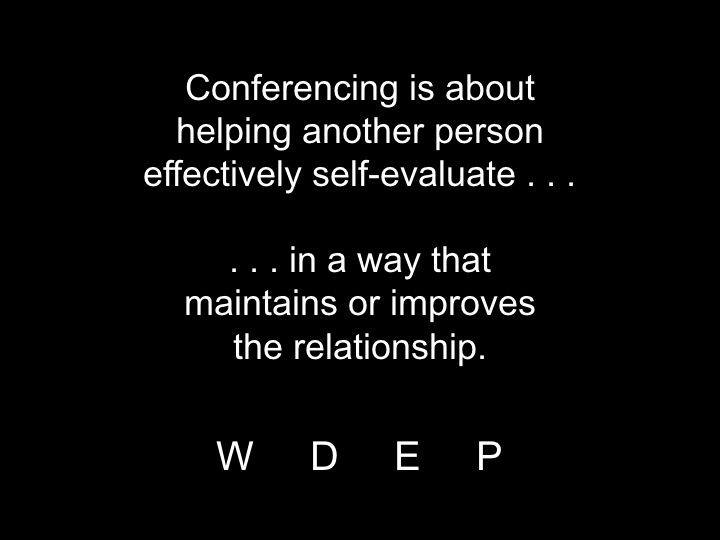
The story above reminds us that we experience problem-solving conferencing opportunities in many normal, every day moments. We can use WDEP conferencing skills as teachers and principals, but we can also tap into WDEP skills as parents and friends. The above story also seems to embody the definition of problem-solving conferencing – that being

Slide1

A lot of us are well-intentioned “fixers” who quickly start sharing advice and solutions when our student, colleague, or friend really just wants someone to listen and help them figure things out. The concept of self-evaluation is hugely important in the choice theory scheme of things. Whether it relates to academic performance and grading or to conferencing with a student regarding a behavior at school, the student’s ability to self-evaluate is the key. The KEY! We can count on this reality as surely as we can count on the law of gravity or the sun coming up in the morning. There is no getting around it. We can advise, direct, order, prescribe, or even threaten, but until a student comes to understand and acknowledge the situation for himself our efforts will lead to frustration and a strained relationship.

When we can non-judgmentally ask WDEP questions the results are frequently amazing! Often, people just need a little help thinking through things on their own and coming up with a plan of their own creation.

Gentle Parenting (and thank you, Milo)

A great list for parents, but just as great for the rest of us, too!

A great list for parents, but just as great for the rest of us, too!

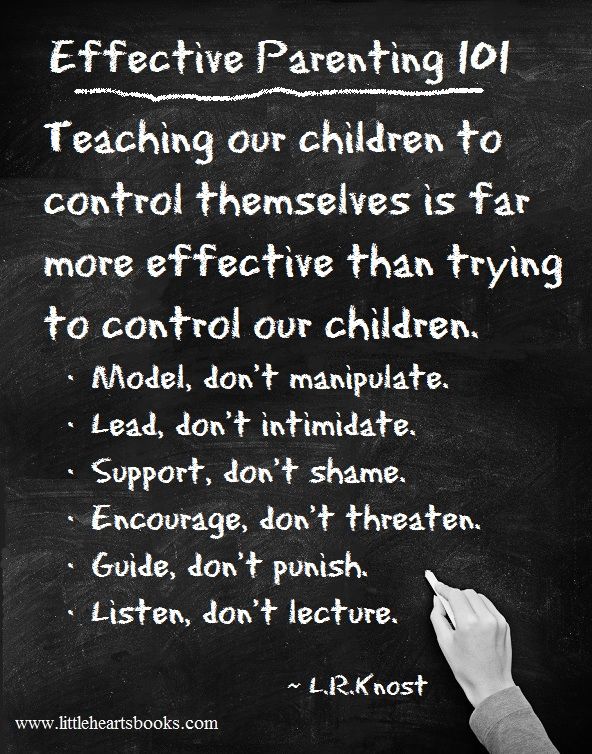
What a great poster from Little Hearts / Gentle Parenting Resources! It makes essential points in a very small amount of space. Some of you may have seen the poster on Facebook, but I wanted to share it with the rest of you who may not have seen it. I have done some exploring on the Little Hearts website, from whence the poster originated, and I am impressed with what is being said and how it is being said. For those of you who are parents, you can check out the website for yourself at –

www.littleheartsbooks.com

The Little Hearts message is so choice theory, yet I didn’t see any evidence of a connection with Glasser or any of his material. For a second, I wondered how the site could be so choice theory, yet not have any choice theory background. Then, of course, I am reminded that effective ideas can be discovered from many angles, by many different people, in many different locations, and in many different ways. If a certain approach works better, that approach is likely to be found by those searching for a better way.

Glasser’s ideas are an example of this kind of “parallel development.” Even though he was an original thinker, not all of his ideas were original. There were other therapists that placed a high value on a positive, caring relationship with clients, for example, and there were other writers who tried to explain the fallacies of the commonly held views regarding mental illness. Each of them, Glasser included, came at their ideas from their own unique perspectives. The upcoming Glasser biography will say more about this kind of parallel development.

—————————————-

airphoto

An aerial view of Milo Adventist Academy.

I did a Soul Shapers 1 workshop last week at Milo Adventist Academy in southern Oregon. Along with the staff from Milo there were teachers from four other schools in the Oregon Conference also in attendance. I was blessed by the experience in several ways. One of the blessings came from making new friends. Choice theory has a way of opening doors to deeper, more personal discussions, and while I didn’t know many of the staff before the week started, I feel that I made some very good friends by the time the week ended. Another blessing came in the form of their good questions. They truly wanted to understand how choice theory could be applied in their lives, personally and professionally. As a result, I have been thinking about some of those questions ever since. I hope to stay in touch with Milo over the coming school year. Maybe technology can help us with that.

—————————————-

The 2013/2014 school year is about to begin. (At least that is the schedule for schools located on west coast of the U.S., from where I am writing.) As a teacher your physical, emotional, and mental “clocks” are probably counting down to the first days of school. Some of you are literally in final countdown mode as you process how many hours you have left compared to the To-Do list of what you still need to accomplish. Even for veterans this can be an intense time as you try to get everything done that needs to be done.

For those wanting choice theory concepts to have a greater presence in their classrooms, just remember that “Structure is our friend.” The opposite of boss-management is not lead-management. The opposite of boss-management is laissez-faire, or the lack of structure or guidance at all. On this continuum, with over-control on one end and no control on the other end, lead-management comes somewhere in between. A lead manager very much wants elements of appropriate and helpful structure to be in place. It is especially helpful when classroom Procedures are identified, clearly described, and then rehearsed as a class. Procedures help classrooms run smoothly. It is also helpful when the classroom rules, the behaviors — e.g. – disrespect toward the teacher or classmates, bullying, dishonesty — that are never acceptable are also clearly outlined, along with a description of the natural consequences that come after breaking a rule. Too many people wrongly assume that choice theory means that kids can apparently do whatever they want. Not true at all. What is true is that lead-managers want to create need-satisfying classrooms in which discipline is not an issue. And if a rule is broken, lead-managers want to lovingly confront the behavior and help the student to make a plan for its correction.

Structure is our friend.

I would love to hear from you regarding ways in which you are keeping choice theory elements in mind for the coming school year – either as a teacher or a parent. Take a moment and share an example of how choice theory is going to affect your classroom or your home.

Sandy Hook, Choice Theory, and Forgiveness

sandy_hook_birthers-620x412

It is one of the most significant of all human qualities – that being the ability to forgive. I was reminded of this truth from a remarkable source – Newtown, Connecticut.

My cousin, a school administrator in New York City, knowing of my interest in choice theory, recently sent me an article* written by Dr. Anthony Salvatore, president of the Newtown Association of School Administrators. It turns out that Newtown schools, including Sandy Hook Elementary School, have been studying and implementing the ideas of William Glasser and choice theory since the early 1990s. As a result, Newtown has sought to be a needs-satisfying school system for students.

In the aftermath of the unspeakable tragedy that occurred at Sandy Hook Elementary, Dr. Salvatore represents a voice of healing. Even his comments about the shooter reflect compassion.

“Although I will never know the answer,” he begins, “I keep thinking of what the conversation was that was going on in Adam Lanza’s head. How can we do better in school to help avoid this behavior again, even knowing we can’t control someone else’s behavior, but we can control the conditions around that person. And that takes a whole global community, not just a school or a classroom. Suicide is a final act and one that tells me he saw no other option for meeting his basic human needs. Did he feel like he was loved and belonged to his family or community? I don’t know. Did he feel like he had power in his life to feel competent about who he was? I don’t know. Did he feel like he had a choice in his life besides taking his own life? I don’t know. Did he feel like his life was filled with fun? I don’t know.”

Salvatore emphasized the need for schools to build positive relationships with students “so they can learn how to make the best choice for meeting their own needs and for helping others in society meet theirs as well. Building on the value of relationships and choice, he closed the article on a note I will not soon forget. His vision of forgiveness is more than inspiring!

“It’s time to focus on cooperation instead of competition in our society. It won’t bring back the lives of the 28 victims who died on Dec. 14, 2012, but it will honor the sacrifice they made that day. My fear is we will make the same mistake other communities have made and not recognize that Adam Lanza also was a victim that day. This is where Newtown can truly be a leader toward a new vision and new understanding. We need forgiveness on so many levels, but we first need healing. We already know from research that isolating bullies in school is harmful to the individual and to the school climate. Alienating someone from a community only exacerbates the feeling of powerlessness and not belonging. We must forgive mistakes and nurture our capacity to do good. We have control over that.”

May Dr. Salvatore’s words be an invitation and inspiration to each of us. May the Spirit work in us to prepare our hearts to respond to others, even those who do us harm, with similar compassion.

——————————-

Forgiveness is such an essential part of good mental health. Within the scheme of choice theory, though, where does it fit in? Which of the basic needs, for instance, are being satisfied when we forgive someone?

My mind quickly goes to the need for love and belonging. Forgiveness has to do with our relationships. We seek forgiveness, whether from an earthly friend or our heavenly Father, to restore a relationship. And we offer forgiveness for the same reason – to restore or maintain a relationship.

What about the other needs, though. Does forgiveness satisfy the need for power in some way? How about the need for freedom? How about the need for joy and fun? And we shouldn’t leave out the physiological need for survival. Does forgiveness impact us on a physiological level?

I would like to hear from you regarding forgiveness and the basic needs. How does forgiveness help us meet our psychological or physical needs?

——————————-

A few of us have started a Facebook page also called The Better Plan. We want it to be a collecting point for choice theory ideas and strategies. I invite you to join us. An article was posted today from a primary grade teacher who has just learned about choice theory on how her management is going to change this coming school year. Great stuff! Check it out.

* This article appeared in the Summer, 2013, edition of The Leader, the newsletter of the American Federation of School Administrators.

Ears, Mouth, and Choice Theory

A young principal described how his dad was a great guy, but that he didn’t know how to listen. With the challenges that come with being a school administrator, Dave (we’ll call him) would occasionally share what he was up against with his dad. He confided that –

I would call him, just needing to talk with someone, someone not close to the situation. My dad was a sharp guy and had a lot of life experience and as soon as I explained the problem, sometimes even before I was done explaining, he would quickly start telling me what I needed to do. He was trying to help. I have no question about that. But I didn’t call for advice. I just needed to talk. The sad thing is that when he started giving me advice during the phone call, I would feel myself withdraw or pull away. I kinda wanted the phone call to be over at that point.

It is easy to fall into the same habit as Dave’s dad. We are quick to tell what the answer is or where the solution lies, rather than simply listening and then accepting or affirming. Husbands are quick to do this with wives, parents are quick to do this with children, and teachers are quick to do it with students. We mean well. The answer seems obvious to us. We just want to save time and get to the solution.

Teachers who learn about choice theory begin to understand the pitfalls of telling, rather than listening, and begin to see that one of the best things we can do for another person is to help them develop their own solutions. In other words, the goal is to help a person effectively self-evaluate. Whether we are a listening to a friend explain why she wants to quit her job and go back to school, a husband listening to his wife wonder aloud about problems with the upcoming Home & School potluck, or a teacher working with a student who keeps forgetting one of the classroom procedures, the answer may have more to do with asking the right question, instead of giving the person your solution.

———-

Conferencing is about

helping another person effectively self-evaluate

in a way that maintains or strengthens the relationship.

———-

Becoming a listener who knows how to ask questions that can lead to self-evaluation is one of the most important steps we can take toward being a choice theory teacher or parent.

One of my mentors, Kendall Butler, once shared with me that “it is better to get something out of someone’s mouth than it is to put it into their ear.” Rather than being smart enough to emphasize the right point, the skill and wisdom lie in asking the right question.

——————–

A new Facebook page has been created called The Better Plan. I invite you to Like the page and become a part of The Better Plan community. Joel Steffen will be helping me manage it and our goal is to locate helpful teaching resources, many of them from within our own community, and to provide a place for teachers and parents to ask questions or comment on other’s questions.

Stringless Love

strings-attached

A key choice theory axiom, maybe THE choice theory axiom, states that the only person we can control is ourselves. This doesn’t mean that we don’t try to control others. We very often do, and in ways that are so subtle that we aren’t aware of it, even as we are in the midst of doing it. Today’s blog will attempt to pull back the curtain of our behavior and give examples of just how powerful this process is, a process that has everything to do with our quality world pictures.

When it comes to axiom #1 it would be more accurate to say that we are controlling for our perceptions, rather than controlling our own or another’s behavior. In other words, the only person’s perceptions we can control is our own. Let me give you an example that Mike (not his real name) shared with me recently –

The other day I am out shopping with my wife, each of us with a list of items to find, and while working on my list I notice her further down the same aisle I am in. I see her and for some reason I want to go to her and express my affection for her, to touch her, you know, to “look lovingly into her eyes” kind of thing. So I’m thinking about that as I’m standing there in the bread section. Some of you may be thinking, “What are you waiting for? Go tell her you love her!” But it’s not exactly that simple. We’re working through some stuff. We’re doing good, but anyway .  .  .

For some reason the question occurs to me, there in the bread section, am I wanting to express my affection to her because I just want to give her affection, or am I wanting to express affection so that she will give me affection in return? Am I wanting to touch her because she would then touch me, too? As I thought about it, I realized that what I really wanted was for her to want me, for her to express affection for me, and for her to touch me. I did feel affection toward her, but more importantly, I was fishing for something from her. My gift was not so much a gift, as much as it was a prompt, maybe even a bit of a trap.

I must admit I was stopped in my tracks at that moment. What you had been saying in the Soul Shapers class kind of just flashed into me. I had this picture in my mind of how I wanted my wife and I to be, how I wanted her to treat me, and there I was trying to create it, trying to turn my picture into a reality. I was stunned at how subtle, yet how real, the process was in my thinking. I was further stunned by how many years I had been behaving this way. My “affection” was really a form of manipulation.

Mike realized that his “love” had strings attached. He was giving, but it was giving to get something in return. When his giving wasn’t responded to in a way that matched his expectations he became frustrated and hurt, and then went about creating another behavior to try to get what he wanted. Maybe this new behavior would be another “loving” action; maybe it would be a punishing action like the silent treatment.

Spouses face this process every day. So does a teacher with his/her students. People have antennae that discern the strings that are attached to gifts. Love with strings attached really isn’t love. Let’s be clear, though. The problem isn’t that we have expectations, at least if the expectations are reasonable and healthy, the problem occurs when we manipulate or coerce to get what we want. It is actually relationship-strengthening to state your expectation and then, using the caring habits, discuss and negotiate the ways in which that expectation can happen.

——   “Love with strings attached really isn’t love.”   ——

On a deeper and more important level, I think this process reveals something about what the presence of sin has brought to our little planet. Jeremiah wrote about our righteousness being like filthy rags, or in other words, even our love seems to involve selfishness. I think the process also reveals one of choice theory’s limitations – that being that choice theory can give us insights into our behavior, but it cannot change the heart. Only the Holy Spirit can give us a perfect love that doesn’t care about strings. Stringless love. That would be powerful.

—————————————

How about telling a friend about The Better Plan blog? It’s easy – http://thebetterplan.org

If today’s blog is helpful, take a moment and click on the Liked link.

What does a lead-manager sound like?

(Not the actual seagulls that Tim photographed. These gulls were willing to fill in as substitutes at the last second. A big thank you to them.

(Not the actual seagulls that Tim photographed. These gulls were willing to fill in as substitutes at the last second. A big thank you to them.)

Lead-management is based on persuasion, invitation, and reasonable guidelines with natural consequences; on the other hand boss-management is based on directing, demanding, and often arbitrary boundaries with reward and punishment applied when boundaries are broken. Capturing the tone of a lead-manager is an important step toward becoming a choice theory teacher or parent. Today’s blog comes to us courtesy of Tim Mitchell, Bible teacher at Mountain View Academy in Mountain View, California. Tim has been a successful pastor for many years, but last year he decided to teach Bible, rather than preach it, and made the switch to the classroom from the pulpit. After attending summer classes, including Soul Shapers 1 at PUC, Tim sent the following Facebook message to his students, a message that captures the tone and content of a lead-manager.

Just took this shot from my backyard where I am working on my summer homework. These birds were about 500 feet in the air and pass overhead regularly. Whenever they fly over I think of you, my students — I want you guys to soar!

My summer school classes are about giving students room to feel freedom and plot out the course of their education as a team. Most schooling is too confining. It’s worse than the average workplace. “Sit in your chair.” Don’t talk.” “Do the (irrelevant) work I tell you to do.” I hated school from 7th grade until about age 22 when I was getting my Masters Degree. And I can see the same in many of your eyes. Once I got interested in school again my grades shot back up.

Pray for me/us so that Bible class can be more relevant, free, team-oriented, humane, and FUN! (Fun is one of the basic human needs!) Let’s begin working in August to set up our procedures so they don’t get in the way of your natural human interest in learning and experiencing new things.

Soar!

I really appreciate Tim’s message. Teaching Bible, teaching any subject for that matter, can be challenging and it’s not unusual for teachers to turn classroom interactions into struggles and battles when students act like, well students. As teachers, we may not want fights, but we tend to go into fight mode when students “ask for it.” Tim’s message “takes the fight out of the classroom” and is setting the tone for a fun, productive, enjoyable school year.

———————————————-

Do you have artifacts — letters, messages to parents, lesson plans, management strategies — that have helped to implement a choice theory approach? I would love to see them, and share them, when you send them on to me. Please take a moment and send me something that has worked for you, or even that you are working on.

———————————————-

Remember to click on the Follow link to become a part of the blog. Our goal is to strengthen and support the choice theory community. Let friends and colleagues know about the blog, too. Thanks.

http://thebetterplan.org

Every once in a while you run across something that puts a smile on your face and a bounce in your step. This music video does that for me. It doesn’t stop with the smile and the bounce, though, as the lyrics to the song are a good reminder for all of us. The message is simple – When the morning comes, things will probably look better. Let the worry go. This too will pass.
I think middle-schoolers and high-schoolers should watch this video as often as needed. A little encouragement with a smile and a bounce can be a good thing. Enjoy!


(*It is true that a music video doesn’t hold the ultimate answer to life’s distresses. Good mental health depends on a positive connection with the Holy Spirit, combined with a good understanding of how our brains work (e.g. – choice theory). Within this context, though, an upbeat piece of music can lift the thinking and the feeling. I can’t vouch for all of OK GO’s music, although their videos are really fun and creative. Also, thanks to the Notre Dame marching band.)

PS – Good mental health includes the ability to consciously and intentionally decide that “this too shall pass.” From a total behavior perspective we run into problems when the rear wheel Feeling tire gets too big. When this happens it is a helpful to practice the “this will pass” skill, especially when we are reminded of passages like –

Because the Lord is my shepherd I have everything I need. Ps. 23:1

And this same God who takes care of me will supply all your needs from his glorious riches, which have been given to us in Christ Jesus. Philippians 4:19

Unless the Lord had helped me, I would soon have died. I cried out, “I’m slipping!” and your unfailing love, O Lord, supported me. When doubts filled my mind, your comfort gave me renewed hope and cheer. Psalms 94:17-19