Off and Running with Glasser and Wong

Screenshot 2014-09-06 19.44.32

Classes begin on Sept. 22 at PUC and one of the courses I will be teaching this Fall quarter is Classroom Management. Pre-service teachers worry ahead of time about whether or not they will be able to manage a classroom and after entering the profession, those teachers who leave teaching mostly do so because of issues relating to management. Classroom management is a very important skill set for teachers to possess. I enjoy teaching the class, even as I feel the pressure of the responsibility to teach it well and teach it right.

There are basically two different paradigms from which to consider classroom management – either you view the world operating according to external control (reward / punishment) or you see it operating according to internal control and the principles of choice theory. There are many different approaches and management models to choose from, but each of them sits on one of these paradigms.

056

I am using two books as texts for the class that I haven’t used before. The first is Choice Theory in the Classroom (1986; 2001), which I am quite familiar with, and the second one is The Classroom Management Book (2014), which is brand new.

9780976423331_p0_v3_s260x420

I chose these books because I think they will help students understand and appreciate the essential elements of classroom management. (A big THANK YOU to those who posted their essential elements in the last blog. I am going to share your insights with my class.) Some of the elements I would like to include –

+ Know yourself – Recognize that your beliefs about motivation and behavior (which you can change) form the frame within which all of your classroom management pieces fit.

+ Prevention rather than cure – Seek to create a need-satisfying class in which students want to be. Focus on positive relationships all the way around. Focus on instructional organization. Focus on teaching and rehearsing the Procedures needed for the room to run smoothly.

+ Natural consequences rather than punishment – If students do break a rule, help them learn to take responsibility for their behavior and restore what they have broken.

I plan to start with Glasser’s Choice Theory in the Classroom and have him help us understand the concepts of choice theory and how the internal control model of human behavior really is the only model that honors the way our brains work. I think role plays in class will help us get the essential points in better ways than me lecturing the points.
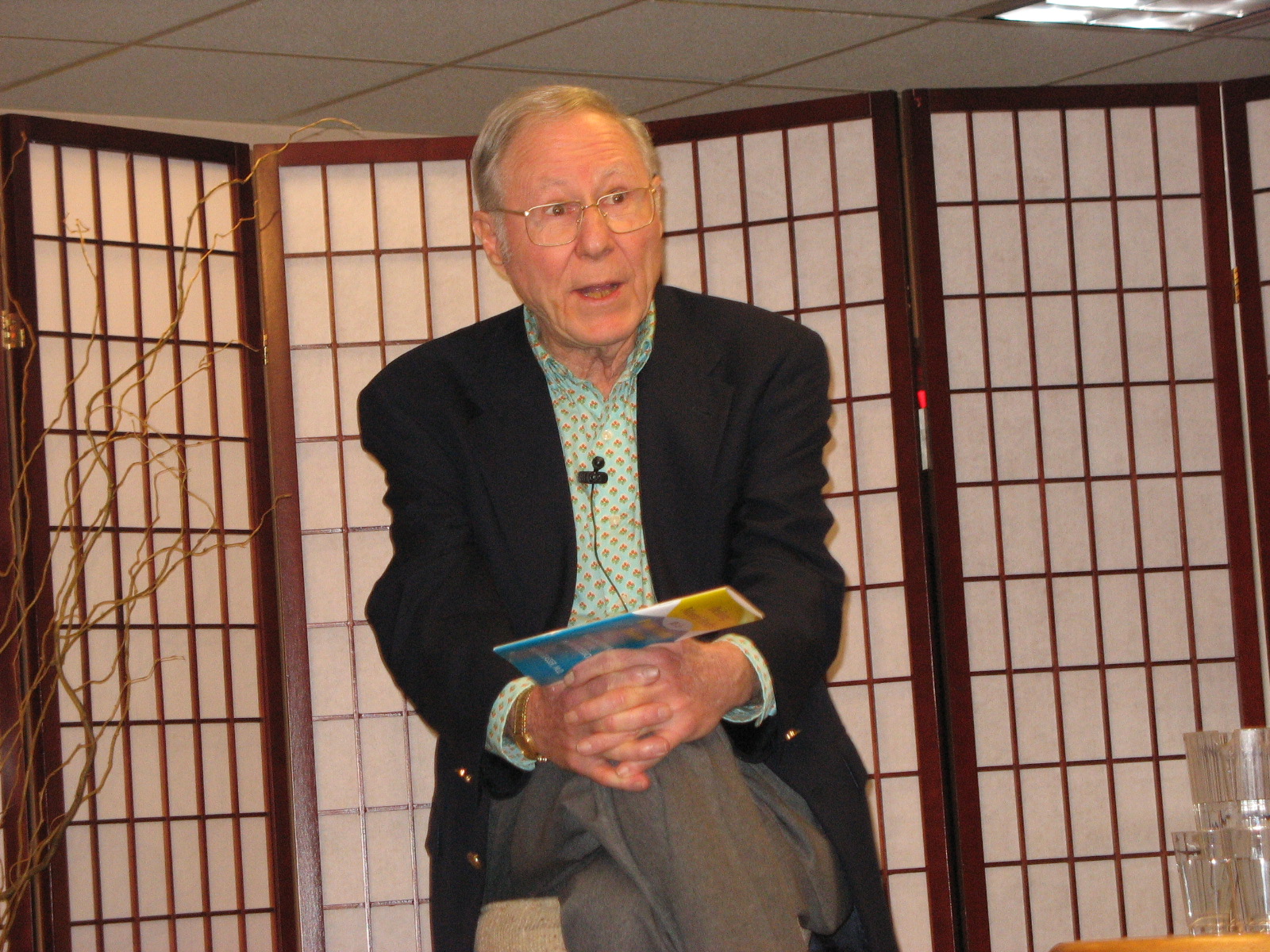
Bill giving a talk in Ventura, CA (2006)

Bill giving a talk in Ventura, CA (2006)

I am glad I re-connected with Choice Theory in the Classroom. I have known about the book, of course, but I haven’t tapped into it like I am about to. Here are a few key points from the book. You can almost hear Glasser’s voice –

“We cannot pressure any student to work if he does not believe the work is satisfying.” (12)

“We are far too concerned with discipline, with how to ‘make’ students follow rules, and not enough concerned with providing the satisfying education that would make our overconcern with discipline unnecessary.” (12)

“When we talk about better discipline with no attempt to create a more satisfying school, what we are really talking about is getting disruptive students to turn off a biological control system that they cannot turn off.” (58)

I then plan to transition into Harry Wong’s new book, The Classroom Management Book. I have been using Wong’s classic The First Days of School for a number of years, and I really like that book, but I decided to go with his new book. The new book is so strong on Procedures and how to teach them. I can supplement what the book doesn’t cover, but I really want the students to have access to what he does cover. I think experienced teachers will want to check out his new book, too.

IMG_1390

I just recently received the latest edition of Educational Leadership, the journal for the Association for Supervision and Curriculum Development, and the entire journal is devoted to the topic of motivation. I will be having the students read several of the articles, including the keynote (lead) article by Daniel Pink, entitled Motivated to Learn: A Conversation with Daniel Pink. The title reminded of the many journal articles back in the day that featured control theory or choice theory and had as part of the title A Conversation with William Glasser. As it so happens, even though this current journal has been devoted to the topic of motivation, and specifically motivation within the school environment, not one of the articles references Glasser or mentions him in any way. It is true that his ideas and beliefs are splashed throughout the journal. Schools wanting to improve instruction and embrace educational “best practice” are heading the way Glasser pointed for years. That really is the important thing.

============

Discipline is helping a child solve a problem.
Punishment is making a child suffer for having a problem.
To raise problem-solvers, focus on solutions, not retribution.
L.R. Knost
(Thank you Bette Blance for sharing this on Facebook)

============

One way to keep Glasser’s legacy alive is to let colleagues know about The Better Plan blog. Think about it.

http://thebetterplan.org

============

Now priced at $17.73 on Amazon; 16 reviews have been submitted.

Now priced at $17.73 on Amazon; 16 reviews have been submitted.

The eBook version of William Glasser: Champion of Choice can be accessed at the following link –

http://www.zeigtucker.com/product/william-glasser-champion-of-choice-ebook/

The paperback version can be accessed at the following Amazon link –

http://www.amazon.com/William-Glasser-Champion-Jim-Roy/dp/193444247X/ref=sr_1_1?s=books&ie=UTF8&qid=1409718917&sr=1-1&keywords=champion+of+choice

For U.S. customers, get a signed copy of Champion of Choice for $20 + $6 (shipping). Send your check, along with any special instructions (e.g.- if the book is a gift), as well as your shipping address, and I will get the biography out to you right away.
Please include your email address, just in case I have questions about your order. My address is P. O. Box 933, Angwin, CA 94508

Get a signed copy of Soul Shapers: A Better Plan for Parents and Teachers for $17.

1308277


Essential Elements in a Classroom Management Class?

_5995852_orig

In two weeks I will start teaching a class on Classroom Management to undergraduate, pre-service teaching candidates. What would you suggest as an essential learning or an essential element to include in a course on classroom management?

Thanks in advance for your help with this!

Well . . . this is frustrating . . . in kind of a good way

02BOOK1-popup

I just learned about a new book by Allen Frances that Harper Collins has published. It is called Saving Normal: An Insider’s Revolt Against Out-of-Control Psychiatric Diagnosis, DSM-5, Big Pharma, and the Medicalization of Ordinary Life.

The Harper Collins ad for the book proclaims that it was written by “the most powerful psychiatrist in America” and that it is “a deeply fascinating and urgently important critique of the widespread medicalization of normality.”

Dr. Allen Frances

Dr. Allen Frances

The actual description of the book, when you find it on Amazon, reads as follows –

Anyone living a full, rich life experiences ups and downs, stresses, disappointments, sorrows, and setbacks. These challenges are a normal part of being human, and they should not be treated as psychiatric disease. However, today millions of people who are really no more that “worried well” are being diagnosed as having a mental disorder and are receiving unnecessary treatment. In Saving Normal, Allen Francis, one of the world’s most influential psychiatrists, warns that mislabeling everyday problems as mental illness has shocking implications for individuals and society: stigmatizing a healthy person as mentally ill leads to unnecessary, harmful medications, the narrowing horizons, misallocation of medical resources, and draining of the budgets of families and the nation. We also shift responsibility for our mental well-being away from our own naturally resilient and self-healing brains, which have kept us sane for hundreds of thousands of years, and into the hands of “Big Pharma,” who are reaping multi-billion-dollar profits.

Frances cautions that the new edition of the “bible of psychiatry,” the Diagnostic and Statistical Manual of Mental Disorders-5 (DSM-5), will turn our current diagnostic inflation into hyperinflation by converting millions of “normal” people into “mental patients.” Alarmingly, in DSM-5, normal grief will become “Major Depressive Disorder”; the forgetting seen in old age is “Mild Neurocognitive Disorder”; temper tantrums are “Disruptive Mood Dysregulation Disorder”; worrying about a medical illness is “Somatic Symptom Disorder”; gluttony is “Binge Eating Disorder”; and most of us will qualify for adult “Attention Deficit Disorder.” What’s more, all of these newly invented conditions will worsen the cruel paradox of the mental health industry: those who desperately need psychiatric help are left shamefully neglected, while the “worried well” are given the bulk of the treatment, often at their own detriment.

Masterfully charting the history of psychiatric fads throughout history, Frances argues that whenever we arbitrarily label another aspect of the human condition a “disease,” we further chip away at our human adaptability and diversity, dulling the full palette of what is normal and losing something fundamental of ourselves in the process. Saving Normal is a call to all of us to reclaim the full measure of our humanity.

It is a little bit frustrating for me (not a lot, but a little bit) that Harper Collins is pushing Saving Normal. I contacted the editor at Harper Collins when I had the Glasser biography manuscript halfway completed, a book that covers the same topics as Saving Normal, and was told that no one was interested in the life story of William Glasser. I disagreed, pointing out Glasser’s long and well-known career, the many books he had published, some of them huge sellers, the worldwide organization he had formed, the over 65,000 people that had participated in Glasser training workshops, and the many Glasser Quality Schools he had inspired throughout the United States.

I contacted this same editor when the manuscript was finished and he surprised me by saying he would love to read it, although he reminded me that he didn’t see Harper Collins getting involved. Still, I was a bit buoyed by his interest in the book. He ended up being very complimentary of the manuscript, emphasizing that it was very well written. I took it as a compliment when he expressed that he didn’t think it needed much editing. In spite of his belief that it was well written and interesting, he wished me luck in finding a publisher.

Since Harper Collins didn’t want to publish the book, or at least one of the editors didn’t want to publish the book, I have very much wanted to prove him wrong. I very much want a lot of people to be interested in Glasser’s story and the development of his ideas. Allen Frances, it turns out, is known for chairing the taskforce that produced the DSM-4, so his prominence is earned. Still, I see Glasser’s contributions to psychiatry, psychology, and education as so much more significant. That Harper Collins would jump on Frances’ bandwagon after so many years of working with Glasser, well, it’s just a bit frustrating.

It is good, though, that Saving Normal has been published. It is now one more voice reminding readers that the ups and downs of life, the challenges and disappointments, the sadness and grief, are not indicators of mental disease. It reminds us that human beings possess a resiliency capable of working through problems, rather than running to Big Pharma. It’s not a cheap book at $45, but I welcome it to the “discussion.” Did I mention that it’s presence is a tad frustrating?

==============

Now priced at $17.73 on Amazon; 16 reviews have been uploaded so far.

Now priced at $17.73 on Amazon; 16 reviews have been uploaded so far.

The eBook version of William Glasser: Champion of Choice can be accessed at the following link –

http://www.zeigtucker.com/product/william-glasser-champion-of-choice-ebook/

The paperback version can be accessed at the following Amazon link –

http://www.amazon.com/William-Glasser-Champion-Jim-Roy/dp/193444247X/ref=sr_1_1?s=books&ie=UTF8&qid=1409718917&sr=1-1&keywords=champion+of+choice

For U.S. customers, get a signed copy of Champion of Choice for $20 + $6 (shipping). Send your check, along with any special instructions (e.g.- if the book is a gift), as well as your shipping address, and I will get the biography out to you right away.
Please include your email address, just in case I have questions about your order. My address is P. O. Box 933, Angwin, CA 94508

Get a signed copy of Soul Shapers: A Better Plan for Parents and Teachers for $17.

1308277

25 Ways to Ask Your Kids “How Was School Today?”

2014-08-29-25ways-890x395_c

If you are into choice theory you have come to recognize how valuable a well-worded question can be. Not all questions are well-worded and lead to quality responses, though.

The Omaha Sun Times recently ran an article entitled, 25 Ways to Ask Your Kids ‘So How Was School Today?’ Without Asking Them ‘So How Was School Today?’ This regularly-asked question garners pretty much the same answer from kids, “Uh, ok.” So what kind of questions might actually get more than an “Uh, ok,” response? Here are some examples from the 25 Ways list –

What was the best thing that happened in school today?

Tell me something that made you laugh today.

If you could choose, who would you like to sit by in class? (Not sit by?)

If I called your teacher tonight, what would she tell me about you?

How did you help somebody today?

How did somebody help you today?

When were you the happiest today?

Who would you like to play with at recess that you’ve never played with before?

What do you think you should do more of at school? (Less of?)

Who in your class do you think you could be nicer to?

If you got to be the teacher tomorrow, what would you do?

Tell me about three different times you used your pencil today.

These kinds of questions will get more than “Uh, ok” answers and will begin to help us empathize with the lives of our children.

Those taking the Soul Shapers training during the summer at PUC (or those taking the basic or advanced Glasser training at locations around the world) learn about the WDEP method of problem-solving conferencing. The letters WDEP stand for categories of questions that will assist the person you are conferencing with – be they student, fellow teacher, parent, or administrator – to effectively self-evaluate and engage in solving the problem, whatever the problem may be.

W stands for Want or What do you Want?
D stands for Doing or What are you Doing?
E stands for Evaluation or Is it Working?
P stands for Plan or What is your Plan?

There are many different questions in each of these categories that can be asked to facilitate self-evaluation and discussion. The key is that good questions can help your student or your child or whoever it is you are trying to help to figure out what they should do and how they should do it. Good questions also minimize the talking that we do and maximize the talking of the person who should be doing the talking – that being your student or child or colleague.

Examples of questions from each of these categories include –

What do you want?
What is your goal?
What are you willing to settle for?
How do you want your class to be?
When was the last time you were happy?

What are you doing?
What action have you taken?
What have you tried?
When you think those thoughts, what do you usually do?
What do you do between 8:00 and 10:00 PM as a general rule?

Is it working?
If you continue to act that way, what do you think will happen?
Are you satisfied with the way things are?
In what ways have things improved?
Is your behavior helping you or hurting you?

What is your plan?
What? Where? When? With whom? How often? What time?
What would you commit yourself to for the rest of the week?
Can you think of something that would help you put this plan into action?
How committed are you to making this happen?

Whether you are creating a PBL lesson (Project-Based Learning) or leading out in a problem-solving conference, a great question is worth its weight in gold!

==========

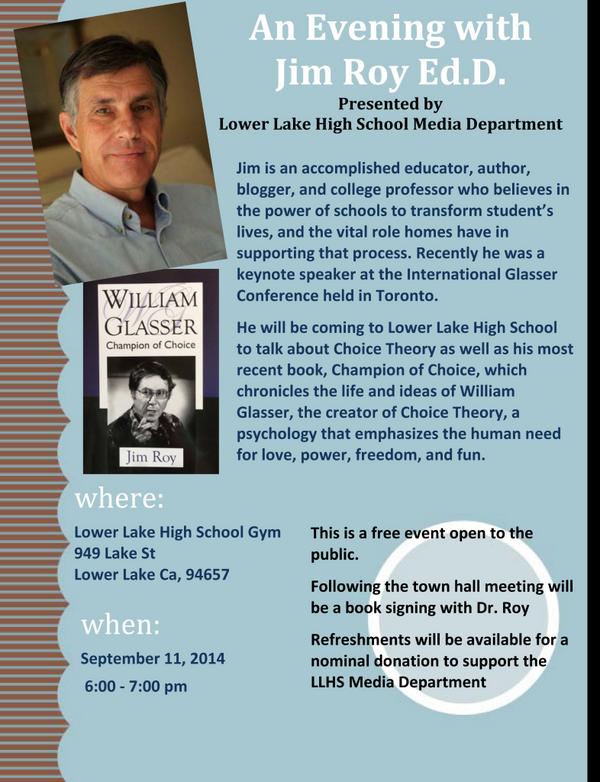
William Glasser: Champion of Choice is now available as an eBook and can be accessed at the following link –

http://www.zeigtucker.com/product/william-glasser-champion-of-choice-ebook/

Now priced at $17.73 on Amazon; 16 reviews have been uploaded so far.

Now priced at $17.73 on Amazon; 16 reviews have been uploaded so far.


Glasser Biography Now Available as eBook

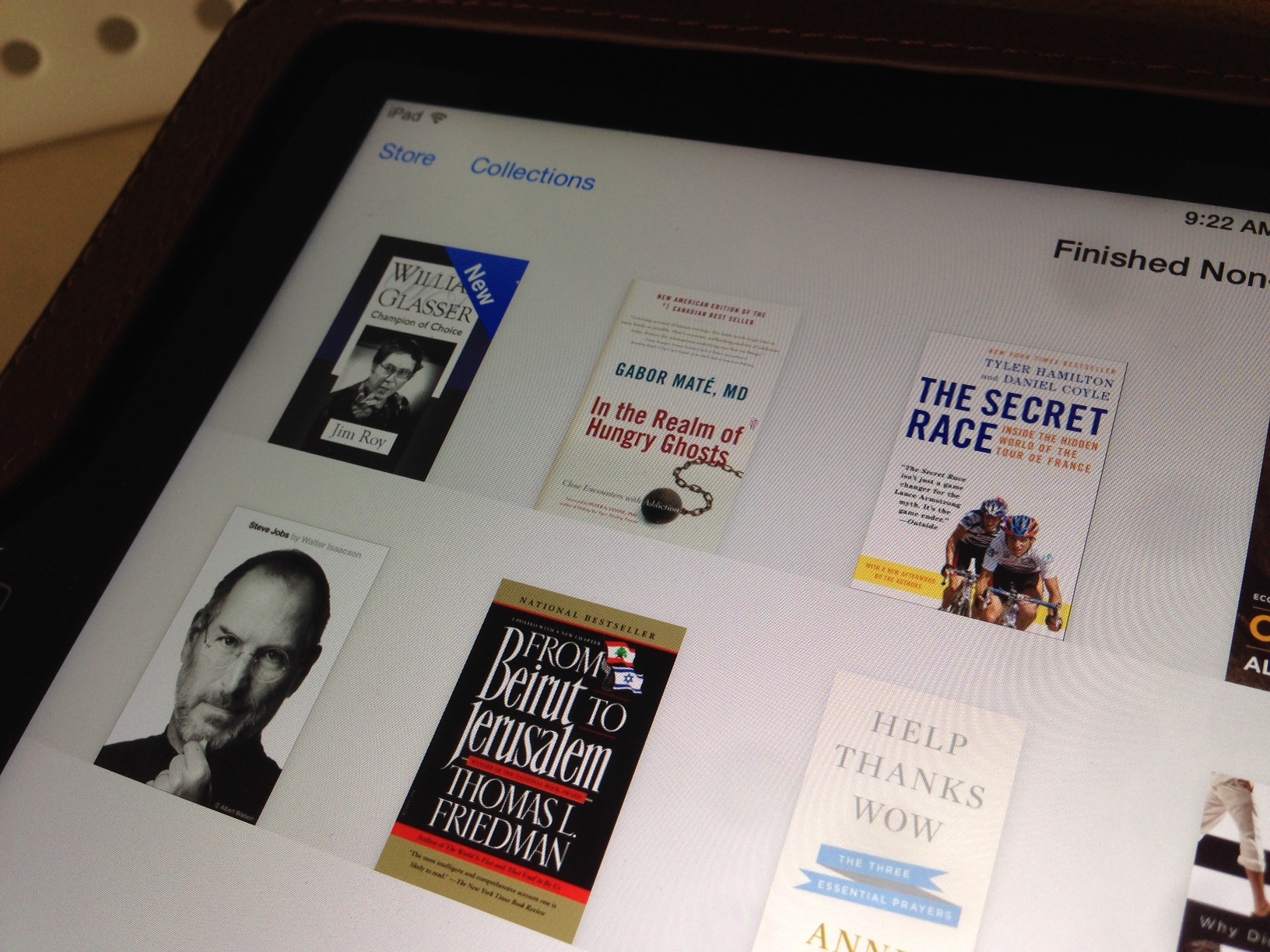
The screen of my iPad, which now includes the new eBook version of Champion of Choice.

The screen of my iPad, which now includes the new eBook version of Champion of Choice.

The biography, William Glasser: Champion of Choice is now available as an eBook.
The eBook version costs just $10 and is quickly available at the following link –

http://www.zeigtucker.com/product/william-glasser-champion-of-choice-ebook/

I bought a copy on my iPad yesterday and the process went fine. I was pleasantly surprised actually on how nice the book looked on my screen, as well as on how well the links worked as I looked through the book. The picture section turned out great, too.

When you go to the Champion of Choice eBook screen, you will be asked to choose an option, either .epub or .mobi format. I had never heard of either of these formats, but Googled both of them and felt pretty sure that the .epub format was best. As it turned out, it was. You are then asked to Add To Cart your eBook purchase. You go through the standard credit card process and then receive a thank you for the purchase message. I wasn’t sure what to do then, as nothing was automatically downloading. I soon received a follow-up email, though, which provided me a download link. Once again, I was given a choice as to where I wanted the book downloaded. One of the options was downloading it into iBooks, which I selected. It downloaded quickly and appeared in my iBooks section like all the books I have purchased through iBooks.

As I said earlier, I am very pleased about how the book looks and performs. It works seamlessly on my Apple platform. I don’t know how it works on the Kindle platform. Maybe one of you can try that out and let the rest of us know.

==============

Thank you, Chris Kinney, for arranging this upcoming event. I am looking forward to it!

BuiYAd1CcAAskUI


==============

The content of your character is your choice. Day by day, what you do is who you become.
Heraclitus

You Are Missed, Bill Glasser!

Bill, at home, ready to visit about whatever is on your mind.  (Photo by Jim Roy)

Bill, at home, ready to visit about whatever is on your mind. (Photo by Jim Roy)

William Glasser passed away a year ago today. His legacy includes a long and successful career in which he influenced countless people on how to be mentally healthy and happy in their relationships with others. As the creator of Reality Therapy, Glasser challenged the therapeutic status quo and began to melt the complexity of human psychology; as the creator of Choice Theory, he provided a model of human behavior that even a child can understand, a model that acknowledged basic human needs and wants.

Everybody needs one essential friend.   William Glasser

Although anticipated, his passing left a void organizationally and more importantly, left a void personally within the hearts of those who were seeking and continue to seek to understand his ideas about motivation and behavior. Organizationally, people have stepped up to maintain and even grow the structure of Glasser, Inc. Time will tell regarding the extent to which the organization flourishes or not. For many of us personally, though, this same process is going on within our own hearts and minds. In what ways and to what extent are Glasser’s ideas flourishing within us as individuals? What do his ideas mean to us personally?

Relaxing in the living room with the TV on, although still ready to talk about life. (Photo by Jim Roy)

Relaxing in the living room with the TV on, although still ready to talk about life. (Photo by Jim Roy)

For me personally, the principles of Choice Theory continue to influence my thinking a great deal. Of course, it is one thing to think something and quite another thing to consistently apply that thinking in your life, but Choice Theory brings me back to a good starting point when I get off track. Before becoming acquainted with Choice Theory, I was very capable of choosing to depress and to withdraw in general. Now, after learning about Choice Theory, not so much. Glasser’s ideas have been a kind of psychological immunization against the common mental distressers for me.

It is almost impossible for anyone, even the most ineffective among us, to continue to choose misery after becoming aware that it is a choice.   William Glasser

His explanation of the importance of the relationships in our lives has been very significant for me, especially the idea that our ability to influence a person is directly dependent on our level of connection with him/her. For parents and teachers this is the gold standard of advice. As long as we are connected to our kids we have influence with them. When that connection is severed, usually due to our anger or disgust or coercive approach, so, too, is the influence. It is crazy how flippant we can be with this kind of connection!

Glasser and Albert Ellis, 2005. (Photo by Jim Roy)

Glasser and Albert Ellis, 2005. (Photo by Jim Roy)

Glasser’s biography, Champion of Choice, became available less than four months after his death. So close. People that knew him and worked with him for many years have affirmed the book’s accuracy, which means a lot to me, and people that thought they knew him well have indicated they learned new things about his life from reading the biography. Of special importance to me, though, is the possibility that readers will learn about the principles of Reality Therapy, Choice Theory, mental health, and the whole idea of getting and staying happy.

If everyone could learn that what is right for me does not make it right for anyone else, the world would be a much happier place.   William Glasser

Today (Saturday, Aug. 23) also happens to be my Sabbath, a day designed for rest and contemplation. Glasser’s ideas have certainly been a part of my spiritual journey and have strengthened and enlarged my concepts of total well-being, love, freedom, purpose, and joy. He has been a mentor to me and I will take solace in reflecting on our time together and the positive ways he influenced me – cognitively, emotionally, and even spiritually.

You are missed, Bill. You are missed.

Glasser's writing space, minus his computer, where so much of his creativity was put to the page. (Photo by Jim Roy.)

Glasser’s writing space, minus his computer, where so much of his creativity was put to the page. (Photo by Jim Roy.)

I invite you to respond to this post and share what Glasser or his ideas have come to mean to you since his passing a year ago. I think you need to register on WordPress to submit comments, but the registration is super easy. No big deal. I encourage you to do it and share.

==============

Now priced at $18.20 on Amazon; 16 reviews have been uploaded so far.

Now priced at $18.20 on Amazon; 16 reviews have been uploaded so far.

5 Must-Have’s to Start the School Year

Quotes About Moving On 0234-236 (Quotes About Children) (16)

One – Treat students like they were your own kids
When our own children are at school we want them to be treated with love and compassion. We appreciate it when an adult seeks to know the full picture before simply handing down some form of discipline. It means a lot to us when our child is given more than one chance to be successful.
The law says that schools and teachers serve in loco parentis, which means in place of the parent. It is true that not all parents know how to treat their children well, but as teachers, let’s take in loco parentis to represent the best parents possible. More than once I have seen parents who admit to their child’s teacher that they have no idea what to do with their kid. Besides teaching students, we can help parents, too, by modeling love and compassion and structure to them.

Two – Plan lessons that matter to kids
When we sit down to plan lessons we may need to ask “Why would this topic matter to my students?” One of our biggest challenges as teachers is to present the learning in a way that interests kids. Relevance is the gold standard for all learning; there is no way around this. The fact that some students like to fill out worksheets doesn’t mean that it’s good for all students (it’s probably not even good for the worksheet students). Glasser felt that knowledge you write out on worksheets or spit back on objective tests was throw-away knowledge. For him, real learning had to do with application and answered the question, How could you use it in real life?

Correct Basic Needs

Three – Intentionally create a need-satisfying classroom
Choice theory describes how every human being is driven by a unique set of basic needs. While we are born with these needs, we are not born with instructions on how to meet them. So from birth we are searching for the people and things and activities that help us feel that our needs are being met. Teachers, both elementary and secondary, can count on the fact that students will be engaged in the process of meeting their own needs as best they can. Some students have learned to meet their needs in ways that are socially acceptable and effective. Some students are seeking to have their needs met in ways that are not effective. It is such a huge gift to students when teachers help them to understand the concept of the basic needs and the ways in which the needs can be met.
For instance, you will have students with a high power need in your classroom. Instead of trying to beat their power, though, with your power, think about designing classroom activities that fulfill this need for students. Classroom management based on reasonable structure and procedures, rather than on reward and punishment disciplinary measures, will meet the basic need for freedom and autonomy.

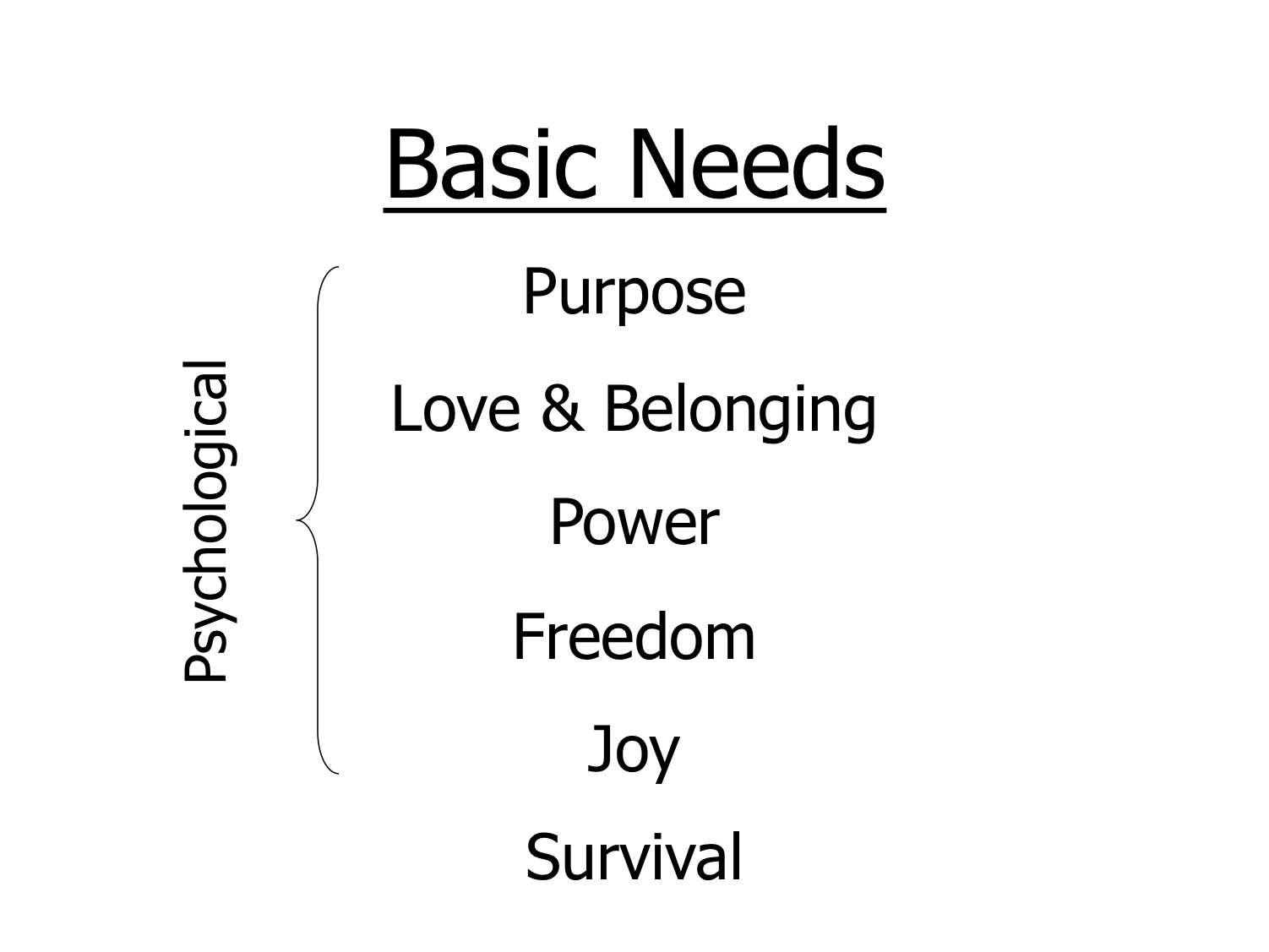
Just remember that human beings are driven to have their basic needs met in six different areas –
Purpose and meaning
Love and belonging
Power and success
Freedom and autonomy
Joy and fun
Survival and safety

These are the areas that we need to be aware of and be intentional about.

abc

Four – Teach for mastery rather than sorting for grades
One way that students can have their need for power met at school is when they are successful in assignments and projects. It is important for teachers to provide students with coaching and multiple chances at improvement. It’s not enough to give an assignment, grade it, and then sort students according to their performance. That isn’t teaching. Teaching occurs when we work to get every student over the learning bar into the success zone.
Get rid of the perception that students should be graded after one attempt. The important thing is that they “get” the concept and can apply it in real-life situations. If it takes more than one attempt to get it, that’s ok. That’s the process of teaching and learning.

Five – Create non-coercive structure on which your students can count
Choice theory doesn’t mean students do whatever they want, whenever they want. Choice theory isn’t based on a laissez-faire approach.
Students, like the rest of us, need and appreciate reasonable structure. We need to be explicit about how things work in the classroom and the order in which simple things are done.

Like Harry Wong reminds us –

Teach the structure, rehearse it, and consistently expect it.

Wong’s new book, The Classroom Management Book (2014), is loaded with over 50 classroom procedures, along with things to keep in mind as you implement them.
Teachers can love the concepts of choice theory, but if they don’t have clear procedures not even choice theory can save them.

9780976423331_p0_v3_s260x420

=============

Now priced at $17.45 on Amazon; 15 reviews have been uploaded. Can we make it 20?

Now priced at $18.20 on Amazon; 16 reviews have been uploaded. Can we make it 20?

For U.S. customers, get a signed copy of Champion of Choice for $20 + $6 (shipping). Send your check, along with any special instructions (e.g.- if the book is a gift), as well as your shipping address, and I will get the biography out to you right away.
Please include your email address, just in case I have questions about your order. My address is P. O. Box 933, Angwin, CA 94508

Get a signed copy of Soul Shapers: A Better Plan for Parents and Teachers for $17.

1308277

6 Rules for Happiness and the Environment

u8toqit

“What does happiness and the environment have to do with one another,” you may ask. According to research presented at the recent American Psychological Association convention the two are closely linked. Dr. Miriam Tatzel, who presented the research, explained that –

For decades, consumerism has been on a collision course with the environment, with consumer appetites draining the planet of natural resources and accelerating global warming.
One view is that we need to change consumption in order to save the planet. But what if we approached it from the other way around? What if what’s good for the consumer meets what’s good for the environment?

lets_create_good_enviornment_for_all

She went on to then present 6 fundamentals for an authentically happy life, that just so happen to also benefit the environment. As you read, consider the fundamentals through the lens of choice theory. If you are a teacher, think about how students could be exposed to these ideas.

1. Cultivate your talents
Cultivate what you are good at. If you’re not sure what that is, seek to discover it. (This is something that teachers can help students with – not in a tracking, stratifying way – but as a journey of discovery.) Develop your talent, as it will be very need-satisfying whenever you are engaged in this activity. Be reminded, though, that there may be little chance of this talent earning you money.

2. Be thrifty
Buy less stuff and you don’t have to earn so much money. Borrowing money weighs us down and creates an emotional burden that outweighs the supposed benefits.

3. Seek out experiences
If you have a choice between buying experiences and buying stuff, choose experiences.
Experiences stay in our memories forever and usually they are shared with others.
(What do you think about #3? Another view is that experiences come into our lives, but then fly away like the wind. Stuff we buy, like furniture or landscaping or cars, is what lasts. Can choice theory help us with this one?)

4. Work on your relationships
Bingo. Bullseye. Home run. Nuff said!

5. Accept yourself
As we were reminded in the last blog post, working on the relationship we have with ourselves is time well spent. Being comfortable with who we are hugely contributes to our positive mental health.
(I think this is an area in which religion too often hurts rather than helps. The picture of God as stern, exacting, arbitrary, and punishing is very damaging, and very inaccurate. The first two chapters in the Bible describe a perfect, sinless world; the last two chapters in the Bible also talk about a perfect world; all the chapters in between describe God’s efforts to win us back, to redeem us, and to restore us, at incredible cost to Himself. He loves and accepts us, and He yearns for us to do the same with ourselves, and with each other.)

6. Find freedom and independence
The research indicates that freedom and independence tap into our deepest human desires. Whether at home, work, or play, we’ve got to find freedom in our lives. With its clear explanation of internal control psychology, maybe this is one of choice theory’s most important contributions.

Dr. Tatzel concluded with –

A society in which some people are idolized for being fabulously rich sets a standard of success that is unattainable and leads us to try to approach it by working more and spending more. Cooling the consumption-driven economy and consuming less is better for the environment and better for humans, too.

This research is a good reminder that –

What’s good for the planet is good for our personal happiness;
what’s good for our happiness is good for the planet.

* This post is based on a PSYBLOG article at  http://www.spring.org.uk/2014/08/6-rules-for-a-happy-life-and-healthier-environment.php?utm_source=feedburner&utm_medium=email&utm_campaign=Feed%3A+PsychologyBlog+%28PsyBlog%29

================

Now priced at $17.45 on Amazon; 15 reviews have been uploaded. Can we make it 20?

Now priced at $17.45 on Amazon; 15 reviews have been uploaded. Can we make it 20?

For U.S. customers, get a signed copy of Champion of Choice for $20 + $6 (shipping). Send your check, along with any special instructions (e.g.- if the book is a gift), as well as your shipping address, and I will get the biography out to you right away.
Please include your email address, just in case I have questions about your order. My address is P. O. Box 933, Angwin, CA 94508

Get a signed copy of Soul Shapers: A Better Plan for Parents and Teachers for $17.
Amazon reviews would be helpful here, too.

Amazon reviews would be helpful here, too.

===============

You can access The Better Plan posts on –

TWITTER
@thebetterplan

===============

Share The Better Plan blog with a friend or colleague. It’s just one more way to spread the good news about choice theory!

Solitary Pleasure and Mental Health?

mm_boardwalk_solitary_man_sunshine_max_bolotov-585x387

The words solitary pleasure and mental health would not seem to go together, yet a case can be made for just that. The August 12 post at mentalhealthandhappiness.com describes how people need to cultivate a solitary pleasure as a way to nurture a relationship with themselves. This is interesting and important on several levels.

When I was a young man I remember hearing that you had to be a me before you could become a we. I took that to mean that it’s important to establish your own identity and to be strong within yourself before you attempt to meld your life with a significant other. Even as we connect with others socially and even if we are in a relationship with a significant other, though, there is something very solitary about the human condition. Mental health seems to require an inner personal strength that is comfortable with solitude. Me before We also conveys the importance of learning how to be fulfilled and secure within yourself, rather than being dependent on another person fixing your insecurity.

16BEST_SPAN-tmagArticle

Another way in which solitary pleasure can be healthy is described in Positive Addiction (1976), where Glasser described how people can be “addicted” to an activity that is actually good for them. After visiting with and surveying runners, he concluded that if certain conditions were met, the act of running could bring the runner into a special mental state where contentment, confidence, and creativity flourished. The runners admitted that if they could run with ease for around an hour, and if the element of competition was not present, they would experience a kind of runner’s “high” that strengthened them and seemed to prepare them to meet their responsibilities even more effectively. They also admitted that when they didn’t run for awhile they began to feel less healthy – physically and emotionally – and wanted to get their running shoes on and get back on the road. Glasser noted that other activities besides running could lead to this Positive Addiction (PA) state as long as the conditions were met. The key is that rather than detracting from our life forces and literally imprisoning us, like negative addictions do, a positive addiction adds strength and creativity to our lives.

And so there is a kind of solitary that is healthy. As humans we need to be able to handle, and even tap into the benefits of solitude. That being said, though, let’s remember that not every kind of solitary is good for us. Choice theory points out the importance of relationships in our lives, and how so much of our emotional distress is created when a relationship suffers. Our mental health, to a great degree, is tied to the quality connections we have with others. So what’s the difference between a healthy solitary and an unhealthy solitary? For me the answer boils down to: Is my solitary a way to escape or is it a way to empower?

21011704-hand-cutting-wood-with-hand-saw

The story is told of a man that went out to the wood pile to cut wood, and how at first he cut the wood quickly and made great progress. He had a lot of wood to cut and he was pleased at how easy it was. As the days went by, though, he seemed to cut less wood in the same amount of time. Rather than getting stronger and cutting even more wood, he was cutting less. It got to the point where he seemed unable to get the saw through the wood at all. Discouragement and frustration became his companions as he went out to the wood pile each day to wrestle with the few pieces he could now handle. When a friend stopped by to visit and noticed how slow he was now cutting the wood, the friend suggested that he ought to sharpen the saw. Indeed, the saw was sharpened and the experience became doable and efficient once again.

We each need to be aware of the ways in which our “saws” are sharpened. It could be meditation or morning devotions, prayer, cycling, walking, knitting, gardening, or hitting golf balls. If life is marked by difficulty and drudgery, it may be that our saw is dull and that we are trying to cut the same amount of wood with it. Caring for ourselves is not a selfish act. Ultimately, we can care for others and do our jobs even better when our “saws” are sharpened. When solitary activities empower us to face our responsibilities and connect with others in the process, they are healthy and needful.

One of the important benefits of “sharpening the saw” activities and healthy solitude is becoming more aware of and accepting of ourselves. As the mentalhealthandhappiness.com post suggested, we need to develop and nurture a healthy relationship within ourself and learn how to meet our own needs in the process.

So, in review –

Me before We

Positive instead of negative addiction

Empowerment rather than escape

Keep that saw sharp

=================

14 Amazon reviews; can we make it 20?

14 Amazon reviews; can we make it 20?

For U.S. customers, get a signed copy of Champion of Choice for $20 + $6 (shipping). Send your check, along with any special instructions (e.g.- if the book is a gift), as well as your shipping address, and I will get the biography out to you right away.
Please include your email address, just in case I have questions about your order. My address is P. O. Box 933, Angwin, CA 94508

Get a signed copy of Soul Shapers: A Better Plan for Parents and Teachers for $17.

Amazon reviews would be helpful here, too.

Amazon reviews would be helpful here, too.

================

You can access The Better Plan posts on –

TWITTER
@thebetterplan

Teaching the Quality World

Today’s blog post is authored by Banning Lary, who I met at the Toronto conference last month. I want to create a page on The Better Plan website at which people can find Choice Theory instructional ideas. This article does just that. The article has previously appeared in The International Journal of Choice Theory and is used with the permission of the author. Thank you, Banning, for sharing this.

Explaining Glasser’s ‘Quality World’
by Banning Lary

During the process of learning about Choice Theory / Reality Therapy (CT/RT) to a level worthy of certification, I found the “How the Brain Works” chart to be intimidating in its complexity. My first instinct was to change the chart and make it more palatable. But, as I began to understand CT/RT the chart began to make more and more sense and I eventually fell in step with the many who have come before me whose minds were positively altered by this sublime and workable model. As certification requires selecting a portion of the chart and preparing a presentation, I wanted to choose an area I wanted to know thoroughly, to the extent that I could explain it to others. I searched Dr. Glasser’s Choice Theory (1998) until I came upon this quote:

“Learning what is in a person’s ‘Quality World’ and trying to support it, will bring us closer to that person than anything else we can do.” (p. 51).

If our work is to help others self-evaluate, learning about their Quality Worlds (QW) seemed not only critically important, but possibly a good place to initiate a dialogue to find out about a person. I thus selected the Quality World portion of the chart as my certification project and developed a PowerPoint presentation, slides of which are incorporated into this article.

As I was setting up my computer to begin my presentation, I passed a white index card to everyone in the class and asked them to read the card and write a one-sentence answer. Every card contained the same set of instructions:

What is a table?

Picture a table you know in your mind. Then
write a one sentence description on this card.

The purpose for this will become clear in a moment.

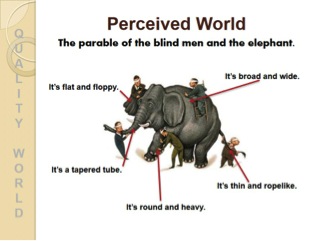
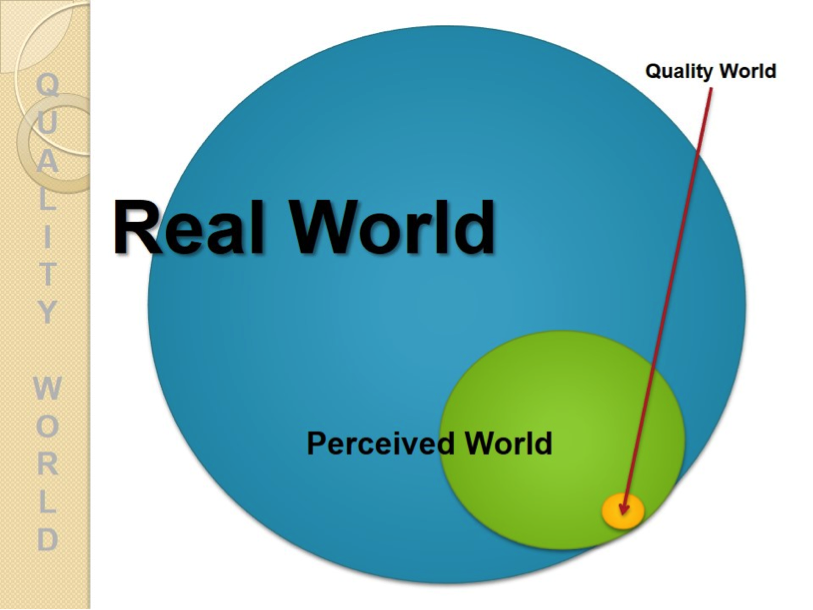
I started my presentation macroscopically and worked inward. I described the Real World as being made up of phenomena, appearances in time and space that can be apprehended by the senses. The Perceived World was described as being a subset of the Real World, comprised of only what we as individuals see, smell, touch, taste or hear. This was further illustrated using the parable of the blind men and the elephant.

Five blind men approached an elephant for the first time and tried to describe it to others. “It’s flat and floppy,” said the blind mind who came in contact with the elephant’s ear. “No, it’s round and heavy,” said the man with his arms round a leg. “It’s like a tapered tube,” said the man holding the snout. “It’s thin and ropelike,” said the man with its tail. “It’s broad and wide,” the fifth blind man said, his arms outstretched spanning the elephant’s torso.

elephant

I then asked my colleagues to read what they had written on their cards. “A table is wooden, rectangular and usually found in a dining room.” “A table is round with a thick glass top.” “A table is made of columns and rows of numbers, like an accountant would use.” “A green felt covered piece of slate housed in a heavy frame with bumpers used for billiards.” And so on.

tables

From one simple word, all these different perceptions. Now what would happen if you asked a group of different people to explain their perception of words like power, love, freedom, physical health or fun: the five basic needs of Choice Theory, their fulfillment ideally represented in a person’s Quality World. Therefore, each person’s Quality World is a subset of their Perceived World which is a subset of the Real World.

realworlddiagram

According to Glasser, a Quality World is made of pictures (people, places, things, activities, ideas and belief systems) we perceive as being need-fulfilling whether anyone else may regard them as need-fulfilling or not. These pictures relate to our past experiences, future aims and ambitions and relate to our idealized selves. Our personal Quality World pictures direct our efforts to fulfill our vision of our basic needs and thereby direct our behavior. Behavior, as Glasser sees it, is comprised of thinking, doing, feeling and physiology (Total Behavior), but that is another area of the chart outside of this discussion.

qualityworldstages

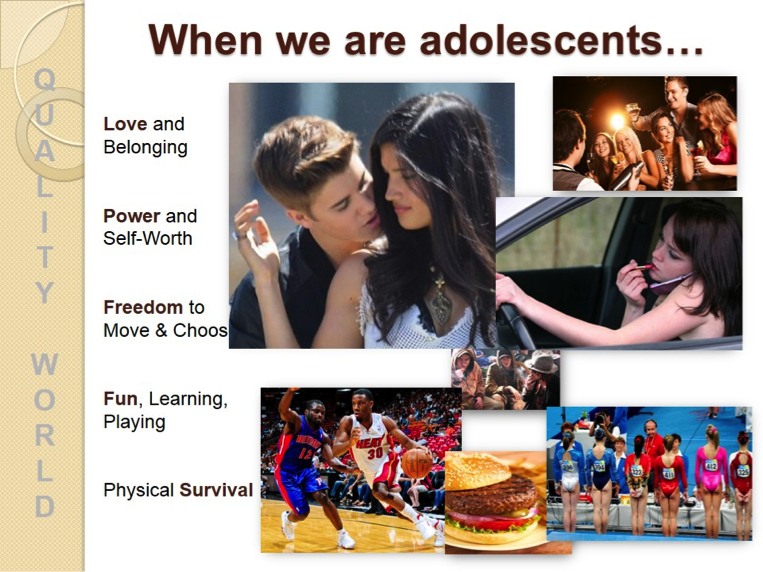
Pictures in our Quality Worlds are changing and changeable as we go through life. Pictures in an infant’s Quality World may just be his or her parents as they fulfil the infant’s five basic needs. These pictures can vary in levels of intensity or in the possibility of attainment, such as personal goals of becoming a doctor, having a family, building a vacation home or even winning an Oscar. The composite Quality World of a young adult will be more complex and contain more pictures. A Teenager, for example, may have a composite Quality World that looks like this:

adolescentqw

Or like this:

adolescentqw2

Notice how the size and span of the images can vary, how one picture can fill one or more of our basic needs. Notice also the change in the size of the pictures in the second example from the first example. Assuming these are Quality World composites from the same individual, notice how the importance of athletic achievement diminished as the desire or want to smoke dope and hang out with pals increased. This acknowledges Glasser’s observation that Quality Worlds are not always comprised of pictures we (others) might ethically, legally or morally judge as being right. And that…

“… a lot of people have not found anyone they can trust and enjoy being with. They may have been rejected or abused… to feel good they begin to replace people pictures with nonpeople pleasure pictures – pictures of violence, drugs and unloving sex – in the quality worlds. As they do so they separate themselves further from people and happiness, compounding the urgency of their problem.” (Glasser, Choice Theory, 1998, p. 49).

In other words, people who do not have their needs fulfilled in ways society regards as being healthy and positive, may turn to negative and destructive activities to get their needs met. This is where aberration begins. And, if we can discover these life diminishing behaviors by being allowed into the other person’s Quality World, we can ask the kind of questions necessary to help the person make more life-sustaining choices. These choices will lead to further refinement and replacement of images in the person’s Quality World.

basicneeds

As an exercise, I then put up a blank screen and pass around a placard listing a variety of images I have in a folder that are easily accessible on my computer. At the top of the card it reads:

QUALITY WORLD = NEED FULFILLING IMAGES

SELECT A QUALITY WORLD IMAGE BELOW AND DESCRIBE HOW IT FULFILLS ONE OR MORE OF THE FIVE BASIC NEEDS: 1) LOVE/BELONGING, 2) POWER/SELF-WORTH, 3) FREEDOM TO MOVE & CHOOSE, 4) FUN, PLAYING, LEARNING, 5) PHYSICAL SURVIVAL.

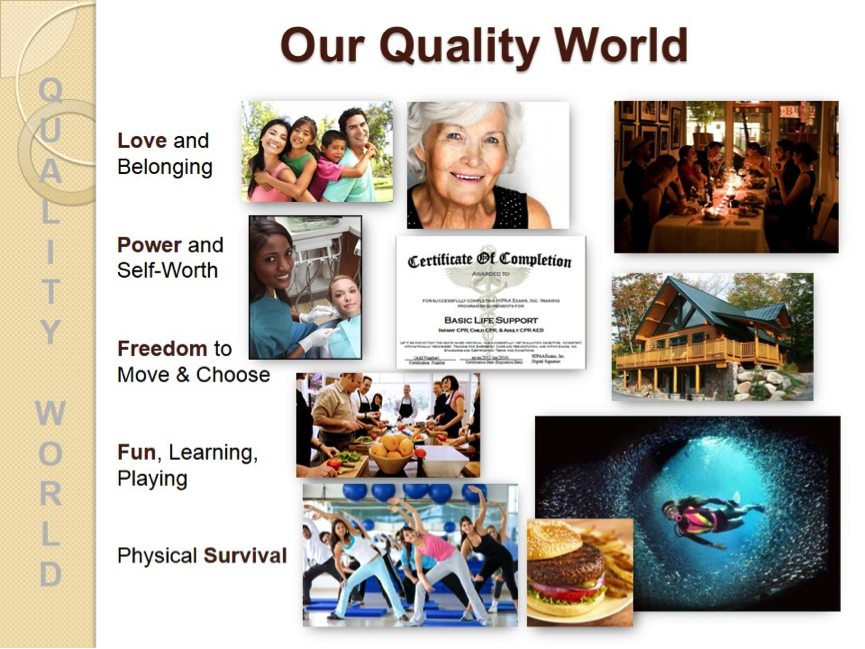
The card is passed around and I ask participants to select an image that fulfills a need and tell how it does so. The images I have used are: Aerobics Class, Backpacking, Basketball, Basketball Professional, Boating, Burger And Fries, Carribean Cruise, Community Service, Cooking Class, Coworkers Smiling, Daughter And Father, Dental Hygenist, Dentist, Dinner Party, Diploma, Family, Father Or Grandfather, Fiesta Dance, Flying Small Plane, Gambling, Gardening, Grandparents , Gymnastics Girls, Hiking, Horseback Riding, Knitting, Making A Movie, Man Fishing, Man Golfing, Man Job Promotion, Man Losing Weight, Man Skiing , Mother, Public Speaking, Quinceanera, Rap Music, Running, Scuba Diving, Sky Diving, Smoking Marijuana, Surgeon, Teaching, Weight Lifting, Travel To Asia, Travel To Europe, Vacation Home, Volunteering In Hospital, Wedding On Beach, Winning The Oscar, Woman And Cat, Woman And Dog, Women Archery,, Woman Bowling, Woman Helping The Elderly, Woman Job Promotion, Woman Losing Weight, Woman Skiing, Woman Snorkeling, Woman Tennis, Woman Water Skiing, Woman With Baby.

Someone might select the image of the diploma and say it fulfills their basic need for power (self-worth). Another might pick the photo of the mother, grandparents or coworkers smiling and refer to fulfilling the need for love and belonging. For fun, I have had them choose scuba diving, golfing, gymnastics, gardening or having a dinner party, which could also fulfill love and belonging, and so forth. There are, of course, no right or wrong answers, but as they select these images I place them on the page. This provides a dynamic example of how a Quality World is created that is easy to understand.

ourqualityworld

After we have constructed a sample Quality World and everyone who wants to participates, I conclude with a good thematic quote from Glasser:

“But, ultimately, whether people agree with us or not, we define reality in the way that works best for us.” (Glasser, Choice Theory, 1998, p. 47).

Therein lies the beauty of the Quality World, the visual composite of our ideal need fulfilling images which uniquely frames the mentality of every individual. By understanding and embracing another’s Quality World, we afford ourselves the opportunity to help people self-evaluate and change their lives.

If this exercise appeals to you, feel free to use it or develop a variation for use in your own work with clients or students or to help educate others about the Quality World and its importance to Choice Theory / Reality Therapy.

References:

Glasser, W. (1998). Choice Theory. New York: Harper Collins.

William Glasser Institute: How the Brain Works Chart

______________________________________________

Banning K. Lary
344 Madison Place
Lexington, KY 40508
859.309.9015
banningkl@gmail.com

=======================


13 Amazon reviews; can we make it 15?

13 Amazon reviews; can we make it 15?

For U.S. customers, get a signed copy of Champion of Choice for $20 + $6 (shipping). Send your check, along with any special instructions (e.g.- if the book is a gift), as well as your shipping address, and I will get the biography out to you right away.
Please include your email address, just in case I have questions about your order. My address is P. O. Box 933, Angwin, CA 94508

Get a signed copy of Soul Shapers: A Better Plan for Parents and Teachers for $17.
1308277

Some Amazon reviews for Soul Shapers wouldn’t hurt either.


====================


You can access The Better Plan posts on –

TWITTER
@thebetterplan